
Patient who wants to look like someone else: how to handle it

Quick facts
- Situation
- The patient brings a photo and wants to look like that person
- Trap
- Trying to copy another face's features
- Strategy
- Find out what they admire and translate it into their own face's proportions
- Warning sign
- Fixation on one person or a wish to take on someone else's identity
"I want her nose, her chin, her lips." More and more, patients arrive with a photo of someone they admire: an actress, an influencer, a friend. The temptation is to promise you can get close. The responsible approach is different: show that the goal is the best of their own face, not a copy.
Why does this happen?
The wish to look like someone else often reflects something deeper.
- Admiration. The person represents an ideal of beauty the patient values.
- Pressure from standards. Social media and filters reinforce a single model.
- Insecurity. They do not see themselves as beautiful and look for an outside model.
- Wish to change identity. Rarer, but it calls for care.
- Ease of explaining. A photo is a practical way to say what they want.
How do you lead the conversation?
The path is to translate admiration into proportion. Instead of comparing features, talk about qualities.
Why translate into proportion?
Because looking like another person is neither feasible nor desirable. Bones, fat, skin, symmetry and expression vary a lot. Trying to copy usually produces artificial faces and frustration. Working with proportion, on the other hand, respects anatomy and leads to more natural results, at the professional's discretion.
What does the reference photo say?
| What the patient points to | What may be behind it |
|---|---|
| "Her nose" | Delicacy, profile line |
| "Her lips" | Volume, definition, symmetry |
| "Her face contour" | Definition, firmness |
| "Her gaze" | Shadows, expression, brow |
| "She always looks young" | Freshness, glow, absence of lines |
Write these translations down. They become the plan: "you want more definition in the contour and more softness in the gaze", instead of "you want her face".
How does the simulation help?
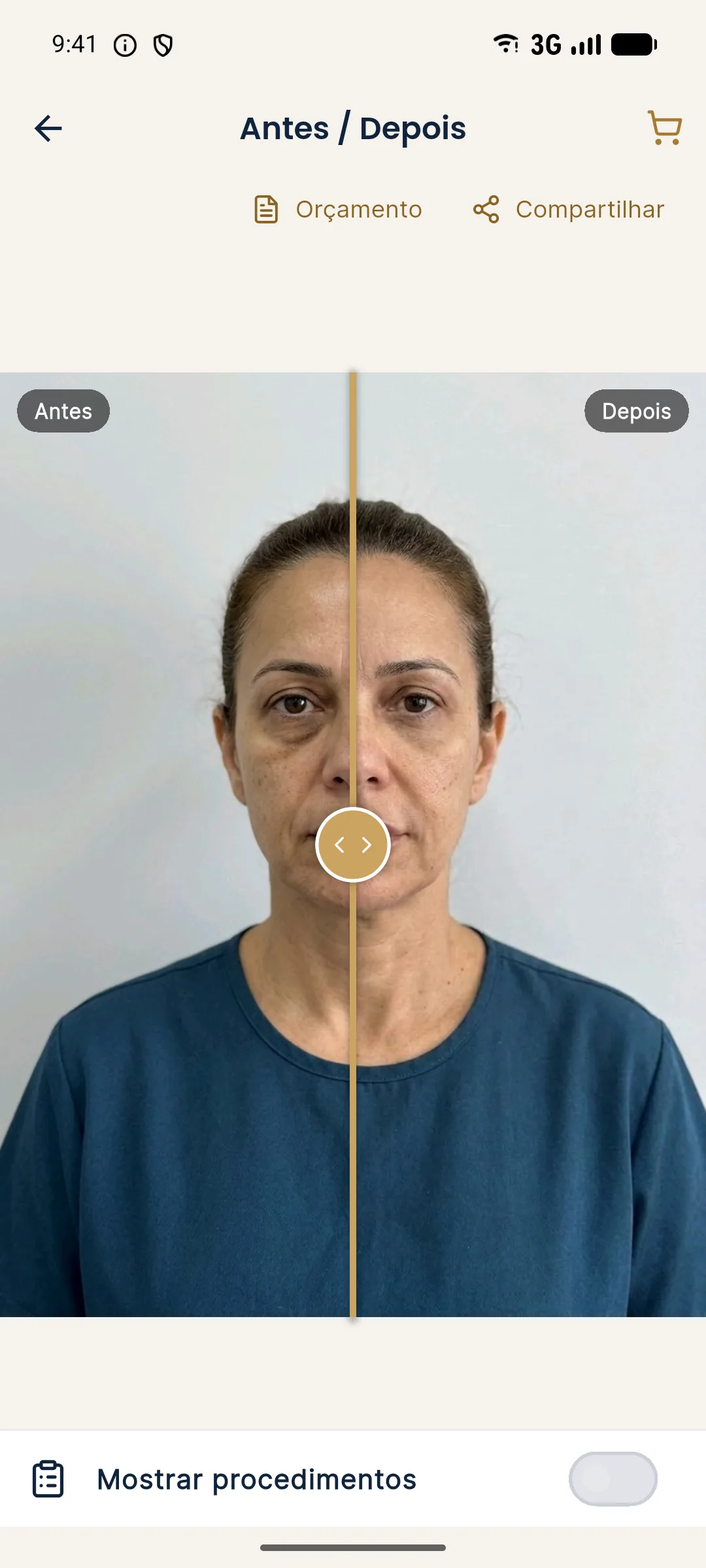
It shows what is possible on the real face. The patient sees the projection made from their own photo, and the comparison with the reference loses force, because the image that matters is theirs. It also lets you test intensities and notice what looks natural.
When should alarm bells ring?
Wanting to look like someone is common. But some signs call for care.
What should you avoid saying?
- "You can look exactly like her." It is an impossible promise.
- "She has a perfect face." It reinforces the comparison.
- "Yours is very different." It sounds disqualifying.
- "That's silly." It invalidates the wish.
Prefer talking about the potential of the patient's own face. To reinforce this idea, read I want my face to look like the photo and patient brings a reference photo.
What about the ethical question?
Reproducing the features of a specific person also involves that person's image. Use the reference photo only during the visit, do not keep it in the patient record unnecessarily and do not use it in promotional material. If the patient asks you to keep it, explain that the case record is about their own face. See LGPD for handling images (in Brazil, the General Data Protection Law).
How should you document it?
In the patient record, note the request in the patient's own words, what they admire, what you explained and the proposed plan. Avoid keeping the image of third parties. Keep the informed consent aligned with the plan, which describes what will be done on the patient's face.
What does a practical step-by-step look like in the visit?
A simple sequence helps you lead without improvising. First, ask for the photo and ask what the patient admires. Second, assess their face and identify where it shares something with the admired quality. Third, explain that resembling the person is not a possible goal, but that working on the quality they value is feasible. Fourth, show an illustrative simulation on their face, at Subtle or Moderate intensity. Fifth, agree on a gradual plan and a reassessment date. This script returns the focus to the patient, reduces comparison and protects you from promises you cannot keep.
What if the patient has already tried this elsewhere?
Some patients arrive after an experience in which they were promised they would "look just like" someone and the result disappointed them. Listen to the story without criticizing the colleague, validate the disappointment and calmly explain why the approach will be different now: focus on the proportions of their own face, a gradual plan and an illustrative simulation. Stressing that the goal has changed helps the patient recalibrate expectations and trust the new path.
Frequently asked questions
Can I make the patient look just like another person?
No. Every face has its own structure, and no procedure reproduces another person's features. You can work on the proportions and harmony of the patient's own face, at the professional's discretion.
What should I do with the reference photo?
Use it to understand what the patient admires: shape, softness, projection. Ask what they like about that person and translate it to their own face, without promising a likeness.
When is the wish to look like someone a concern?
When it is fixed, intense, repetitive or comes with distress about their own image. In those cases, be supportive, avoid injecting and consider referring for a mental health assessment.
Does the simulation help in these cases?
It helps show, on the patient's own face, what is possible in an illustrative way. It is a tool to align expectations, without promising a likeness to another person.
Harmy images are illustrative simulations generated by AI from the patient's photo to support the conversation between practitioner and patient. They are not a promise of results. Indication, technique, product and volume are solely the decision of the licensed practitioner. This content is for information only and does not replace a clinical assessment.