
YouTube for HOF professionals: format and topic plan

Quick facts
- Role of the channel
- In-depth education that keeps being found over time
- Difference from short-form networks
- Lives on search, and old videos still bring visits
- Requirement
- Scripting, consistency and willingness to record without exposing patients
- Rule
- Follow the council's advertising rules in the title, thumbnail and speech
Among social networks, YouTube is the one that most resembles a search engine. People do not scroll a feed: they type a question and watch the video that answers it. For the orofacial harmonization (HOF) professional, this changes the logic: a well-made video keeps bringing visits months and years after it is published, unlike a story that disappears in a day.
This guide shows who YouTube makes sense for, which formats work in healthcare, how to build a topic plan, how to record simply, what to watch for regarding rules and confidentiality, and how to repurpose the material into short videos. There are no audience numbers and no promise of returns. For the context of the other networks, see Instagram for HOF, TikTok for HOF clinics and short videos.
Why YouTube is different
| Feature | YouTube | Short-video networks |
|---|---|---|
| How the audience arrives | Active search for an answer | Feed recommendation |
| Video lifespan | Long, can be found for years | Short, peaks in the first days |
| Depth | Complete explanation | One idea per video |
| Production effort | Higher (script, editing) | Lower per piece |
| Viewer intent | Wants to understand the subject | Wants to be entertained or curious |
| Relationship with Google | Videos also appear in search results | Little presence in search |
The consequence is that YouTube usually serves best those who want to build long-term authority and are patient. Those who need quick returns tend to get frustrated. In exchange, a patient who arrives after watching several videos by a professional comes with trust and more mature questions.
Who it makes sense for
Before recording the first video, assess honestly. A channel that dies after the third video does more harm than good.
If most answers are "no", consider other channels or start with short videos only. YouTube suits those who already produce content and want to go deeper, as shown in content marketing for HOF.
Which videos work in healthcare
The guiding question is: what does the patient type into Google before looking for a clinic? Each well-explained answer is a potential video.
- Explaining procedures in simple language: what it is, who it is usually recommended for, what the assessment is like, what care and risks are involved.
- Common questions: how long it lasts, whether it hurts, when I can return to my routine, who should not have it. Answers are general and always point back to the assessment.
- Myths and facts, calmly and without sensationalism.
- Honest comparisons: differences between types of procedures, without naming brands or promising results.
- Behind the scenes without patients: what the consultation is like, how the room is organized, the safety routine.
- Answers to audience questions, with the authors identified and their consent when quoting them.
- Videos for colleagues: management, patient service, clinic routine. In this case the audience is the professional.
Each video should answer one question, and the title should be the question or very close to it. That is what makes the video findable.
From topic plan to script
A good script for an educational video is simple. It does not need to be memorized, only structured.
The closing deserves attention. Avoid the pushy "book now". Prefer "if you have questions about your own case, an in-person assessment is the way to go". The same logic applies to tone, described in ethical captions for HOF.
Recording with little
The first obstacle is believing you need a studio. You do not. What viewers tolerate least is bad audio, then a dark picture, and only last a lack of polish.
- Audio: a cheap lavalier microphone beats the phone's microphone. Record in a room without echo.
- Light: from the front, soft, from a window or a simple lamp. Avoid strong light behind you.
- Framing: camera at eye level, a clean background, no papers or screens visible.
- Length: as long as needed. Cut pauses and repetitions in editing.
- Captions: help people watching without sound and improve comprehension.
- Thumbnail: clear, with few words and no promise of results.
When recording at the clinic, check the background: no patient records, schedules, screens or labels in view. A long video is far more likely to capture an unwanted detail than a short one. Review the precautions in professional confidentiality on social media and in clinic behind the scenes without exposing patients.
How Harmy can illustrate the video
A video about planning or about the consultation gains clarity with images. The app has a sample patient (a fictional person) that lets you show the full flow without exposing anyone: front photo, area marking, ml planning and the Before/After slider. The illustrative simulation notice must stay visible, and the narration needs to make clear that this is an illustration, not a result.
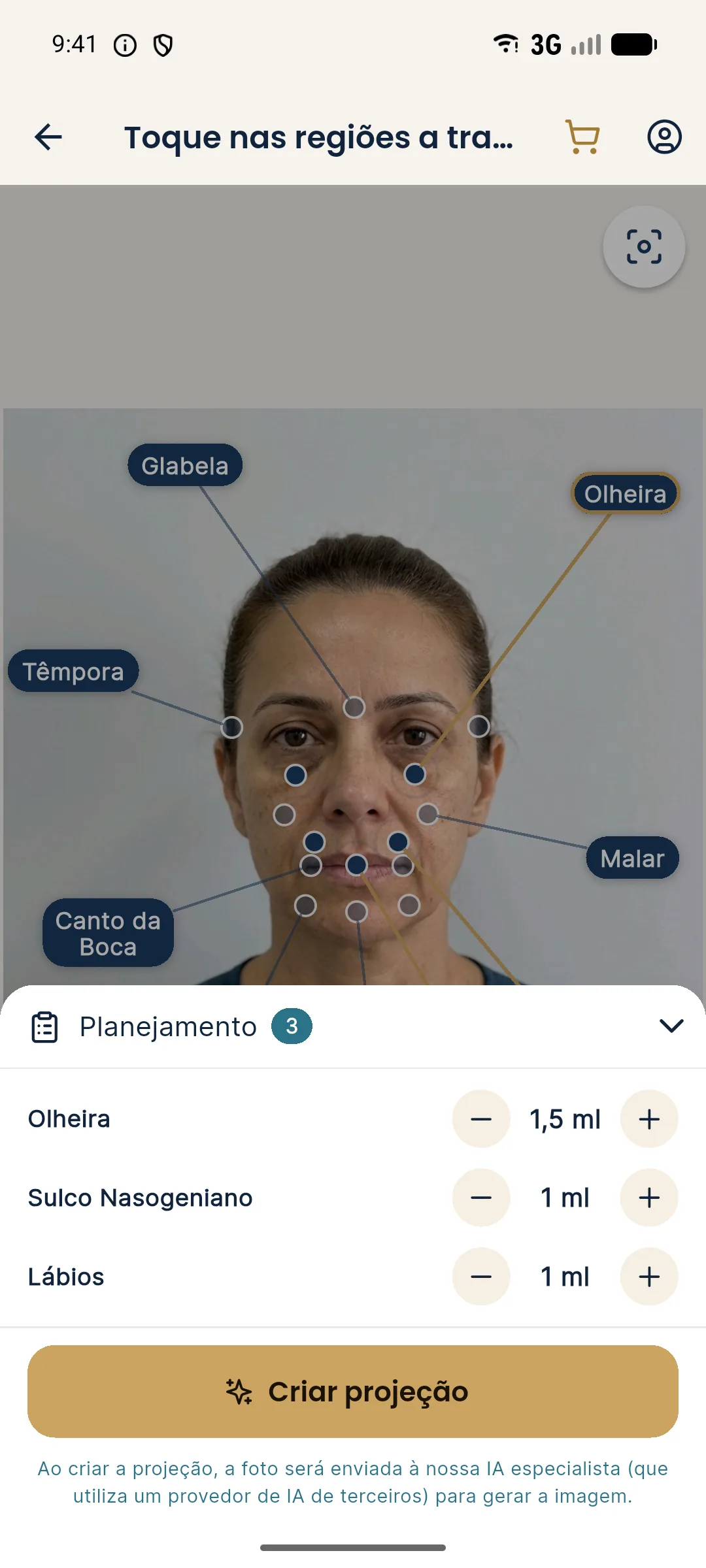
This approach works for videos such as "how I present the plan to the patient", aimed at colleagues, and for educational videos about what a simulation is and what its limits are. See also the limits of visual simulation in the consultation.
Rules, confidentiality and limits
A long video exposes the professional more than a post does. Everything said becomes a record, subject to the council's rules and to LGPD (Brazil's data protection law).
The rules in what you may advertise (CFO and CONAR) and in advertising in HOF also apply. The same goes for the title and thumbnail: a promise in the thumbnail is a promise made by the video. For testimonials and case studies, see the reasoning in LGPD consent for patient photos.
Being found: YouTube search basics
Since YouTube works as a search engine, a few simple adjustments help.
- Title with the question or topic in patient language.
- Description with a summary, the video's chapters and the address of the clinic or website.
- Chapters marked with timestamps, which make navigation easier.
- Captions that are proofread, with the terms people type.
- Playlist grouping topics, such as "questions about fillers".
- Video link on the clinic's website, on the page for the matching service.
This integration ties the channel to the rest of your online presence, as shown in basic SEO for HOF clinics.
Repurposing without recording again
A well-structured long video yields other formats, and that is where the effort pays off.
| Format | How to extract it | Caution |
|---|---|---|
| Short video | Cut the segment that answers one question | Keep the meaning, do not take it out of context |
| Text post | Turn the points into a caption | Review tone and rules |
| Website article | Transcribe and edit | Rewrite, do not copy the speech |
| Newsletter or list | Summarize and link the video | Respect contact consent |
| Stories | Highlight one question from the video | No patient or identifiable data |
Plan the calendar together, using content pillars and the monthly editorial calendar. One long video a month and three or four clips are enough for a sustainable routine.
Quiz: what to record first?
First 90 days
- Month 1: define the list of questions, pick the first five and record two short test videos, without publishing.
- Month 2: publish the first videos, with a question as the title and a full description, and link them on the website.
- Month 3: repurpose the best ones into clips, watch which questions generate contacts and adjust the topic plan.
Do not expect quick results. If after six months the channel has helped patients arrive better informed and the clinic to be found by the people looking for it, the effort paid off. If not, narrow the scope or redirect the time to a channel better suited to your profile.
Frequently asked questions
Is it worth having a YouTube channel as a HOF professional?
It can be worth it for those who enjoy explaining and are consistent. Long educational videos keep being found through search, but they take work and are slow to pay off. It is not the fastest route.
Do I need professional equipment to record?
No. A recent phone, good audio, natural light or a simple lamp and a clean background are enough to start. Audio usually matters more than picture.
Can I talk about procedures and show patients?
Talking about them in an educational way is possible within the council's rules. Showing a patient requires specific written consent and attention to the advertising rules. In general, the safest approach is to avoid identifying people.
What is the ideal video length?
Whatever the topic calls for. An educational video usually works well when it delivers the answer clearly and without padding. Prefer shorter, dense videos over long, empty ones.
How do I repurpose the video on other networks?
Cut out segments that answer a single question and post them as short videos, with captions. A well-structured long video yields several clips.