
How to explain hyaluronidase to the patient

Quick facts
- Core message
- An enzyme exists that dissolves hyaluronic acid
- When it comes in
- Dissatisfaction, excess volume or a complication, at the professional's discretion
- Caution
- Do not promise a perfect reversal or present it as fixing a mistake
- Record
- Mention the possibility in the informed consent
Talking about hyaluronidase before placing the filler takes balance. If the topic sounds like "if I make a mistake, I can undo it," the patient senses insecurity. If it is never mentioned, they find out later that there was a way out and ask why nobody said so. The solution is to present the enzyme as a transparent part of the plan, neither as an alarm nor as a guarantee.
What can you say in one sentence?
The sentence has three strengths: it uses the technical name and translates it, it states the reason (to inform), and it includes two possible situations without sounding like a prediction of error. The glossary entry on hyaluronidase explains the concept for the professional.
When does hyaluronidase come into the plan?
Present the most common situations, without alarm:
| Situation | How to explain it |
|---|---|
| Aesthetic dissatisfaction | The patient prefers less volume or a different contour |
| Excess volume | The result looks more obvious than agreed |
| Irregularities or nodules | It can be used to smooth them, depending on the assessment |
| Vascular complication | Part of the emergency response, under a specific protocol |
The last row needs care. In a case of vascular occlusion or suspected ischemia, hyaluronidase is part of a fast, specific response that is not just "an injection." The patient should know it exists but does not need the protocol details. For the professional, the topic is covered in hyaluronidase in the clinic and hyaluronidase: allergy and testing.
How do you keep it from sounding like an announced mistake?
Tone matters more than words. Three precautions:
- Bring up the possibility while explaining the product, alongside its other characteristics, and not only when a problem appears.
- Give the reason. "Because I want you to be in control" positions the enzyme as respect for autonomy, not as insurance against failure.
- Avoid the alarmist conditional. Prefer "if you want to change your mind" over "if it goes wrong."
What should you not promise?
The enzyme is effective on hyaluronic acid, but the result depends on the amount, the area, the type of gel and the time since placement. Do not promise that the face returns exactly to its previous state, that it takes a single session, or that it leaves no trace. It is also not acceptable to use it as a shortcut to "test" volumes: placing more than planned in order to undo it later is a practice patients tend to reject once they learn of it.
This connects with the topic of communicating the need for hyaluronidase, which covers the moment the enzyme actually has to be used, and with excess volume after filler.
How do you explain that it only works on hyaluronic acid?
This point often goes unnoticed. Hyaluronidase acts on hyaluronic acid, not on biostimulators or other types of dermal filler. When the plan includes different products, the patient needs to know that the "way out" differs from one to the other. See the overview in filling or stimulating.
How does Harmy help?
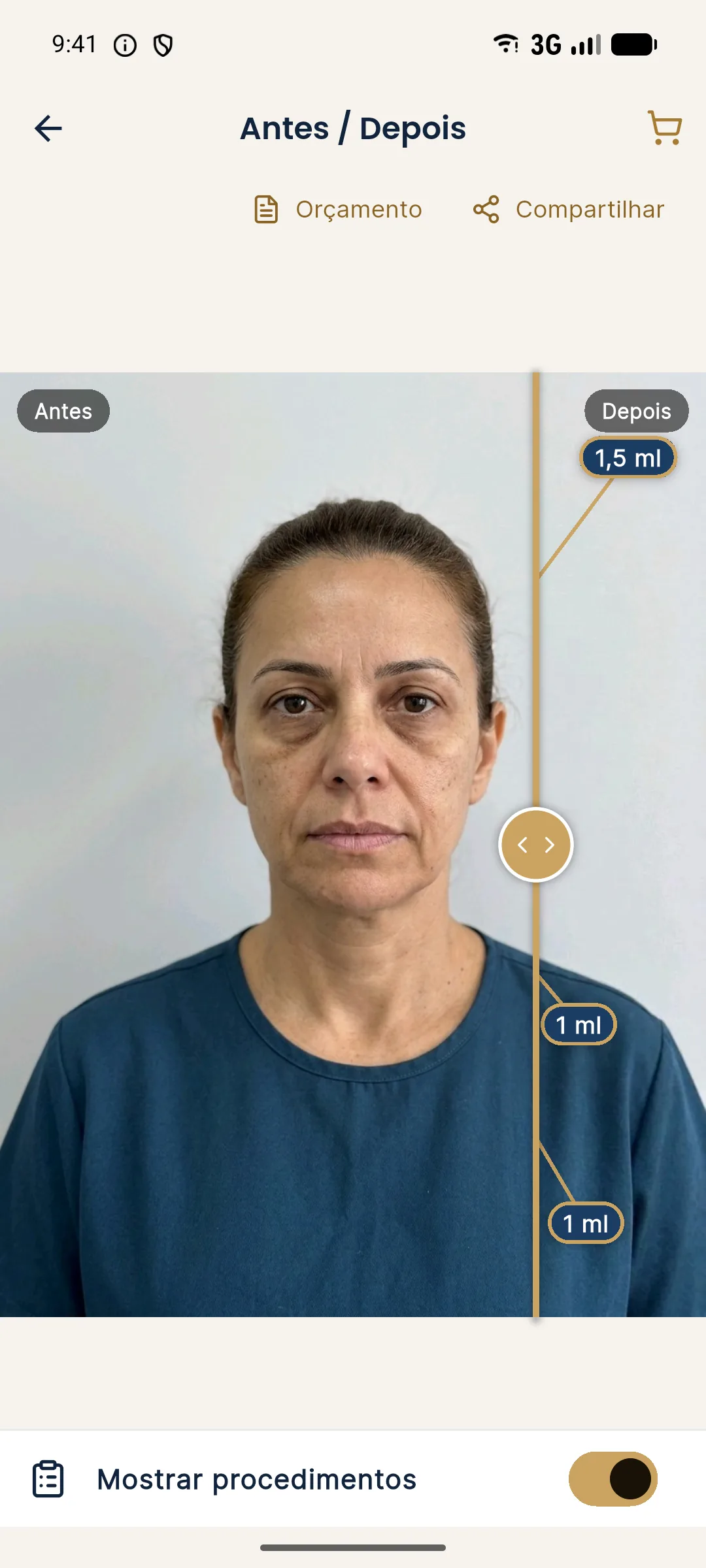
Harmy does not simulate dissolving, but it lets you show, before placement, a subtle and realistic projection, which lowers the chance that the patient will want to undo the result because of excess. The use is indirect: show a smaller volume and then adjust together with the patient.
What if the patient fears an allergy or a side effect from the enzyme?
Ask about allergies during the medical history and explain that hyaluronidase can also cause reactions, generally rare, such as redness, itching and local swelling. The patient should know this is taken into account when preparing the clinic. There is no need to go into protocol details during the consultation: it is enough to say that the enzyme is used with judgment, that there is a plan for reactions, and that they will be monitored. If there is a significant allergy history, record it and assess whether extra caution is needed before placing the filler.
Which questions should you expect?
What should you record?
In the informed consent, include the mention of hyaluronidase as a possibility for reversing hyaluronic acid, the associated risks and the response in case of a complication. In the patient record, note that the explanation was given. Reading the consent form with the patient is covered in how to explain the informed consent.
When hyaluronidase is presented naturally, the patient sees it as a sign of the clinic's care and not as a prediction of error.
Frequently asked questions
How do I explain hyaluronidase to the patient?
Say it is an enzyme that dissolves hyaluronic acid, used when a filler needs to be reduced, either by the patient's choice or because of a complication. Explain that the decision on how to proceed belongs to the professional.
Should I mention hyaluronidase before placing the filler?
Yes, in simple terms. The patient should know there is a way to reverse hyaluronic acid, and that it does not apply to other types of product.
Does hyaluronidase undo everything and bring the face back to how it was?
That is not a promise anyone can make. It dissolves hyaluronic acid, but the result depends on the amount, the area and the response, and more than one session may be needed.
Can I present hyaluronidase as a safety guarantee of the treatment?
You can present it as an available resource, without using it to downplay risks. It does not remove the risk, and a vascular complication demands a fast, specific response.
Harmy images are illustrative simulations generated by AI from the patient's photo to support the conversation between practitioner and patient. They are not a promise of results. Indication, technique, product and volume are solely the decision of the licensed practitioner. This content is for information only and does not replace a clinical assessment.