
Fill or stimulate: how to explain the difference to patients

Quick facts
- Dermal filler
- Delivers volume or contour with the product itself
- Biostimulator
- Stimulates the body to produce collagen, gradually
- Key phrase
- One puts it in, the other asks the body to do it
- Caution
- Do not name brands when explaining and do not promise an exact timeframe
Many patients use "filler" for everything injected into the face. When the plan includes both product families, or when the patient compares quotes, the confusion shows up: "why do I need two?" or "why haven't I seen a result yet?". Explaining the difference in simple language, before starting, avoids these misunderstandings.
What is the key phrase?
One short phrase settles most of the conversation. Keep this one.
The point is to separate what the product does (filler) from what the body does in response to the product (biostimulator). Anyone who understands this accepts the wait better.
How do you compare them in a table?
A side-by-side table helps in the consultation and fits on an instruction sheet.
| Aspect | Dermal filler (e.g., hyaluronic acid) | Collagen biostimulator |
|---|---|---|
| How it works | Delivers volume or contour with the gel itself | Stimulates the skin to produce collagen |
| When it shows | Generally right after injection, once the swelling goes down | Gradually, over weeks to months |
| Reversal | Hyaluronic acid can be dissolved with hyaluronidase | There is no equivalent antidote |
| Common use | Contour, localized volume, proportion | Skin quality and support |
| Duration | Usually months up to about a year or more, depending on product and area | Usually longer, but varies widely between patients |
Timeframes are usual ranges and depend on the product, the area and metabolism, at the professional's discretion after assessment. The reversal row deserves attention: the patient should know that the biostimulator has no equivalent to hyaluronidase.
Which analogy works?
The most common is the brick and the mason:
- Filler: you deliver the bricks already in place.
- Biostimulator: you call the mason, and the work is done little by little.
The analogy is good for explaining the difference in timing, but it may suggest that the result is guaranteed. Complete it: "Each person's body responds in its own way, so the result varies."
How do you explain it when the plan uses both?
In a combined plan, state the role of each and the order. For example: "The filler resolves the contour of a specific area now; the biostimulator works on skin quality over the coming weeks." If there are sessions on different days, explain the reason and the interval. See also the patient's question at biostimulator or filler.
How do you use Harmy to show the filler?
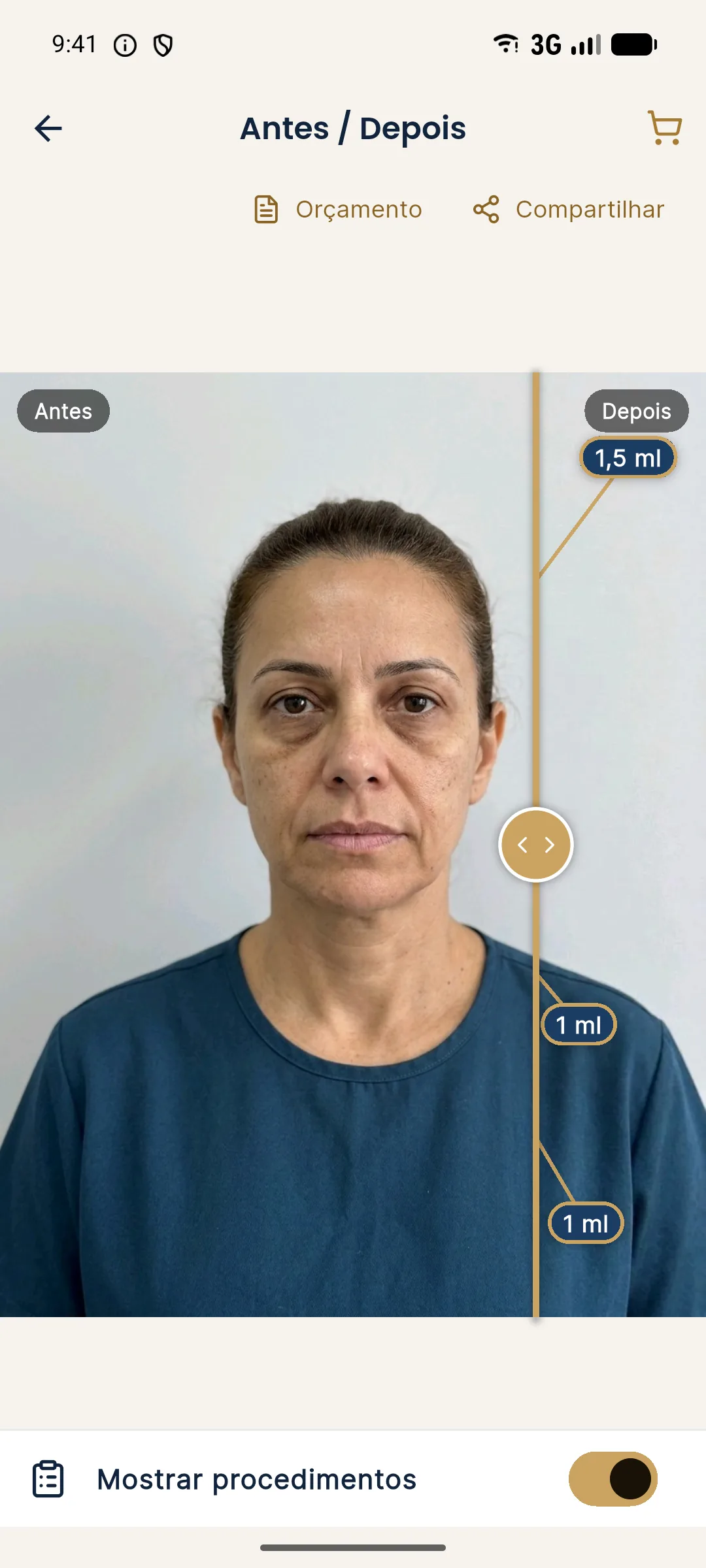
The app simulates volume by area, which comes close to the effect of a filler. It does not simulate the gradual effect of collagen. So, when showing the projection to someone who will have a biostimulator, warn them that the image is an illustration of harmony, not a prediction of the stimulation effect. See presenting the projection in the consultation.
When does each one tend to make more sense?
In general, filler answers concerns about localized volume and contour, such as lips, chin or the transition between cheek and eye. The biostimulator usually comes in when the concern is skin quality and firmness over wider areas. These are tendencies, not rules: the choice depends on the assessment, the area, the skin and the patient's expectations, and is at the discretion of the qualified professional, according to the rules of their professional council.
A good question to close the explanation is: "Would you rather see a quicker, localized change, or are you willing to wait for a gradual, broader one?" The answer guides the plan and shows that the choice is also the patient's.
Which questions should you expect?
How do you record the explanation?
Note in the patient record that the differences were explained, including the irreversibility of the biostimulator, and mention in the informed consent the type of product and the expected timeframe. The detailed explanation of the biostimulator is at how to explain the biostimulator to the patient, and the risk context at biostimulators: overview.
When the patient leaves understanding why each product exists, the conversation about price, sessions and follow-up becomes much more objective.
Frequently asked questions
What is the difference between filler and biostimulator?
A filler, such as hyaluronic acid, delivers volume or contour with the product itself. A biostimulator stimulates the body to produce collagen, and the effect is gradual.
Can I explain it with an analogy?
Yes. A common analogy is the brick and the mason: the filler puts the volume in place ready-made, the biostimulator calls on the body to build it. Use it carefully and without promising results.
Can filler and biostimulator be used together?
In some plans yes, at the professional's discretion after assessment. Explain to the patient the role of each and what to expect from each stage.
Can the patient choose just one of the two?
Yes, as long as they are informed. It is up to the professional to explain what each one solves best and what it leaves unsolved, so the decision is a conscious one.
Harmy images are illustrative simulations generated by AI from the patient's photo to support the conversation between practitioner and patient. They are not a promise of results. Indication, technique, product and volume are solely the decision of the licensed practitioner. This content is for information only and does not replace a clinical assessment.