
I'll Talk to My Husband: How to Support the Decision
"I'll talk to my husband and let you know." It is one of the most frequent answers from someone who does not book on the spot. It can mean many things: a supportive consultation, a shared family budget, a disguised veto or just a polite way to postpone the decision.
The worst response is the one that tries to close before the conversation. The best is the one that gives the patient resources and leaves the door open. The content is about communication, the decision belongs to the patient and clinical conduct is at the professional's discretion, according to the rules of their professional council (in Brazil, CFM, CFO and others). The conversation also applies to a husband, wife, partner, mother or any person the patient trusts.
What can "I'll talk to my husband" mean?
Four scenarios are common:
| Scenario | How to recognize it | How to handle it |
|---|---|---|
| Family budget | She talks about price and timing | Offer a clear quote, in phases |
| Partnership | She wants his opinion, without fear | Give material and respect it |
| Her own doubt | Uses the husband as an excuse | Ask what still worries her |
| Pressure or veto | She gets tense, lowers her voice | Be supportive, without confronting, and move to another format |
Ask openly, without judging: "does he know what you are thinking of doing?" or "does he usually weigh in on these decisions?". The answer and the tone say a lot.
Respect without accepting everything
Two wrong stances repeat themselves. The first is to minimize: "you don't need to ask permission". It sounds disrespectful of her relationship. The second is to accept the veto without asking, leaving the patient in the position of someone giving up for lack of support.
The balance point is this: the decision about her body is hers, and whom she listens to is her choice. You offer information so she can decide well, whichever way she goes. Patient autonomy includes the freedom to consult whomever she wants.
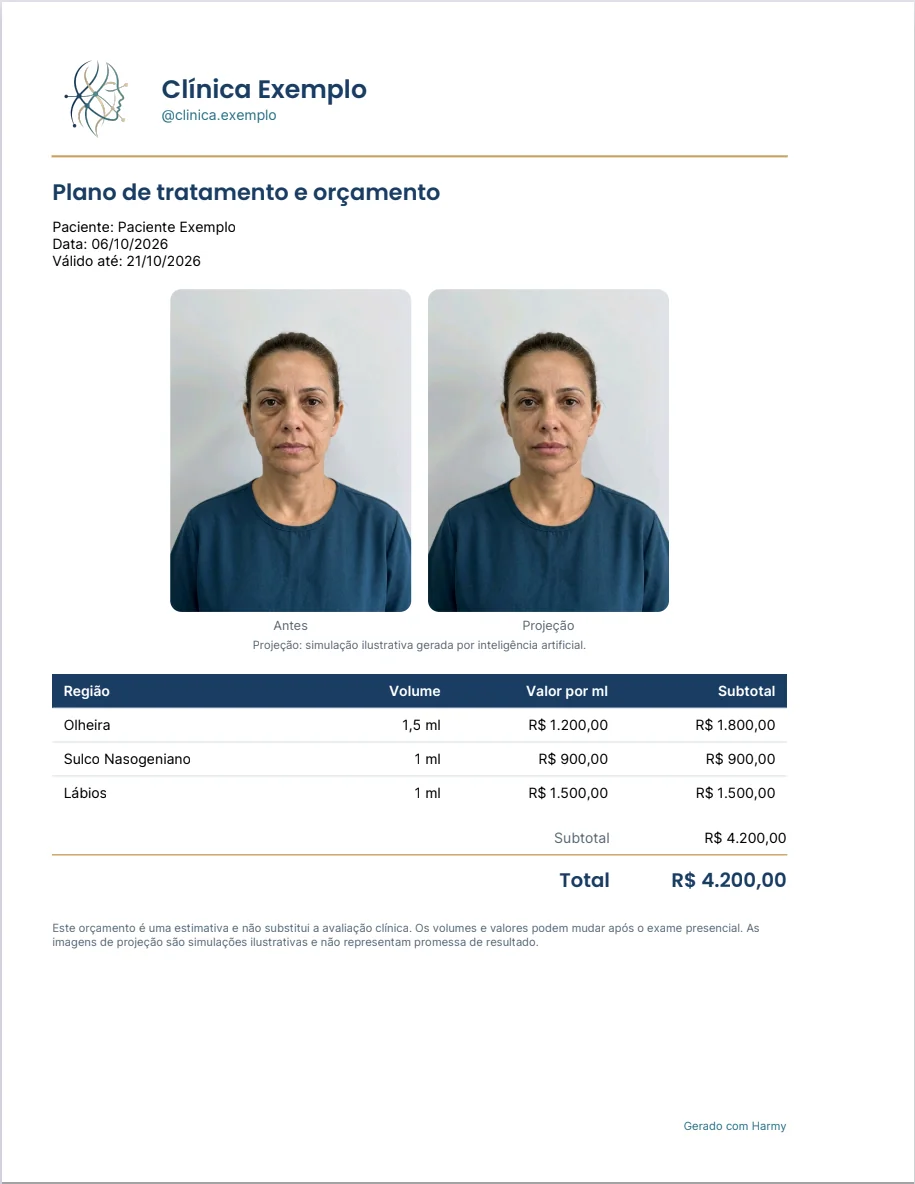
Material to take home
What the patient takes with her is what speaks for you in the conversation you are not part of. Make material that stands on its own:
- a summary of the plan in plain language (areas, phases, order);
- a short explanation of what the simulation is and is not;
- the main risks, without alarmism;
- a clear quote, with a validity period that leaves room;
- a channel for questions, including the husband's.
Make sure the patient understands the image as illustrative, not a promise of results. If the husband sees the simulation as a promise, any deviation becomes a complaint. See illustrative simulation notice to the patient and sending the simulation to the patient by WhatsApp.
Talking to the husband: yes or no?
The patient may ask you to talk to him. Some rules:
- Only with her authorization. The data and images are hers, protected by the LGPD (Brazil's data protection law) and by professional confidentiality.
- In-person or video conversation, with her present. Avoid speaking alone with the partner.
- Explain, don't convince. Your role is to inform.
- Don't discuss her face as if it were his. The partner has an opinion, the decision is hers.
- Record the conversation and her presence.
If he comes with a demanding tone or disrespectful comments about her body, stay calm and refocus: "the decision is hers, and I am here to help her decide well".
How to follow up without pressuring?
After the consultation, the follow-up weighs as much as the conversation. A gentle script:
- Agree during the consultation on when and how to follow up ("may I message you next week?").
- Send a short message, without repeating prices or deadlines.
- If there is no reply, a second, spaced-out message.
- If she comes back, start by listening: "how did the conversation go?".
- If she decides against it, respect that and leave the door open.
The goal is to keep the relationship, not to close the sale. For other moments of postponement, see I'll think about it and undecided patient.
What if he says no?
It can happen. The patient comes back and says: "he doesn't want it". The responses depend on the context:
- She agrees with him. Respect that. The decision is hers, and postponing is part of the process.
- She disagrees but does not want conflict. Be supportive, without encouraging confrontation. Offer time.
- She is afraid. Offer a listening ear and, if appropriate, information about support networks. It is not the clinic's role to resolve the relationship.
In no case should the clinic perform the procedure without the patient's free consent. Informed consent only has value if given without coercion.
What should be recorded?
- The decision to consult the husband, in neutral language.
- The material handed over.
- What was agreed about following up.
- If there was a conversation with the husband: date, the patient's presence and a summary.
The patient record should keep the essentials. Avoid noting assumptions about the couple's relationship.
Frequently asked questions
Should I try to convince the patient before she talks to her husband?
No. Pressuring before the conversation can make things worse. Give clear information, take-home material and openness to pick up again whenever she wants.
Can I talk directly to the husband?
Only with the patient's authorization and respecting confidentiality. The decision and the information belong to her, and the husband does not replace her consent.
How do I tell support from interference?
Support is when the partner talks and the patient decides. Interference shows up when he vetoes, controls, or the patient is afraid of going against him. In that case, the conversation changes tone.
Can I send the simulation so the patient can show it to her husband?
You can, with the illustrative simulation notice, if the patient wants. Agree on it beforehand and remind her that the image is not a guarantee of results.
Harmy images are illustrative simulations generated by AI from the patient's photo to support the conversation between practitioner and patient. They are not a promise of results. Indication, technique, product and volume are solely the decision of the licensed practitioner. This content is for information only and does not replace a clinical assessment.