
Patient Who Changed Their Mind Mid-Plan: How to Re-Plan

Quick facts
- Situation
- The patient changes what they had decided before or during the plan
- Principle
- Changing their mind is the patient's right, but it requires a new agreement
- Attention
- Update the quote, the consent and the patient record
- Trap
- Following the old plan out of inertia or charging the patient for the change
The plan was settled: areas chosen, ml defined, quote approved. The day before, or in the chair, the patient says they have changed their mind. They want to drop an area, add another, postpone everything or do less. It is a common situation, and how you react decides whether the patient feels safe or guilty.
Why do patients change their minds?
Almost always for legitimate reasons. Listening before reacting helps you understand what weighed on them.
- A doubt that came up later. They researched, talked it over, slept on it, reconsidered.
- A change in circumstances. Budget, schedule, an event, health.
- Fear. As the date approaches, anxiety grows.
- Reaction to the simulation. They saw it and wanted more, less or something different.
- Pressure from others. Read the patient pressured by others.
How do you react in the moment?
Keep a neutral tone and thank them for telling you. Showing annoyance teaches the patient to hide doubts next time.
What if it is the day before or the same day?
Never treat a patient who is in doubt. Pause, talk and, if needed, reschedule. A procedure done with hesitation often brings regret, and it falls on you. See the indecisive patient.
How do you re-plan?
Re-planning means redoing the assessment with the new information, not just swapping items. Review the face, the goal and the order of priority.
| Change | What to adjust |
|---|---|
| Removing an area | Quote, consent, projection |
| Adding an area | Assessment, quote, consent, new simulation |
| Reducing the volume | Plan by area and expectation |
| Postponing everything | Record, follow-up date, quote validity |
| Switching professionals | Handing over information and ending follow-up |
How does Harmy help?
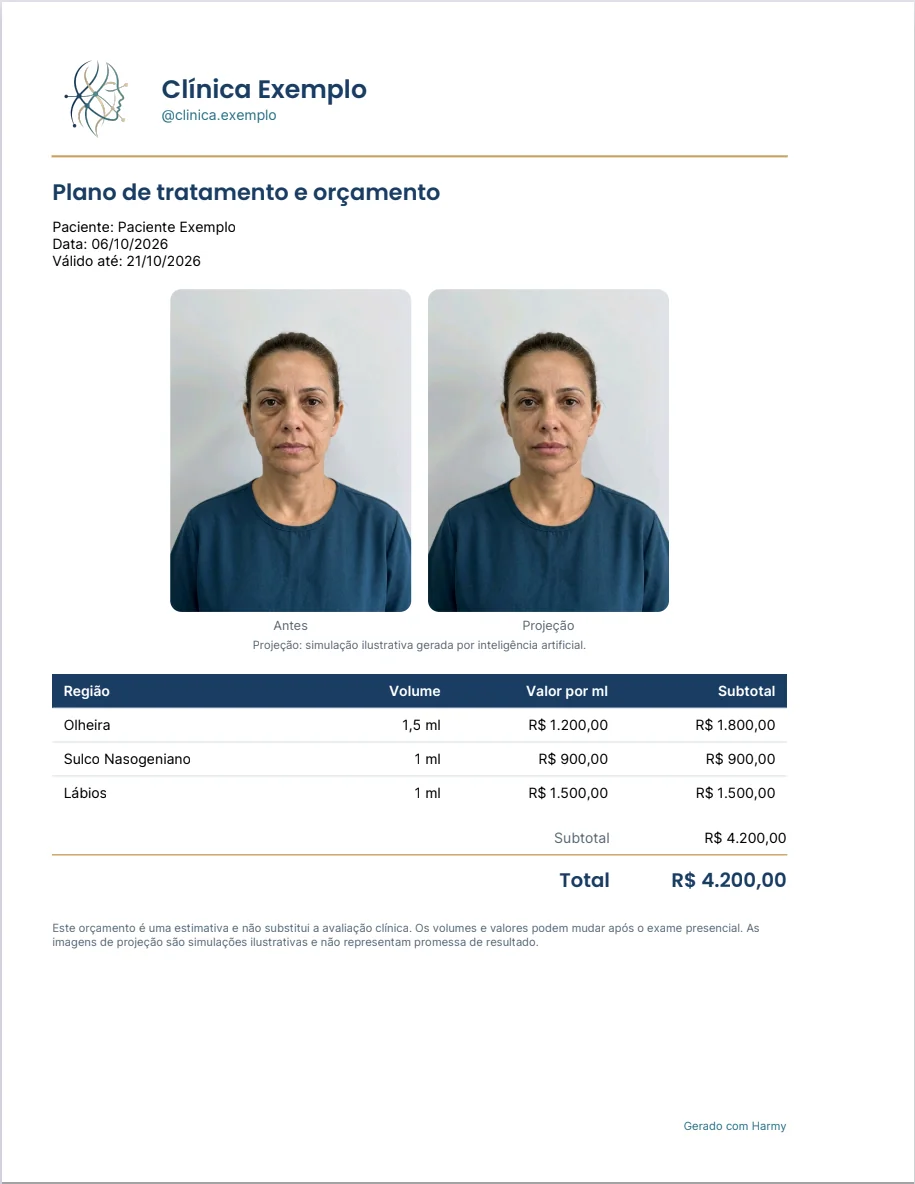
Since the projection is generated from a frontal photo, with the chosen areas and ml, redoing the plan means creating a new projection. Planning accepts a draft, which makes it easy to adjust without starting from scratch. History keeps the patient's sessions, and the PDF quote can be regenerated with a price per ml, discount, validity and notes.
What should you update in the documentation?
Three documents need to follow the plan: the quote, the informed consent and the patient record. A consent form that describes areas or volumes that will no longer be done is not valid as authorization for what will be done. Update it, collect a new signature when appropriate and file the previous version.
What about the amount already paid?
If there was prepayment, handle it clearly and in good faith, according to what was agreed in writing and consumer law. State explicitly in the document what happens to the amount if the plan changes. Avoid improvising on the spot: it creates conflict. See setting expectations in writing.
When is the change a sign of something else?
Frequent changes with no clear reason may indicate deep insecurity, pressure or distress about their image. If this keeps happening, talk carefully and consider pausing. Read the patient who always wants more and when to refer to psychology.
Changing one's mind is part of deciding. What you control is how you welcome it and how you record it.
How do you keep the plan from changing too much?
You can't control a change of mind, but you can reduce the chance that it happens from lack of clarity. Plans explained calmly, with time to decide and with an illustrative simulation tend to produce fewer last-minute reversals. Hand over the quote and the consent form in advance, arrange a confirmation conversation before the date and let the patient take the material home.
Another useful step is to split the plan into stages. When the patient sees a gradual path, with reassessment between sessions, they feel they are not taking on everything at once. This reduces anxiety and makes a change of mind easier to absorb, because the plan is flexible from the start. See explaining why more than one session is needed and do I need to do everything at once.
What should you say when the change costs the clinic?
Sometimes the change of mind causes a loss: a reserved slot, material set aside, prepayment. Even so, avoid shifting the blame to the patient. Agree on clear rescheduling and cancellation rules in writing, when giving the quote, and apply them with common sense. A patient who feels punished for changing their mind tends to hide doubts next time, which increases clinical risk.
Frequently asked questions
Can the patient change their mind after signing the consent form?
Yes. Consent can be reviewed at any time, up to the procedure. If the plan changes, update the document and record the new decision.
How do I re-plan without seeming unsure?
Treat the change as a normal part of the process. Acknowledge what changed, reassess the face and the goal, and present the new plan as clearly as the first.
What should I do with the quote already sent?
Update it and send a new one, making clear what changed and the validity. Avoid changing prices without explaining, and keep the previous version on file.
What if the patient changes their mind on the day of the procedure?
Stop and talk. Do not treat what they no longer want. If appropriate, reschedule, adjust the plan and record the decision. Never pressure them to keep to what was agreed.
Harmy images are illustrative simulations generated by AI from the patient's photo to support the conversation between practitioner and patient. They are not a promise of results. Indication, technique, product and volume are solely the decision of the licensed practitioner. This content is for information only and does not replace a clinical assessment.