
Storing Botulinum Toxin and Maintaining the Cold Chain
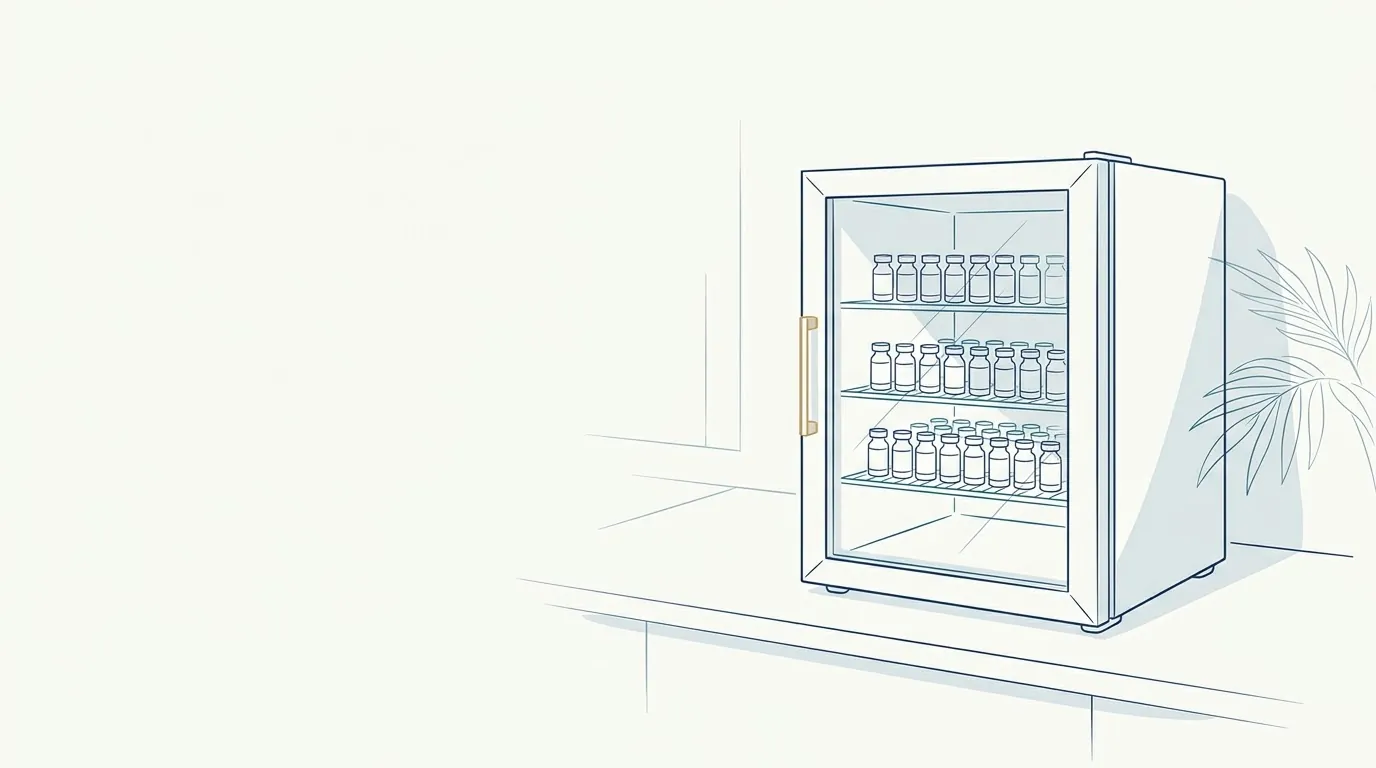
Botulinum toxin is a protein. Heat, unplanned freezing, agitation and time beyond the limit can reduce its potency without changing anything visible in the vial. The patient notices later, as a weak or short-lived effect, and the professional is left not knowing whether the problem was the dose, the product or the refrigerator.
This guide covers storage in the clinic: receiving, the refrigerator, the reconstituted vial, transport and what to do when the temperature leaves the range. It does not cover dilution or reconstitution technique: each product has its own, defined in the package insert, and the decision belongs to the licensed professional, in line with the rules of their professional board.
The rule that applies to everyone: the insert rules
Type A botulinum toxin products registered with ANVISA (Brazil's health regulatory agency) do not all share the same storage rule. Most call for refrigerating the sealed vial, generally between 2 °C and 8 °C, and some are described as stable at room temperature before reconstitution, within a defined temperature limit. Once reconstituted, each one has its own time limit and condition.
| Storage point | What tends to vary between products | Where to check |
|---|---|---|
| Sealed vial | Refrigeration or room temperature; exact range; whether it can be frozen | "Storage precautions" section of the insert |
| Light protection | Whether the vial must stay in its original packaging | Insert and carton |
| Expiration | Period counted from manufacture | Label and carton |
| After reconstitution | Period of use (hours or days) and temperature | Insert, preparation section |
| Vial use | Whether it is for a single patient or session | Insert |
| Disposal | Handling of waste and the vial | Insert and the clinic's waste plan |
Anyone working with more than one product needs more than one routine. The comparison between products is in differences between type A botulinum toxins, and the basic concepts are in botulinum toxin: fundamentals.
What should the refrigerator be like?
The refrigerator is where the cold chain most often fails in the clinic. What good practice recommends, and what local health inspection usually checks:
- Exclusive use for health products, with no food or drinks.
- Min/max thermometer, preferably digital with a log, to know whether the temperature left the range overnight or over the weekend.
- Temperature log in a spreadsheet, with date, time, current reading, maximum, minimum and who checked it.
- Vials on the middle shelves, away from the door (which fluctuates with every opening) and away from the back or the freezer compartment (risk of freezing).
- Original packaging, which protects from light and keeps the lot and expiration date visible.
- Organization by expiration date, with what expires first at the front.
- Power outage plan: who is notified, where the products go, how long the refrigerator holds its range when kept closed.
The full routine for purchasing, receiving and control is in injectables inventory in the HOF clinic. Cost and loss points are covered there too.
What about the reconstituted vial?
Once reconstituted, toxin has a shorter time limit and, generally, must go back to the refrigerator when not used right away. The precautions that repeat across inserts and clinical protocols:
- Write down the date and time of reconstitution on the vial or on a label, with the name of whoever prepared it.
- Respect the insert's period of use and discard whatever exceeds it, even if product is left over.
- Keep aseptic technique at every draw. An open vial is a gateway for contamination; see biosafety in HOF.
- Follow what the insert says about use per patient. Splitting a vial beyond what is intended raises the risk of contamination and complicates traceability.
- Handle gently, as the product's insert directs.
How should toxin be transported?
Transport between supplier and clinic, or between clinics for those who work in more than one place, is a frequent blind spot.
- On receipt, check whether the package arrived in the conditions the insert specifies (for example, refrigerated, with ice packs and without freezing the product) and record it.
- Reject or set aside product that arrives out of condition, and notify the supplier.
- When you transport it yourself, use a cooler with a thermometer, with no direct contact between the vial and the ice, and as little time as possible out of the refrigerator.
- Never leave toxin in a car, in a bag or exposed to the sun.
For those who work at more than one address, the safest approach is usually to keep product stored at each location, with its own control, instead of carrying vials back and forth. Check with your local health inspection office what applies to your case.
What to do when the temperature leaves the range?
Temperature excursion is the name given to the period when the product was outside the insert's range. It happens with a refrigerator that shuts off, a door left ajar, a power outage or freezing at the back of the shelf.
| Step | What to do |
|---|---|
| 1. Set aside | Take the vials out of use and label them "under evaluation" |
| 2. Measure | Note the maximum or minimum temperature reached and for how long |
| 3. Consult | Call the manufacturer's customer service with the lot, expiration date and excursion data |
| 4. Decide | Follow the manufacturer's guidance: release or discard |
| 5. Record | Document what happened, the guidance received and what became of the product |
| 6. Correct | Fix the cause: equipment, alarm, checking routine |
Storage and lack of response
When a patient reports a weak, short or absent effect, the investigation goes through several causes before concluding antibodies: dose, technique, interval between sessions, product and storage. That is why the storage and reconstitution record is not bureaucracy; it is the only way to rule out that hypothesis later. The full reasoning is in botulinum toxin treatment failure.
Traceability: what to record?
In the patient record for each application: product, ANVISA registration number, lot, expiration date, date and time of reconstitution and quantity applied per area. In the clinic: invoices, temperature logs and a record of excursions and discards.
The guide to injectables traceability and the lot and traceability record template organize this flow. To check whether a product has a valid registration, see how to look up an injectable's registration at ANVISA. Expired vials, leftovers and packaging follow the clinic's waste plan, covered in PGRSS in the HOF clinic (Brazil's healthcare waste management plan).
How to explain it to the patient?
A patient who has done some research often asks about where the product comes from, especially after news about counterfeits. Showing the controls reassures more than guaranteeing.
Toxin storage checklist
- Each product's insert accessible, with the temperature range highlighted.
- Dedicated refrigerator, with a min/max thermometer.
- Temperature logged at the start and end of the day.
- Vials on the middle shelves, in original packaging, in order of expiration.
- Date and time of reconstitution written on the vial.
- Period of use after reconstitution respected and leftover discarded.
- Written plan for power outages and temperature excursions.
- Product, registration, lot and expiration date in each patient's record.
To price toxin while accounting for losses from the reconstitution time limit, see how to price botulinum toxin.
Frequently asked questions
Does botulinum toxin need to be refrigerated?
For most products, yes: the package insert calls for refrigerating the sealed vial, generally between 2 °C and 8 °C. Some products are described as stable at room temperature before reconstitution, within a defined limit. The rule is to follow the insert of the product you use.
How long does botox last after reconstitution?
It depends on the product. Each insert defines the period of use after reconstitution and the storage condition during that time, which is usually refrigeration. Write the date and time on the vial and discard whatever goes past the insert's limit.
Can botulinum toxin be frozen?
Only if the product's insert allows it. Many inserts expressly say the product must not be frozen, especially after reconstitution. If in doubt, do not freeze it and ask the manufacturer.
What should I do if the refrigerator shut off with toxin inside?
Do not use the product as if nothing had happened. Set aside and label the vials, note how long and at what temperature they were kept, and contact the manufacturer's customer service, which will assess whether the product can still be used.
Does poorly stored toxin lose its effect?
It can lose potency. Toxin is a protein sensitive to heat, improper freezing and handling, and the loss does not show on the label. That is why a storage failure is one of the causes to investigate when the response is weaker than expected.
Harmy images are illustrative simulations generated by AI from the patient's photo to support the conversation between practitioner and patient. They are not a promise of results. Indication, technique, product and volume are solely the decision of the licensed practitioner. This content is for information only and does not replace a clinical assessment.