
Injectables inventory: purchasing, expiration dates and lots
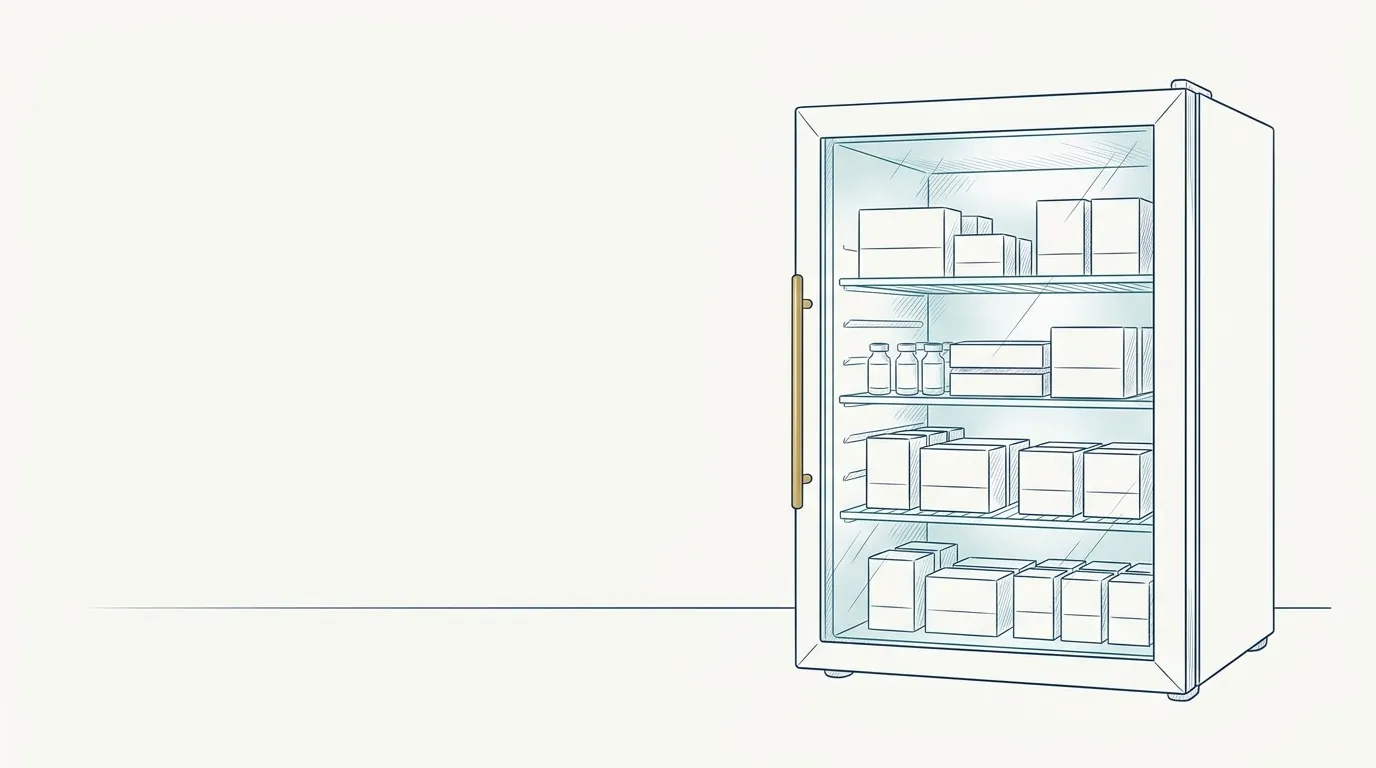
Injectables inventory is one of the areas of an orofacial harmonization (HOF) clinic where money, safety and routine meet. It weighs on cash flow (it is usually the largest variable cost), on patient safety (an expired or poorly stored product is a risk) and on record keeping (lot and expiration date are part of traceability). Even so, in many clinics the control system is a box in the fridge and the memory of whoever bought it.
This guide organizes the subject into purchasing, receiving, storage, use, losses and disposal. It does not replace the product label, the manufacturer's manual, or the guidance of the health authority and your professional council. The storage conditions for each product are on the label of the product you have in hand, and the label is what counts. We do not name brands.
Which products are usually in stock?
| Category | Examples | Special attention |
|---|---|---|
| Botulinum toxin | Vials for dilution per the label | Expiration sealed and after opening or reconstitution; see botulinum toxin storage |
| Fillers | Hyaluronic acid syringes | Lot, expiration, storage conditions |
| Biostimulators | Vials or syringes depending on the product | Preparation and post-preparation shelf life per the label |
| Threads | Sterile packaging | Packaging integrity and sterilization expiry |
| Enzyme | Hyaluronidase | Storage per the label; availability for emergencies |
| Anesthetics | Topical and injectable | Expiration and storage |
| Disposables | Needles, cannulas, syringes, gauze, gloves | Packaging integrity and expiration |
| Emergency supplies | Kit items | Periodic review; see the office emergency kit |
Each category has its own conditions. The inventory routine works when every product has a simple "card": name, lot, expiration date, storage condition (from the label), location and quantity.
How do you purchase well?
Purchasing decides whether inventory will be organized or a source of losses. Points of attention:
- Origin. Buy only from legitimate suppliers, with an invoice, and only registered products. To check whether an injectable is registered with ANVISA (Brazil's health regulator), see how to look up an injectable's registration with ANVISA.
- Transport conditions. Products that require controlled storage must arrive as the label specifies. Ask the supplier how transport is handled and, on receipt, check the packaging and the conditions.
- Quantity. Buy based on consumption, not on the discount. Idle product loses shelf life and creates cost.
- Expiration date on arrival. Set a minimum remaining shelf life rule for accepting a delivery.
- Price and payment terms. The cost of the product goes into the cost of the treatment. See pricing per ml and cash flow in the HOF clinic.
What should you do on receiving?
Receiving is the moment for checking, and it is cheaper to fix problems there than later:
- Compare the invoice with what was ordered.
- Check the integrity of the packaging (seals, damage, leaks).
- Check the lot and expiration date of each item and record them.
- Check the transport conditions specified on the label (for example, if the product requires refrigerated storage, note whether it arrived in compatible conditions).
- Store it immediately in the right place.
- Record the arrival in the inventory log, with date, supplier, lot and expiration date.
If anything is out of the ordinary, record it and talk to the supplier before using the product. If there is any doubt about storage, do not use it until it is clarified.
Where and how should you store it?
The golden rule is: the product label rules. Each manufacturer defines the temperature range, light protection and storage time before and after opening or preparation. Some products call for refrigeration, others for room temperature. That is why the answer to "does hyaluronidase need to be refrigerated?" is: it depends on the product and the presentation, so check the label.
Practices that are usually recommended and look good in a health inspection (confirm with your health authority):
| Practice | Why |
|---|---|
| Refrigerator used only for health products | Prevents contamination and openings for reasons unrelated to the clinic |
| Thermometer with maximum and minimum readings | Shows whether the temperature left the range and when |
| Daily or periodic temperature log | Documents proper storage |
| Organization by category and by expiration date | Reduces errors and losses |
| Clean area, no food stored | Biosafety and compliance |
| Restricted access | Prevents misuse and makes control easier |
| Plan for power outages or equipment failure | Defines what to do with the product if the temperature leaves the range |
| Original, labeled packaging | Keeps lot, expiration date and identification |
If the temperature left the range on the label, do not assume the product is still good. Set it aside, label it, and consult the manufacturer or its customer service to decide.
How do you track expiration dates and lots?
Two principles solve most losses:
- FEFO (first expired, first out): use first what expires first. Inventory should be organized so that the product with the shortest shelf life is at the front.
- Traceability: every product applied should have its lot and expiration date noted in the patient's record. If there is a recall or a complication, this lets you identify who received it. See injectables traceability, the lot and traceability log template and patient records and documentation in HOF.
A simple routine:
- Weekly: scan the expiration dates and set aside what expires soon.
- Monthly: full inventory count, comparing the physical stock with the log.
- When opening or preparing a product: note the date and time, to respect the shelf life after opening or preparation per the label.
- When applying: record the product's lot and expiration date in the patient record.
How do you prevent losses and control cost?
Losses of injectables have known causes: expiration, storage failure, opened product left unused, disposal due to contamination, use above what is needed due to lack of planning. Practical measures:
- Schedule patients who need the same product on the same day, when clinically appropriate, to reduce leftovers.
- Buy what turns over. Slow-moving items in large quantities are an expiration risk.
- Measure the monthly loss per product: (purchased − used − in stock). If the loss is high, the effective cost goes up.
- Include the loss in the price. The pricing calculation uses effective cost, not nominal cost. See pricing botulinum toxin by area and pricing lip filler.
- Calculate the yield of the material per patient with the syringe yield calculator.
Hypothetical example: fictional figures. A clinic buys products that add up to R$ 12,000.00 in a month. When it counts inventory, it finds that R$ 900.00 expired unused. The loss is 7.5% of what it bought. Instead of accepting it as "normal," the clinic starts buying smaller quantities, more often, and grouping patients who need the same product. The next month, the loss drops and so does the cost per treatment.
What should you do with expired product, leftovers and waste?
- Expired or unusable: set it aside, label it "do not use," record it and dispose of it according to the clinic's waste management plan. See PGRSS in the HOF clinic (Brazil's healthcare waste management plan).
- Leftover opened product: use it only within the time frame and conditions on the label. Otherwise, discard it.
- Sharps: appropriate rigid container, disposal according to regulations.
- Packaging and labels: save the lot information in the patient record before discarding the packaging.
- Return to the supplier: when the manufacturer or supplier instructs a recall or exchange, follow it and record it.
What about patient safety?
Organized inventory is also part of safety:
- The right product at the right time. Legible labels and organization reduce errors.
- Emergency readiness. The emergency kit and the availability of hyaluronidase when hyaluronic acid is used are part of the inventory, with expiration dates reviewed. See the emergency checklist for the HOF office.
- Consent and forms. When the patient receives a product, the informed consent and the instructions reflect what was applied.
- Integration with the health authority. Storage, records and disposal are usual inspection points. See the health license for the HOF clinic and the ANVISA RDC for the HOF clinic.
Common mistakes
- Storing everything "out of habit," without checking the label of each product.
- Using a household refrigerator shared with food.
- Having no thermometer or temperature log.
- Buying a lot for the discount and losing it to expiration.
- Not noting the lot in the patient record.
- Opening a vial without noting the date and time.
- Having no plan for power outages.
- Forgetting to review the emergency supplies.
Inventory checklist
- Does each product have its lot, expiration date and storage condition recorded?
- Did I check the storage conditions on the label of each item?
- Is the refrigerator dedicated, with a thermometer and a log?
- Do I use FEFO and review expiration dates weekly?
- Does the applied lot go into each patient's record?
- Do I measure the monthly loss and include it in the price?
- Do I have a plan for power failures and for out-of-range product?
- Are the emergency supplies within their expiration dates?
- Do I discard expired product and waste according to the clinic's plan?
Organized inventory is not bureaucracy: it protects the patient, shows up in cash flow and gives peace of mind in any inspection. Start with the essentials (label, lot log, thermometer and monthly count) and build on it as the clinic grows.
Frequently asked questions
Does hyaluronidase need to be refrigerated?
It depends on the product and the presentation. Some labels call for refrigeration and others for room temperature, so the rule is to follow the manufacturer's label for the product you have, and to record how and where it is stored.
How should botulinum toxin be stored in the clinic?
According to the product label, which usually gives the temperature range, the shelf life while sealed and the conditions once opened or reconstituted. Store it with temperature control and a log, and check the label before any decision.
Can I keep injectables in the break room fridge with food?
It is not good practice. In general, a refrigerator used exclusively for health products is recommended, with a thermometer and a temperature log. Also check what the health authority in your municipality requires.
What should I do with expired product or a doubtful cold chain?
Do not use it. Set it aside, label it, record it and dispose of it according to the clinic's waste plan and the manufacturer's guidance. If there is any doubt about storage, treat the product as unusable until it is clarified.
How do I track lot numbers and expiration dates of injectables?
Record the lot and expiration date of each product when it arrives, organize the inventory so that what expires first is used first, and note in the patient record the lot applied to each patient. This makes it possible to trace recipients if there is a recall or a complication.