
Pricing per ml in HOF: How to Calculate Your Rate
Pricing orofacial harmonization (HOF) by gut feeling or by what "everybody charges" is the fastest way to work a lot and keep little. The cost of each milliliter injected goes far beyond the syringe: there are supplies, chair time, taxes, card fees, follow-up and the reserve for when something goes off plan.
This guide shows how to build your price per ml from the ground up, with a calculation table you can reproduce in a spreadsheet. The numbers used are fictional, chosen only to make the math easy to follow. They are not a market reference. Use your own.
Why price per ml?
Charging per ml has two clear advantages. For you, the price tracks real cost, which is proportional to the product used. For the patient, the plan is transparent: they see how many ml go into each area and understand why the quote has that amount.
It also makes adjustment conversations easier. If the patient wants to start with less, you reduce the amount and the price adjusts with it, without renegotiating the whole price. And when they come back to add more, the same criterion applies.
Botulinum toxin follows a different logic: it is usually charged per area or per unit, and the vial is diluted and divided. The cost reasoning in this article applies to it too, replacing "ml" with "unit" or "area".
Which costs go into the price per ml?
1. Product
The cost of the syringe divided by its volume. If the syringe holds 1 ml, the cost per ml is simply the syringe price. Include freight and any storage loss. Use the price you actually pay, with the invoice in hand.
2. Procedure supplies
Needles, cannulas, topical or injectable anesthetic, antiseptic, gauze, gloves, drapes, marking material, disposables. Calculate the cost per procedure and divide it by the average volume injected per procedure.
3. Chair time
This is the most forgotten cost. Add up the clinic's monthly fixed costs (rent, building fees, electricity, internet, receptionist, accountant, software, equipment depreciation, your own salary) and divide by the hours you actually see patients in the month. That gives you the cost per hour. Multiply it by the procedure time (including consultation, preparation, photos and cleanup) and divide by the average volume.
4. Follow-up and adjustment
If a follow-up visit with a small adjustment is included, it has a cost: chair time and sometimes a fraction of product. Set a reserve per ml for it. It is better to have it in the price than to take it out of your own pocket.
5. Reserve for complications
Anyone using hyaluronic acid needs hyaluronidase on hand, plus supplies to manage complications. This is a safety cost, not an optional one, and it should be spread into the price.
6. Taxes and fees on revenue
Taxes on revenue and card terminal or installment fees apply to the price, not to the cost. That is why they enter as a percentage, in the divisor of the formula.
7. Margin
What is left to pay the business, reinvest and build a reserve. Like taxes, margin is a percentage of the final price.
The formula
With the costs per ml added up (items 1 to 5) and the percentages on the price (items 6 and 7):
Price per ml = direct cost per ml ÷ (1 − taxes − fees − margin)
The common mistake is adding the margin on top of cost ("cost plus 30%"). That delivers a real margin lower than planned, because taxes and fees eat part of what you thought was profit.
Hypothetical calculation table
Hypothetical example: fictional values, just to illustrate the math. Consider an average procedure of 2 ml, with 1 hour of chair time covering consultation, injection and setup, 1 ml syringes, and a clinic with R$ 12,000.00 in monthly fixed costs and 80 patient hours per month.
| Item | How to calculate | Value per ml |
|---|---|---|
| Product | 1 ml syringe at R$ 300.00 | R$ 300.00 |
| Supplies | R$ 40.00 per procedure ÷ 2 ml | R$ 20.00 |
| Chair time | (R$ 12,000.00 ÷ 80 h) = R$ 150.00 per hour × 1 h ÷ 2 ml | R$ 75.00 |
| Follow-up reserve | Follow-up time and possible adjustment, spread out | R$ 40.00 |
| Complications reserve | Hyaluronidase and emergency supplies, spread out | R$ 10.00 |
| Direct cost per ml | Sum | R$ 445.00 |
| Taxes on revenue | Hypothetical percentage | 15% |
| Card fees | Hypothetical percentage | 4% |
| Desired margin | On the final price | 30% |
| Minimum price per ml | R$ 445.00 ÷ (1 − 0.15 − 0.04 − 0.30) = R$ 445.00 ÷ 0.51 | R$ 872.55 |
| Rounded price | Round up | R$ 875.00 |
Checking: of R$ 875.00, R$ 131.25 is taxes, R$ 35.00 is fees, R$ 445.00 covers the direct cost and R$ 263.75 is left, about 30% of the price. The math works.
What if you had done "cost plus 30%"?
In the same hypothetical example, R$ 445.00 × 1.30 = R$ 578.50. Taking out 19% for taxes and fees (R$ 109.92) and the direct cost, you would be left with R$ 23.58 per ml, about 4% of the price. The difference between the two methods is the difference between a healthy business and one that just moves money around.
What does a discount cost?
A discount looks small on the price and large on the profit, because the cost of the product does not go down.
| Situation (hypothetical) | Price per ml | Taxes and fees (19%) | Direct cost | Left over | Margin |
|---|---|---|---|---|---|
| No discount | R$ 875.00 | R$ 166.25 | R$ 445.00 | R$ 263.75 | 30% |
| 10% discount | R$ 787.50 | R$ 149.63 | R$ 445.00 | R$ 192.87 | 24% |
| 20% discount | R$ 700.00 | R$ 133.00 | R$ 445.00 | R$ 122.00 | 17% |
In this example, a 10% discount on the price takes away about a quarter of what is left. If you are going to discount, do it with a rule (cash payment, which removes the card fee, or closing the full plan) and put it in writing on the quote.
Opened syringes and partial volumes
If the plan calls for 0.5 ml and the syringe holds 1 ml, the rest normally cannot be saved for another patient. You need to decide how this shows up in the price. Some options in use:
- Minimum per opened syringe: the minimum amount for an area equals 1 ml.
- Same-day complement: the rest is used in another area of the plan, if clinically indicated.
- Price per area: for areas that almost always use the same volume, a fixed price.
What does not work is charging for 0.5 ml and absorbing the cost of 1 ml without noticing. And the volume indication remains clinical: leftover product is no reason to inject more than needed.
Checklist to review your price
- Did I use the real product price, with freight, from the invoice?
- Did I count supplies from a real procedure, item by item?
- Did I calculate my hourly cost using the hours I actually see patients?
- Is follow-up in the price, or does it come out of my pocket?
- Does the complications reserve exist?
- Are taxes, fees and margin in the divisor, and not added on top of cost?
- Do I know how much margin a 10% discount takes away?
- Do I have a rule for opened syringes and partial volumes?
- Did I review the price after the last product price increase?
Redo the math whenever the supplier raises prices, when fixed costs change or when the hours seen in a month vary a lot. The price per ml is not a one-time number.
How to bring the price per ml into the quote
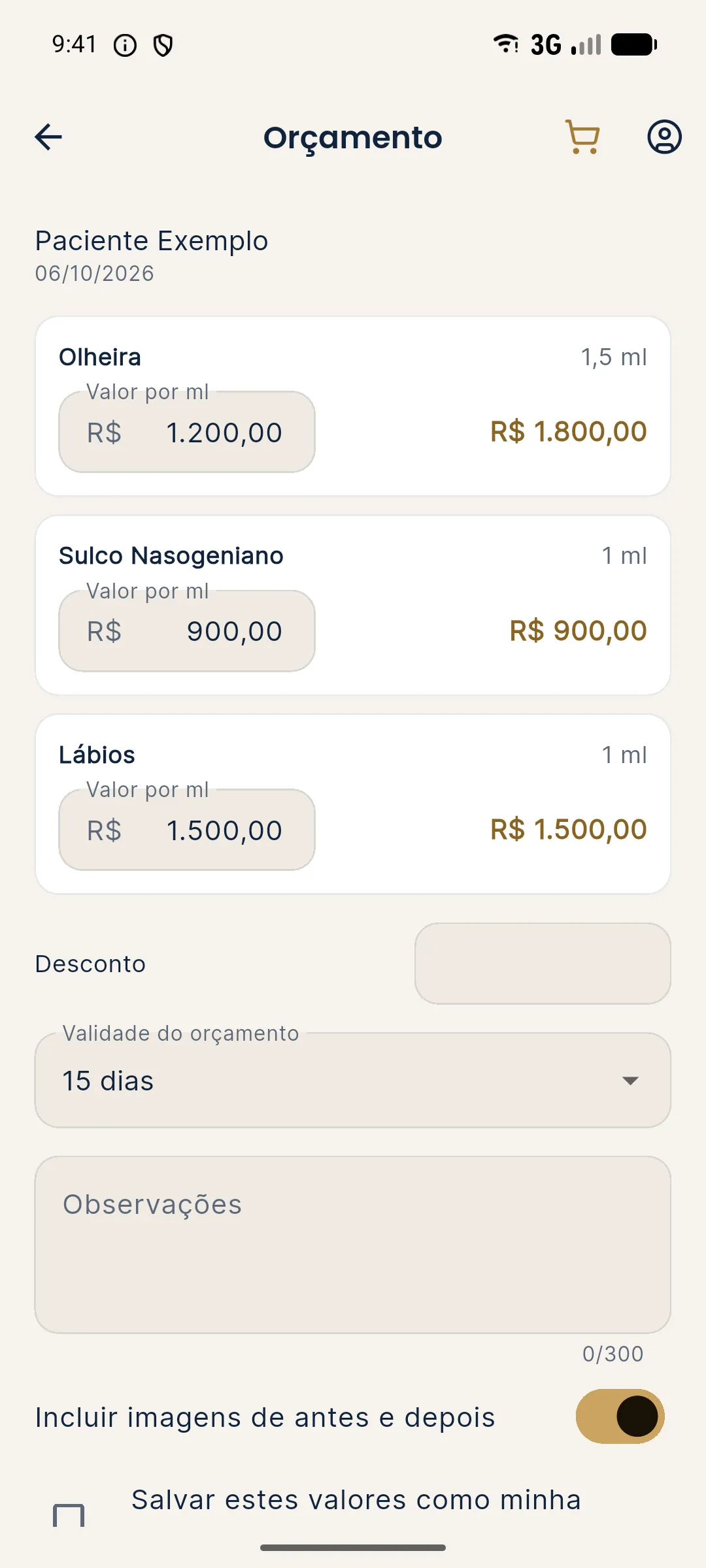
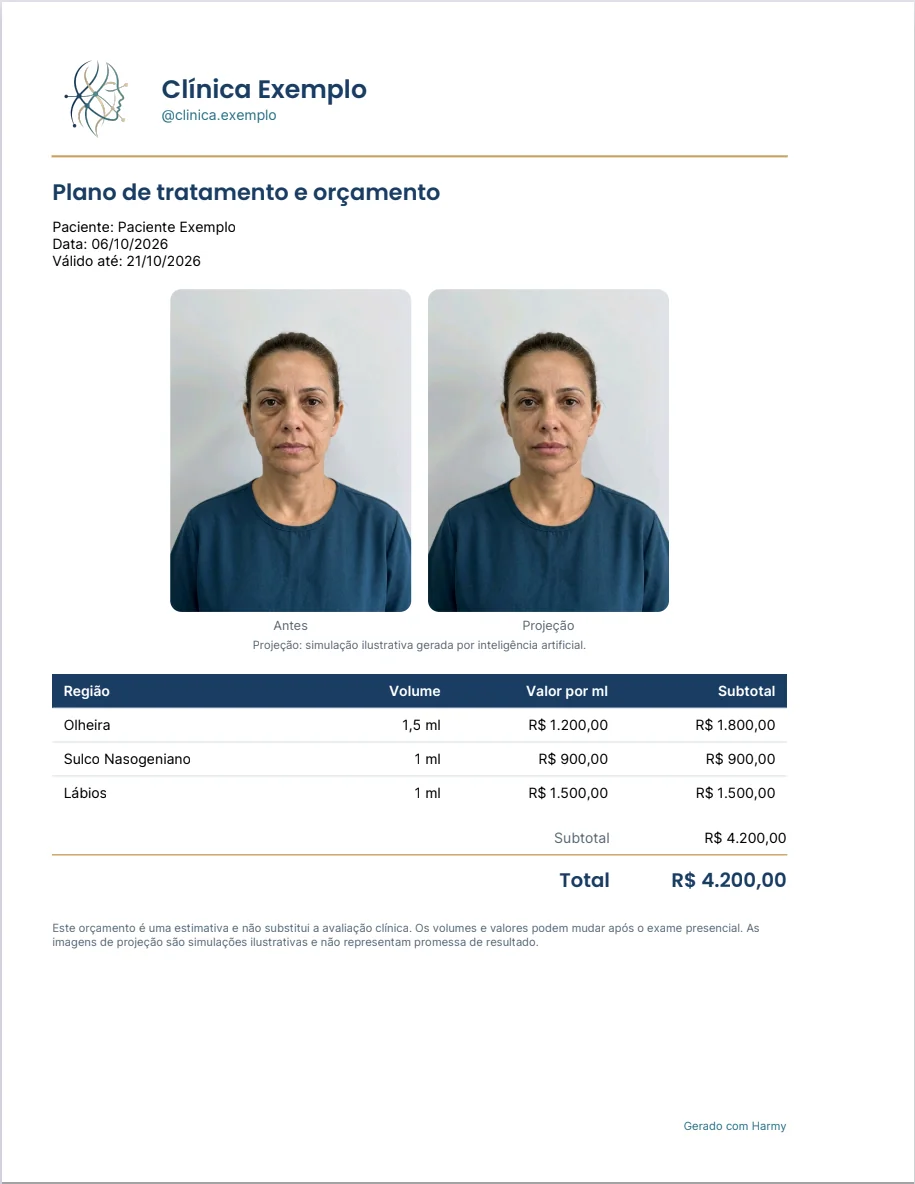
With the price calculated, the quote becomes simple: area, amount in ml, price per ml, subtotal. The patient understands the logic, and when they want to start with less, the math adjusts itself. In Harmy, the Plan already defines the ml for each marked area, and the quote in PDF picks up those volumes. You enter the price per ml for each area (and can save your price table), apply a discount if there is one, set the validity in days and the notes, and choose whether the simulation images are included. The PDF comes out with the clinic's name and logo.
The step by step is in quote in PDF. To guide the conversation when the patient finds the price high, see patient objections and answers.
Summary
A well-built price per ml starts from real cost: product, supplies, chair hour, follow-up and safety. Taxes, fees and margin enter as a percentage of the price, in the divisor. Discounts only with a rule and knowing what they cost. With the math in hand, you negotiate calmly, because you know exactly how far you can go and why.
Frequently asked questions
How do I calculate the price per ml of filler?
Add up the direct cost per ml (product, supplies, chair time, reserve for follow-up and complications) and divide by 1 minus the sum of the percentages for taxes, fees and desired margin. The result is the minimum price that keeps your margin.
Should I charge per ml or per area?
Charging per ml makes the plan transparent and easy to adjust, because the patient sees where the amount comes from. Many professionals combine both, with a price per ml and a minimum per area or per opened syringe.
How much margin should I build into the price per ml?
It depends on your structure, your positioning and your revenue goal. What matters is that the margin is calculated on the final price, after taxes and fees, and not added on top of cost.
Is it worth discounting the price per ml?
Only with a clear rule and a clear idea of the effect on margin. A small discount on the price usually eats a much larger share of the profit, because the cost of the product does not go down.