
Low-Level Laser After HOF Procedures
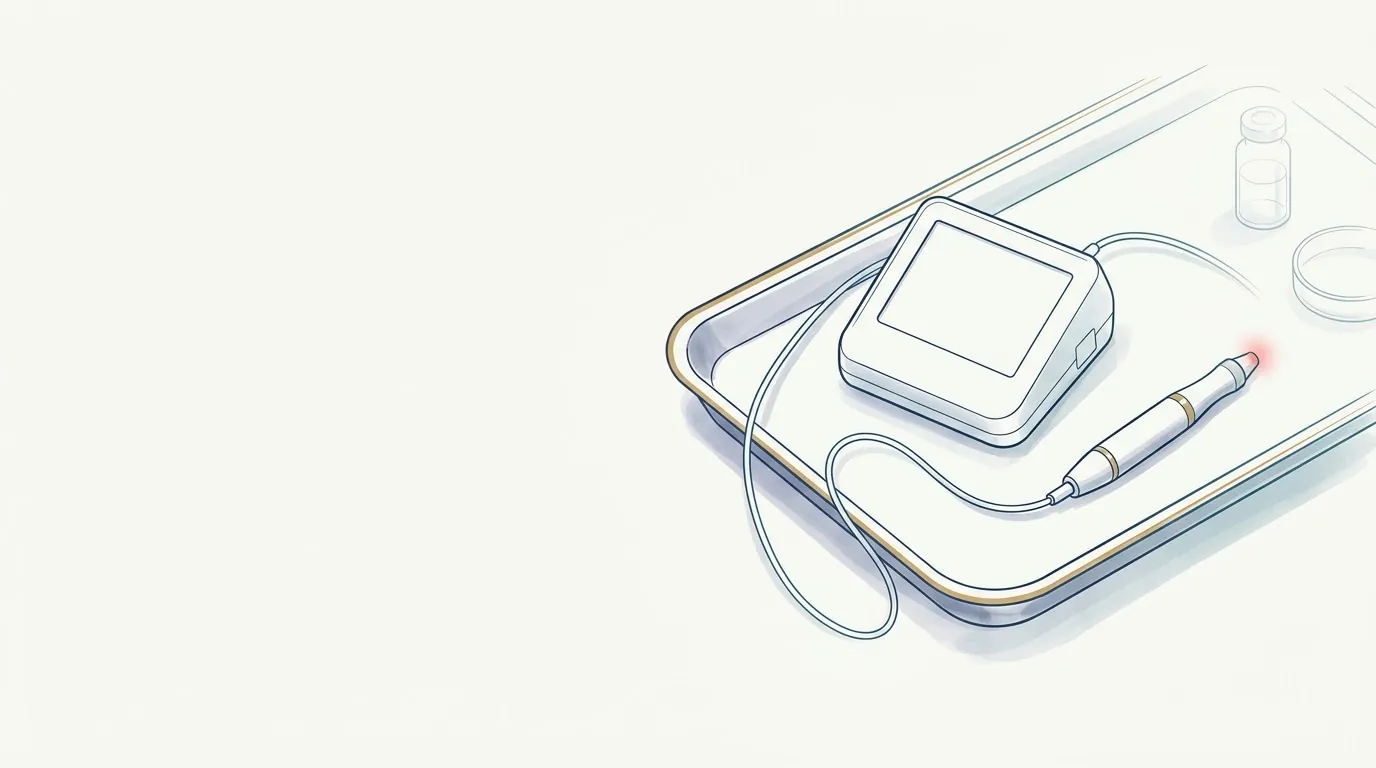
Photobiomodulation is the use of low-power light, generally red or near-infrared, emitted by a laser or LED, to modulate cellular processes without meaningfully heating the tissue. Formerly called low-level laser therapy, it appears in the aftercare of orofacial harmonization (HOF) procedures as an attempt to reduce swelling, pain and ecchymosis.
This page summarizes what the technique is used for, what the evidence supports and where it should not be sold as a solution. Application parameters, such as wavelength, energy and time, are decisions for the qualified practitioner, according to the device registered with ANVISA (Brazil's health regulatory agency) and the rules of their professional council.
How does photobiomodulation work?
The most cited mechanism is photochemical: light absorbed by components of the mitochondria would increase cellular energy production and modulate the inflammatory response and microcirculation. From this come the proposed applications in healing, pain and swelling.
Two points set photobiomodulation apart from other technologies:
- Low power, little heat. It does not depend on heating the tissue, unlike high-power aesthetic lasers, radiofrequency and microfocused ultrasound. That is why the concern about freshly placed filler is different. See laser and microfocused ultrasound after filler.
- Dose-dependent response. The photobiomodulation literature describes a response in which too little energy may have no effect and too much energy may inhibit the desired effect. That is why parameters matter, and protocols vary widely between studies.
What is it used for after HOF procedures?
| Proposed use | What is expected | Level of support, in general terms |
|---|---|---|
| Swelling after filler or threads | Reduced swelling in the first few days | Small, heterogeneous studies; variable results |
| Ecchymosis and hematoma | Faster absorption of the color | Reports and small studies |
| Post-procedure pain | Complementary relief | More evidence in other areas of health than in facial aesthetics |
| Paresthesia after sensory nerve injury | Support for recovery | Use described in dentistry, with limited evidence for HOF |
| Cold sores | Support in managing lesions | Use described; does not replace the prevention and treatment indicated |
| Vascular occlusion | Complementary measure cited in some protocols | Weak; never in place of the main management |
Where should it not be used?
The greater risk is not the light: it is delaying the right management by relying on it.
- Suspected vascular occlusion. Disproportionate pain, pallor, livedo or color change call for the office protocol, with hyaluronidase when the product is hyaluronic acid. Light, if used, comes afterward and as a complement.
- Suspected infection. Increasing pain, warmth and discharge call for assessment and their own management, not light sessions.
- A suspicious skin lesion at the site, which needs a diagnosis before any energy is applied.
- Swelling that does not follow the expected course, such as delayed swelling, which has other causes. See delayed swelling after hyaluronic acid.
What safety precautions does the technique require?
Even at low power, the device emits light that can injure the eyes.
- Eye protection for patient and practitioner, with goggles specific to the device's wavelength.
- A device registered with ANVISA, following the manufacturer's maintenance schedule and manual.
- Targeted medical history: photosensitizing medications, diseases with photosensitivity, skin lesions at the site and pregnancy, according to the manufacturer's contraindications.
- Hygiene of the tip between patients, as in biosafety in HOF.
- Recording the device, the parameters used and the area in the patient record.
What should you assess before buying a device?
Photobiomodulation requires investment in equipment, training and chair time. Before buying, answer honestly:
| Question | Why it matters |
|---|---|
| Is the device registered with ANVISA? | Using an unregistered device is a health and ethical risk |
| Which wavelengths and powers does it offer? | They define the depth and type of effect possible |
| Does the manufacturer provide a manual with contraindications and parameters? | Without it, every session becomes improvisation |
| How many patients per month would have a real indication? | Defines whether the investment pays off without forcing indications |
| Is there evidence-based training, not just marketing? | Avoids promising what the technique does not deliver |
| Does your council allow your profession to use it? | Rules vary and some are in dispute |
Hypothetical example: an office that does few thread sessions a month may not justify a device just for aftercare, while a service with many procedures and a standardized protocol may use it often. Use the break-even calculator to test the math first.
And after threads and biostimulators?
After threads, swelling and pain tend to be more marked than with filler, and that is where many practitioners concentrate the use of light. With biostimulators, the logic is the same, with the caveat that the technique has not been shown to change the collagen response or prevent nodules. In both, keep the instructions specific to each procedure, as in complications of PDO threads.
Is photobiomodulation covered by council rules?
In dentistry, Resolution CFO-198/2019 (from Brazil's Federal Council of Dentistry) lists biophotonic procedures and laser therapy among the areas of competence of the HOF specialist, and laser therapy also appears in other areas of dentistry. For other professions, the situation depends on each council's rules and, in some cases, on court decisions. Check with your council before offering it. The CFO context is in orofacial harmonization at the CFO.
Is it worth charging separately or including it in the package?
It is a management decision. Some practitioners include sessions in the aftercare of procedures with more expected swelling, such as threads; others offer it as a standalone service. If you charge for it, make clear in the quote that it is complementary care, with no promise of effect. Hypothetical example: a filler package with one light session at the follow-up a few days later, described as "complementary photobiomodulation session, per assessment", without promising less bruising. To think about price and margin, see profit margin in HOF.
How do you explain it to the patient?
Include the technique in the informed consent when it is part of the plan, and keep the written aftercare instructions. See post-procedure instructions and clinical follow-up visit.
And in Harmy?
Checklist for using photobiomodulation as aftercare
- Indication defined as complementary, never as the main management.
- Vascular occlusion and infection ruled out before the session.
- Registered device and written protocol.
- Eye protection for patient and practitioner.
- Photosensitivity, medications and skin lesions checked.
- Parameters and area recorded in the patient record.
- Expectations explained without a promised timeline.
- Your council's rules checked.
Frequently asked questions
Does low-level laser help after filler?
It is used to try to reduce swelling, pain and bruising after the procedure, and there are favorable studies and reports, but the evidence in harmonization is still limited and heterogeneous. It should be presented as complementary care, without promising faster recovery.
Does low-level laser damage hyaluronic acid?
Photobiomodulation works at low power with little thermal effect, unlike lasers and technologies that heat tissue. Still, there is little specific research on the interaction with each filler, so follow the guidance of the device and product manufacturers.
Is photobiomodulation useful for vascular occlusion?
Some protocols cite photobiomodulation as a complementary measure in managing vascular occlusion, but it does not replace the main management. When occlusion with hyaluronic acid is suspected, the priority is the office protocol, with hyaluronidase, and referral when needed.
What is the difference between photobiomodulation and aesthetic laser?
Photobiomodulation uses low-power light, generally red or near-infrared, to modulate cellular processes without meaningful heating. High-power aesthetic lasers work through heat or ablation and have other indications, risks and intervals.
Harmy images are illustrative simulations generated by AI from the patient's photo to support the conversation between practitioner and patient. They are not a promise of results. Indication, technique, product and volume are solely the decision of the licensed practitioner. This content is for information only and does not replace a clinical assessment.