
Smooth, Barbed and Spiral PDO Threads: Differences
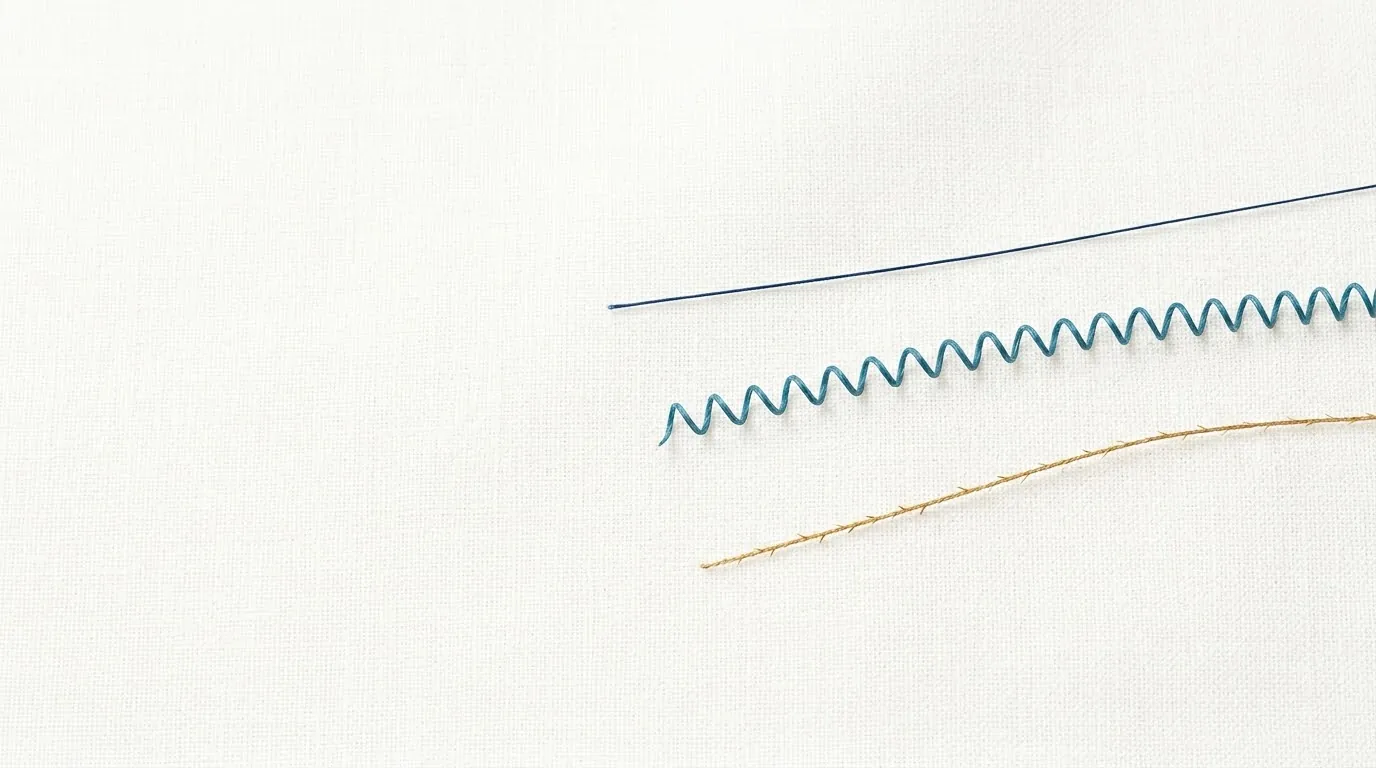
When a patient asks for a "PDO thread," they rarely know there are different types with different goals. The smooth thread, the spiral (the "screw") and the barbed thread are made of the same polymer, polydioxanone, but the shape of the thread changes what it does in the tissue: stimulate collagen, give mild support or reposition.
This guide compares the types at a review level. It does not include gauges, lengths, vectors or insertion technique, which are the decision of the licensed professional, following the product's instructions for use and the rules of their professional board. For the definition of the material, see the PDO entry; for threads in general, thread lift.
How are PDO threads classified?
The most useful classification is by the surface of the thread, because that is what defines the interaction with the tissue:
| Type | What it is like | Interaction with the tissue | Main goal |
|---|---|---|---|
| Smooth (monofilament) | Simple thread, no relief | Foreign body reaction only | Collagen stimulation, skin quality |
| Spiral or screw | Thread wound into a spiral, or several twisted threads | More material per track, no anchoring | Collagen stimulation with a mild filling effect |
| Barbed (with cogs) | Thread with barbs along the body | Mechanical anchoring, plus foreign body reaction | Modest repositioning and support |
Smooth and spiral threads usually come mounted on a needle, and many barbed ones on their own needle or cannula. The insertion device is part of the registered product.
What changes among the barbed threads?
Barbed threads vary in three aspects that appear in the instructions for use and in manufacturers' materials:
- Direction of the barbs: unidirectional (all facing the same way) or bidirectional (in opposite directions from the middle of the thread), which changes the way of anchoring.
- Manufacturing: barbs cut into the thread itself, which reduces the diameter at the cut point, or molded by pressing, which preserve more of the thread body. The literature discusses differences in tensile strength between the two processes.
- Distribution: barbs in one line, in several lines or in a helical pattern along the thread.
These variables influence anchoring strength and thread behavior, but they do not turn the thread into surgery. The repositioning effect remains modest and temporary. Because each manufacturer describes its own thread with different commercial terms, compare by what is in the instructions for use (barb type, direction, manufacturing process and indication), not by the name.
When is each type usually considered?
| Situation | Type that usually applies | Limit |
|---|---|---|
| Thin, dull skin, fine lines | Smooth | Gradual, modest effect |
| Small depressions, mild loss of support | Spiral | Does not replace the volume of a filler |
| Mild to moderate laxity in the midface or lower face | Barbed | Modest repositioning; does not treat excess skin |
| Marked laxity, excess skin | None as a solution | Surgical indication |
| Significant volume loss | None on its own | Filler or biostimulator |
The indication by area, in the patient's language, is in PDO threads: areas of the face. Specific applications are in PDO threads in the neck and lower face and PDO threads in the brow.
What about threads of other materials?
Besides PDO, there are absorbable threads made of other polymers, such as poly-L-lactic acid and copolymers with caprolactone. They are usually described as being absorbed more slowly than PDO, which changes the expected duration and the time of exposure to complications. Comparing materials depends on the registered product and its instructions for use.
How long does each type last?
PDO is degraded by hydrolysis over months, whatever the shape of the thread. The effect may outlast the thread itself because of the collagen formed around it, and varies with the type, the number of threads, the area, the quality of the skin and the patient. The barbed thread tends to lose its anchoring first, as the barbs are absorbed. The patient's questions about this are in how long PDO threads last.
Which risks change with the type?
The general risks apply to all: swelling, bruising and ecchymosis, asymmetry, infection and pain. Some concentrate in certain types:
| Risk | Most associated with | Why |
|---|---|---|
| Dimples and waviness | Barbed | Anchoring and traction on the skin |
| Palpable or visible thread | All, more in thin skin | Superficial plane or thin skin |
| Extrusion | All | Thread near the surface or the exit point |
| Pain with movement | Barbed | Traction in mobile areas |
| Nodules and granuloma | All, rare | Reaction to the material or infection |
| Nerve or gland injury | All, rare | Track near important structures; paresthesia may occur |
Recognition and management, at a review level, are in complications with PDO threads.
PDO thread, biostimulator or filler?
The smooth and spiral threads come close to the collagen biostimulator in goal; the barbed thread has anchoring as its differentiator. None of them replaces volume like a filler. The comparisons, in the patient's language, are in biostimulator or PDO threads and PDO threads or hyaluronic acid.
How to assess the thread candidate?
The type of thread is the second decision. The first is whether the patient is a candidate for threads. Some points weigh in that assessment:
| Factor | Favors | Disfavors |
|---|---|---|
| Skin thickness | Medium-thickness skin | Very thin skin, where the thread becomes palpable |
| Degree of laxity | Mild to moderate | Marked, with excess skin |
| Facial volume | Reasonable volume or already replaced | Significant untreated volume loss |
| Weight | Stable | Ongoing loss or gain |
| Expectation | Modest, temporary improvement | Surgical facelift effect |
| History | No previous complication in the area | Infection, scar or earlier thread with a complication |
Patients with significant volume loss usually benefit from replacing volume first, because the thread works better on supported tissue. Patients with marked laxity tend to be frustrated with any type of thread, and the conversation about surgery is the most honest. The expected recovery, in the patient's language, is in PDO thread recovery, and the risks in PDO thread risks.
How to explain it to the patient?
The informed consent should cite the type of thread and the risks specific to it; there is an informed consent template for PDO threads and one for PDO thread aftercare instructions. Pricing is covered in pricing PDO threads.
And in Harmy?
Checklist before choosing the thread type
- Goal defined: collagen stimulation, mild support or repositioning.
- Degree of laxity and skin quality assessed and recorded.
- Indication checked in the instructions for use of the registered product.
- Patient informed that the effect is modest, temporary and different from surgery.
- Risks specific to the chosen type in the consent form.
- Product, type, lot and number of threads in the patient file.
Frequently asked questions
What is the difference between a smooth and a barbed PDO thread?
The smooth thread has no barbs and works mainly through collagen stimulation around it. The barbed thread has small barbs that grip the tissue and allow some repositioning, in addition to the stimulation. The choice depends on the goal and the assessment.
What is a screw PDO thread?
It is the smooth thread wound into a spiral, or made of more than one twisted thread, which takes up more space in the tissue than a simple smooth thread. It is used mainly for collagen stimulation and a mild filling effect, not for traction.
Does a barbed PDO thread lift the face?
It can reposition tissue in a modest, temporary way in mild to moderate laxity. It is not equivalent to a surgical facelift, and in marked laxity the result tends to be limited and shorter-lived.
Which type of PDO thread lasts longest?
The polymer is the same, so all of them are absorbed within months. The effect may outlast the thread because of the collagen formed, and varies with the type, quantity, area and patient.
Harmy images are illustrative simulations generated by AI from the patient's photo to support the conversation between practitioner and patient. They are not a promise of results. Indication, technique, product and volume are solely the decision of the licensed practitioner. This content is for information only and does not replace a clinical assessment.