
How many units of botox per area are normal?

 BeforeSimulation
Quick facts
- Question
- How many units of botox per area are normal
- Short answer
- There is no single number; the dose is individual
- What changes the dose
- Muscle strength, sex, age, expression, history and goal
- Who decides
- The licensed professional, after assessment
"How many units will it be?" is the question patients ask to compare prices, to distrust whoever injects little and to feel reassured by whoever injects "plenty". The problem is that it rests on a wrong assumption: that there is a normal number per area. There is not. The dose of botulinum toxin is individual, and a public page is not the place to tabulate values per point.
This page has no numbers, and that is deliberate. It shows what makes the dose vary, what the patient can ask and how you explain the variation without sounding evasive. Setting the dose is up to the licensed professional, according to the rules of their professional council (in Brazil).
Why there is no "normal" number
The toxin unit is a measure of biological potency that is not comparable between different products. That alone makes it risky to compare "how many units" between professionals using different products. Beyond that, the dose depends on who is being treated:
| Factor | How it affects the dose |
|---|---|
| Muscle strength | Stronger muscles usually call for more; thin ones, less |
| Sex | On average, men have stronger facial musculature |
| Age and type of wrinkle | A static wrinkle is approached differently from a dynamic one |
| Expression pattern | Someone who frowns a lot is a different case from someone who frowns little |
| Goal | Soften the movement or paralyze it almost completely |
| History | First time or maintenance; previous response |
| Area | Each area has its own characteristics |
| Symmetry | Asymmetric faces call for fine adjustment between sides |
That is why talking about a "standard number" oversimplifies. Two patients in the same area may need very different doses.
What patients often get wrong
Patients often think more units mean more value or more quality. In practice, a higher dose is not better by definition. More toxin can paralyze too much, change the expression and raise the chance of effects such as asymmetry and a drooping eyelid or brow. A lower dose may be enough for a natural result. Quality is in the adjustment, not in the number.
On the other hand, injecting too little to keep the price low can deliver a short effect and frustrate the patient. The solution is transparency: explain how the dose was planned. To see how duration relates to this topic, see botox: how long does it last and botox wore off quickly.
What to ask the professional
If you guide patients, it is worth teaching them to ask, instead of hiding behind numbers:
How to explain to the patient that the dose is individual
Use analogies. The dose is like that of a medication adjusted to weight and condition: it changes from person to person. Show their own face in motion, point out the muscles that contract hardest and explain that the plan starts from that. If the patient insists on a number, answer honestly: what matters is the proportionate result, not the total.
Quote and price communication
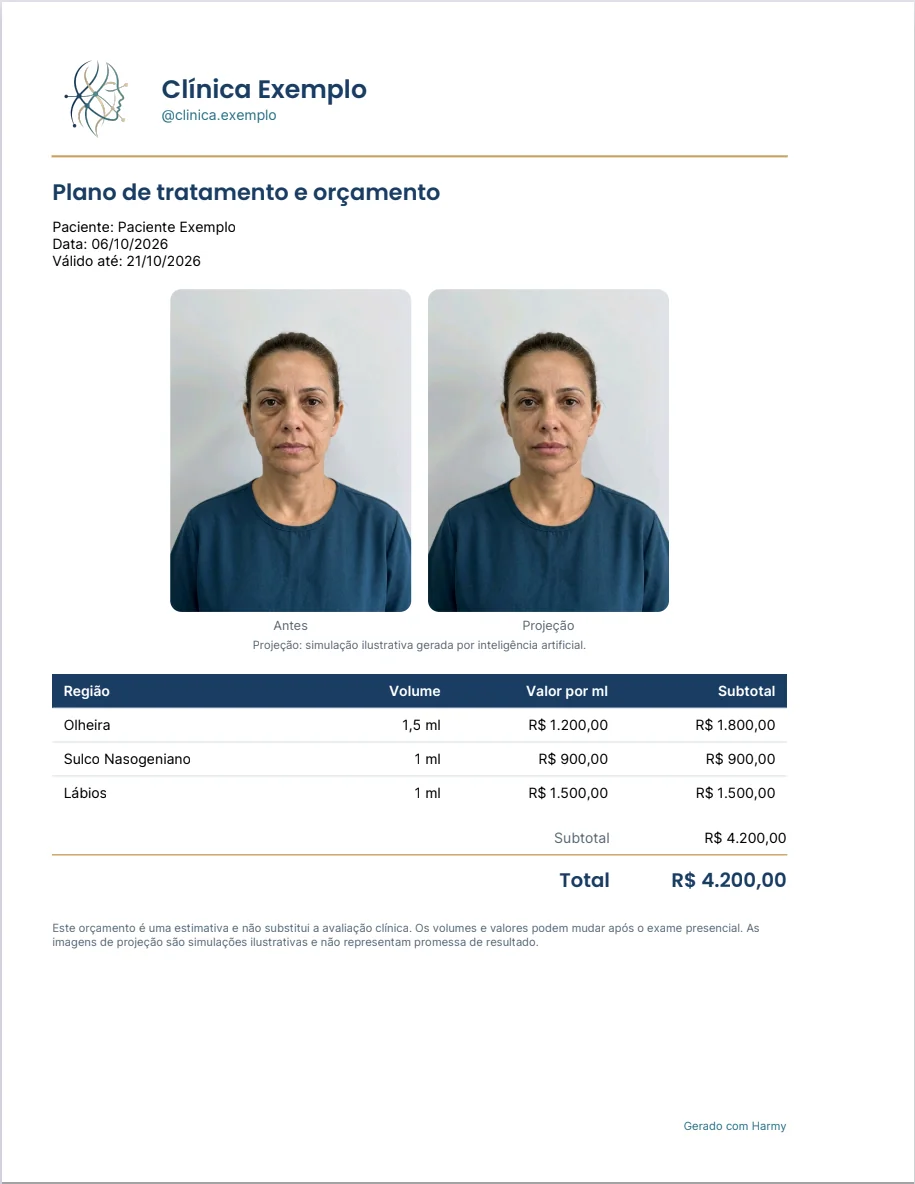
Many professionals charge per area, not per unit, precisely so the conversation does not turn into a counting exercise. In the quote, describe the areas and the goal, and leave the dose to clinical judgment. In Harmy, the PDF quote is issued per area, with a validity date and notes, and the price per ml (or per area) can be saved in My clinic. For toxin, the app's ml is a symbolic unit for the glabella: the real amount of toxin is set by you.
Review and adjustment
The follow-up, at about two weeks, is the time to assess whether the dose was proportionate. Standardized photos at rest and in expression help. If needed, the adjustment is made at the professional's discretion. Record the product, lot, areas and approach in the patient record, without turning it into a number to compare with another case. The topic "botox did not work" is covered in botox had no effect.
In summary
There is no "normal" number of units per area. There is the right dose for that patient, set at assessment and checked at follow-up. Explaining this clearly is a sign of professionalism.
Frequently asked questions
How many units of botox are normal?
There is no single number. The dose varies with the area, the strength of the muscle, the goal and the patient, and is set by the licensed professional after assessment.
Do more units give a better result?
Not necessarily. A higher dose can increase the effect and duration in some cases, but also the risk of stiffness, asymmetry and other unwanted effects.
Why is the quote per area and not per unit?
Because the amount needed varies between patients. Many professionals charge per area to avoid the idea that fewer units is better or worse.
How do I know the right amount was injected?
The assessment at follow-up, with photos and expression tests, shows whether the effect is proportionate. Asking the professional how the dose was planned is the patient's right.
Harmy images are illustrative simulations generated by AI from the patient's photo to support the conversation between practitioner and patient. They are not a promise of results. Indication, technique, product and volume are solely the decision of the licensed practitioner. This content is for information only and does not replace a clinical assessment.