
When to postpone facial harmonization: reasons to reschedule

Quick facts
- Question
- In which situations it is better to reschedule the procedure
- Principle
- An elective procedure can wait; safety cannot
- Postponing is not refusing
- The approach is to reschedule for a suitable moment
- Who decides
- The licensed professional, after medical history and examination
Every professional has been there: the patient arrived, the schedule is full, the syringe is ready, and something in the consultation says "not today". Postponing is one of the most valuable and least appreciated decisions in the office. It protects the patient, protects you and, contrary to what it seems, usually improves the relationship. This page gathers the situations where postponing makes sense and how to handle it without losing the patient.
The criteria are general guidance, and the final decision belongs to the licensed professional, after medical history and examination, according to the rules of their professional council (in Brazil).
Principle: elective can wait
Facial harmonization is an elective procedure. There is no clinical urgency that justifies injecting with an avoidable risk factor. Pressure from the schedule, an event or the patient's wishes should not replace judgment. When in doubt, postpone.
Situations that usually justify postponing
| Situation | Why postpone |
|---|---|
| Infection or active lesion in the area (inflamed acne, herpes, wound) | Risk of contamination and of worsening the condition |
| Fever, a bad flu or general malaise | Inflammatory response and risk of complication |
| Pregnancy or suspected pregnancy | Lack of safety data for most products |
| Breastfeeding | Approach varies; decide case by case |
| Medication that affects clotting, without guidance | Higher risk of bruising |
| Recent procedure in the area (laser, peel) | Inflamed skin, settling still under way |
| Upcoming event | Swelling and bruising may coincide with the occasion |
| Unrealistic expectations or pressure from others | The result is unlikely to satisfy |
| Anxious, undecided patient or one under strong emotion | Rushed decision |
| Skin with dermatitis, active psoriasis or irritation | Intact skin is a prerequisite |
Some of these situations have their own pages: active acne, psoriasis on the face, breastfeeding and botox and patients on blood thinners.
When the problem is the patient's moment
Some postponements come not from an illness but from context. The patient who has just ended a relationship and wants to "change everything", the one who wants to look like someone else, the one who arrives in a hurry before a party. In these cases, the decision is harder and more important. See patient who wants to change after a breakup and saying no to the patient who demands it today.
Upcoming event: how far in advance?
Many patients book the procedure the week of the wedding, graduation or trip. The risk is swelling and bruising, which can last from days to more than a week. In general, it is advised to schedule far enough ahead for recovery and for a possible touch-up. The pages botox before a wedding and biostimulator before an event go into the reasoning.
How to reschedule without losing the patient
A well-communicated postponement strengthens trust. Explain the reason clearly, without alarm, and offer a date right away. Record it in the patient record and confirm in writing. If the reason is health-related, suggest contacting the appropriate physician. If it is about expectations, schedule a conversation first.
Harmy's role in postponing
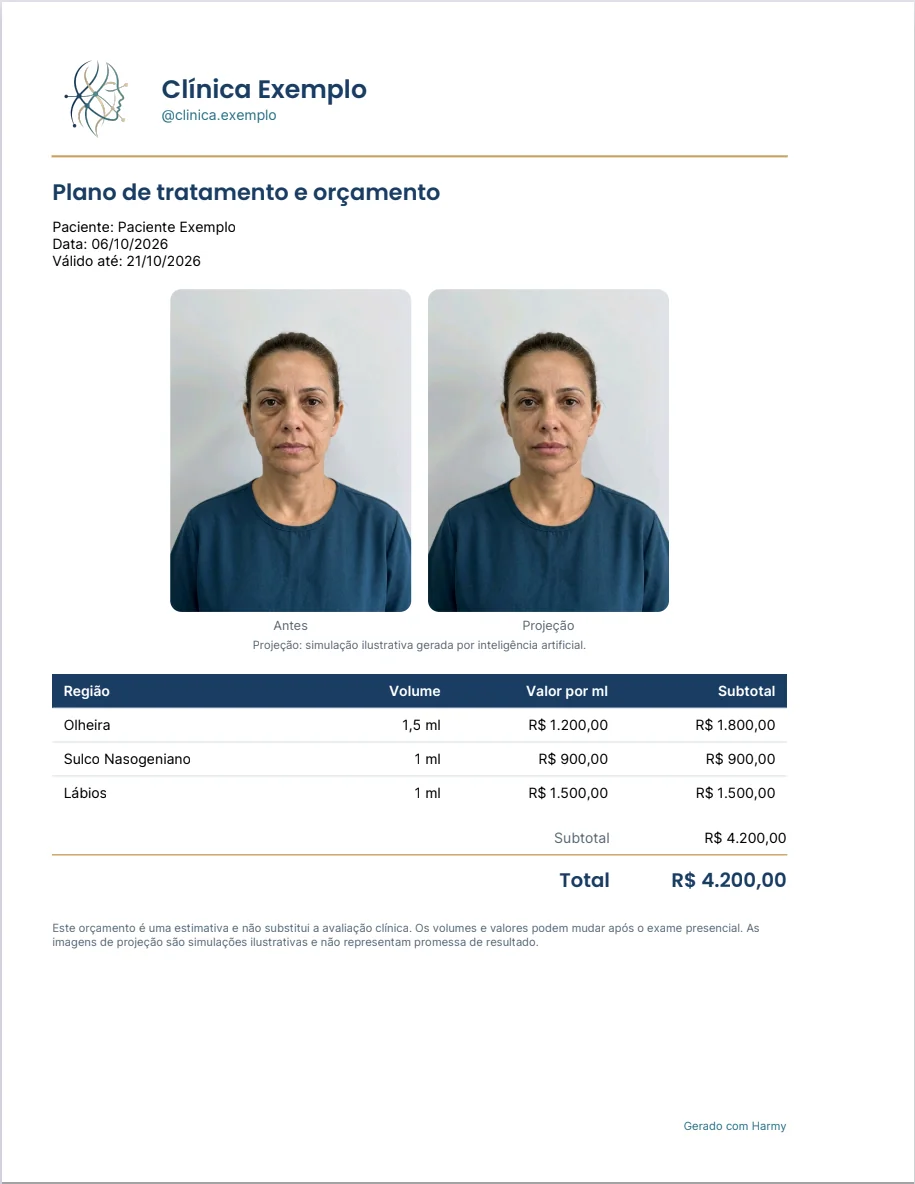
Postponing does not have to mean a lost consultation. You can use the time to take the frontal photo, mark the areas and generate the illustrative simulation, which the patient takes home to think about. That way the consultation has value even without an injection, and the PDF quote is ready for the return visit, with a validity date.
Recording and consent
Note the reason for postponing, the guidance given and the new date. If the patient insists on going ahead anyway, record the conversation and hold your position when there is risk. As a last resort, you can refuse, and the ethics are covered in when the professional refuses to perform harmonization.
Postponing is, almost always, the cheapest and safest path. A good result is worth more than a squeezed-in session.
Frequently asked questions
When should I postpone filler or toxin?
In general, when there is infection or an active lesion in the area, fever, pregnancy or breastfeeding (depending on the procedure), use of medication that affects clotting without guidance, and when the patient's expectations are misaligned.
Can I do harmonization with the flu or a cold?
Fever or general malaise usually justifies postponing. A mild cold is the professional's call.
Is doing harmonization close to an event a problem?
It can be, because swelling and bruising may appear. It is usually advised to do it far enough in advance to allow recovery.
Can the patient ask to postpone?
Yes. Doubt, fear or a change of mind are valid reasons, and an informed decision should prevail over any schedule.
Harmy images are illustrative simulations generated by AI from the patient's photo to support the conversation between practitioner and patient. They are not a promise of results. Indication, technique, product and volume are solely the decision of the licensed practitioner. This content is for information only and does not replace a clinical assessment.