
Forehead Lines (Frontal Wrinkles): Anatomy and Treatment
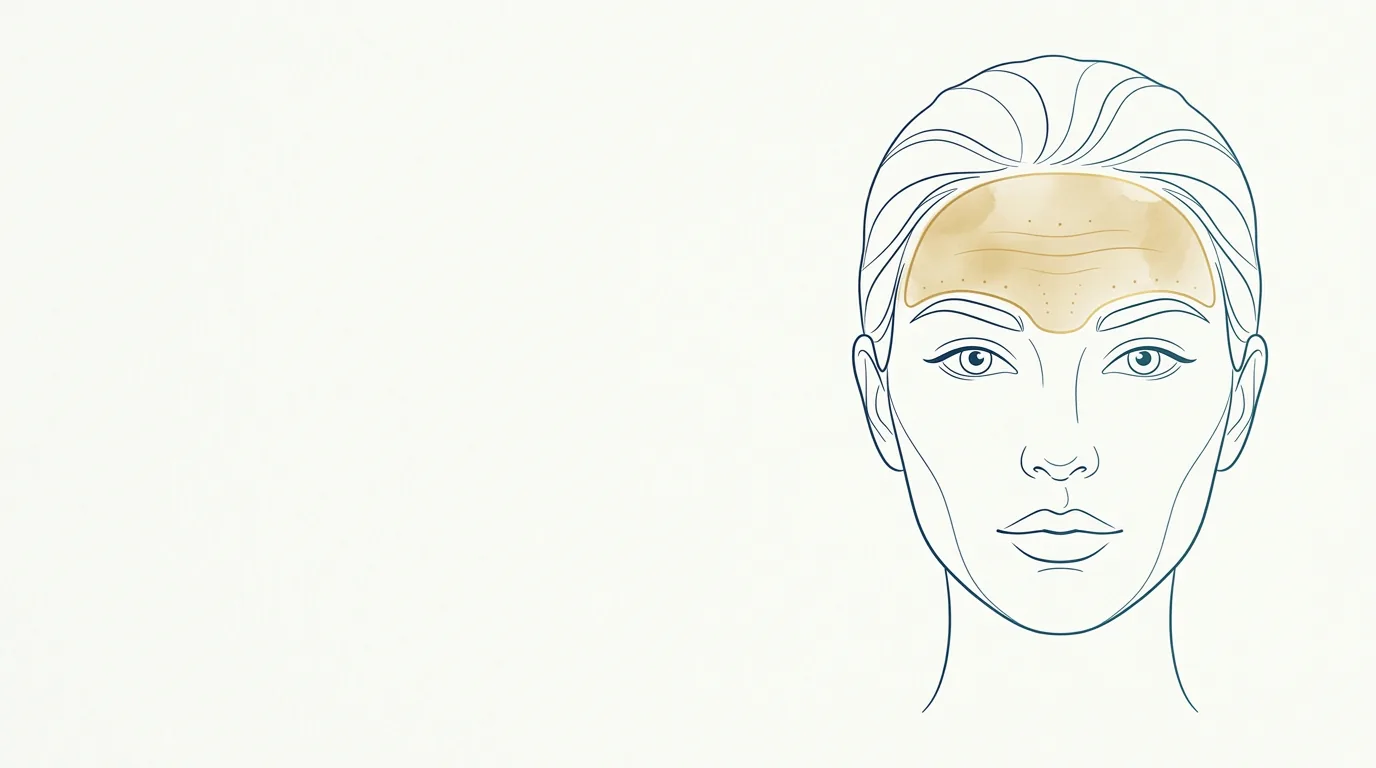
Forehead lines (frontal wrinkles) are the horizontal lines that cross the forehead and become more obvious when the patient raises their eyebrows. They are in the upper third of the face and, together with the glabella, make up the most common pair of concerns in the orofacial harmonization clinic. Treatment is usually done with botulinum toxin, with special attention to brow balance.
What are the anatomical boundaries of the forehead?
The frontal region runs from the upper edge of the eyebrows to the hairline, and laterally to the temporal lines, where the temporal fossa begins. Underneath is the frontal bone, covered by skin, subcutaneous tissue, the frontalis muscle, and the galea aponeurotica.
The frontalis muscle (frontal belly of the occipitofrontalis) is responsible for the horizontal lines. It does not attach to bone: its fibers blend with the skin and the brow muscles. That is why, when it contracts, it lifts the eyebrows and wrinkles the skin above them. In many patients there is a central strip with fewer fibers, which explains different line patterns from one person to another.
Vessels and nerves to watch
- Supraorbital and supratrochlear arteries, which rise from the upper orbital rim and communicate with the orbital circulation.
- Frontal branch of the superficial temporal artery, in the lateral portion of the forehead.
- Supraorbital and supratrochlear nerves (sensation) and the temporal branch of the facial nerve (motor), which supplies the frontalis from the side.
With toxin, the vascular risk is low. With filler, the forehead requires the same care as the glabella, because the vessels of the area communicate with the ophthalmic artery.
What do patients usually ask for?
Concerns tend to come in like this:
- "My whole forehead is covered in lines."
- "When I talk, my whole forehead wrinkles."
- "I want to get rid of the wrinkles, but I don't want to look expressionless."
- "One eyebrow goes up more than the other."
During the assessment, observe the forehead at rest and at maximum contraction, the height and shape of the eyebrows, the upper eyelid, and whether the patient uses the frontalis to compensate for eyelid heaviness. People who keep their brows raised to open their eyes may end up with a heavy-eye feeling if the frontalis is blocked too much.
Also distinguish dynamic wrinkles, which respond well to toxin, from static wrinkles, which generally improve only partially and may call for complementary approaches.
Which procedures can be done on the forehead?
The main treatment is botulinum toxin in the frontalis muscle. In most cases it is planned together with glabella toxin, because treating only the elevator or only the depressors changes the brow position.
For marked static lines, some professionals add skin techniques or superficial filler with low-density hyaluronic acid. These combinations depend on individual assessment and the professional's experience, and are not the first step for most patients.
What are the usual doses for the forehead?
The dose is expressed in toxin units, which are not interchangeable between products. The table below describes the reasoning, always at the discretion of the licensed professional, after assessment.
| Factor | Dose tendency | Note |
|---|---|---|
| Thin frontalis, low brow | More conservative dose | Higher risk of brow ptosis |
| Strong frontalis, high forehead | Intermediate to higher dose in the label | Assess the distribution of the lines |
| Patient who uses the frontalis to open the eyes | Conservative dose and reassessment | A heavy-eyelid feeling may appear |
| Durability | Generally 3 to 6 months | Varies with product, dose, and patient |
In the first session, many professionals prefer a conservative approach with a follow-up to assess and adjust, instead of aiming for the maximum effect at once.
Care, contraindications, and complications
The general contraindications for toxin apply: neuromuscular diseases, medications that interfere with the neuromuscular junction, pregnancy and breastfeeding, active infection at the site, and allergy to the components.
Reported complications in the forehead:
- Brow ptosis, the most feared, linked to a high dose or a distribution that is too low.
- Exaggerated lateral brow lift, when the lateral portion of the frontalis is more active than the central one.
- Facial asymmetry of the eyebrows.
- Swelling, bruising, and temporary headache.
If hyaluronic acid is used in the forehead, the area should be treated as one of relevant vascular risk. Have hyaluronidase available and a protocol for managing vascular occlusion. See the overview of safety and complications.
How to assess the forehead before treating?
A quick, organized assessment avoids a good part of the complications in this area. Some steps many professionals follow:
- Forehead at rest: are there visible lines without contraction? They indicate a static component.
- Maximum contraction: ask the patient to raise their eyebrows and observe where the lines concentrate and how far the muscle extends.
- Brow position: a low or already drooping brow increases the risk of ptosis with toxin.
- Upper eyelid: excess skin may be being compensated by the frontalis.
- Prior asymmetries: record them in a standardized photo before any injection.
This record also protects you. An eyebrow asymmetry that already existed can be blamed on the procedure if it is not documented. See the guidance on standardized clinical photography.
How do forehead lines appear in Harmy?
Today the forehead has no point of its own in Harmy's marking step. The available points are Glabella, Temple, Tear Trough, Cheekbone, Nasolabial Fold, Mouth Corner, Lips, Chin, and Jawline. This means you can and should plan the forehead in the consultation, but the projection generated by the app does not yet show changes in that area.
In practice, when the plan includes both forehead and glabella, you can mark the glabella in the app to illustrate the softening between the eyebrows and explain verbally to the patient what to expect on the forehead. Because Harmy changes only what was marked, the forehead will look the same as in the original photo in the projection. Make this clear in the conversation.
How to talk to the patient about the forehead
The most common fear is ending up with a "still" forehead. It is worth explaining that the goal is to soften the lines while keeping some movement, and that the first session is usually conservative. When you show an illustrative simulation of another area in the plan, remind the patient that the forehead is not represented in it.
To organize the whole consultation, from diagnosis to proposal, see the first consultation script.
Frequently asked questions
What causes forehead lines?
They form from repeated contraction of the frontalis muscle, which raises the eyebrows. Over time, loss of skin elasticity makes some lines visible at rest as well.
Can botulinum toxin in the forehead make the eyebrow droop?
It can. The frontalis is the only brow elevator, and reducing its strength too much can cause ptosis, especially in people who already have a low brow or excess skin on the eyelid.
Why treat the forehead together with the glabella?
Because the frontalis and the glabellar depressors work in opposition. Treating only one side of that balance can change the shape of the brow in a way the patient did not expect.
Does Harmy simulate forehead line treatment?
Not yet. The forehead has no point of its own in the app's marking step today. You can plan the area in the consultation, but Harmy's projection covers only the available points, such as the Glabella.
Harmy images are illustrative simulations generated by AI from the patient's photo to support the conversation between practitioner and patient. They are not a promise of results. Indication, technique, product and volume are solely the decision of the licensed practitioner. This content is for information only and does not replace a clinical assessment.