
How to explain to patients what harmonization does not solve

Quick facts
- Core message
- Stating the limits early protects the relationship and the expectation
- Timing
- At the assessment, before closing the plan
- Resource
- List of limits and informed consent
- Common mistake
- Promising, or implying, that it solves everything
Most frustrations in harmonization arise from an expectation the professional did not correct in time. The patient imagined that the procedure would solve something it does not, and the professional never said no. Stating the limits beforehand is a form of care: the patient decides better, you deliver what you promised and the follow-up stops being an argument. This page lists the most frequent limits and suggests how to talk about each one.
Why say what it does not solve before saying what it does?
Because the order changes how people listen. Someone who first hears "I am going to treat your dark circles" holds on to the promise; someone who first hears "dark circles have several causes and harmonization solves some of them" holds on to the nuance. Limits work as the frame of the plan, not as an apology.
What are the most common limits?
The table below works as a script. Choose the rows that make sense for the patient in front of you.
| What the patient may expect | What harmonization does not solve |
|---|---|
| A symmetrical face | No face is symmetrical; injectables do not change bone. See natural asymmetry |
| A surgical effect | Excess skin and significant laxity may call for surgery |
| Stopping aging | The process continues; the plan may soften some signs |
| Perfect skin | Texture, spots and photoaging call for other approaches |
| Changing appearance | The aim is to preserve identity |
| Fixing self-esteem | A procedure does not replace emotional support when needed |
| Immediate, permanent results | Effects are gradual or temporary, depending on the product |
Each limit can become a short phrase in the consultation. The more specific, the better: instead of "it is not a miracle," prefer "your neck laxity may call for an approach that is not injectable."
How do you talk about each limit with sensitivity?
Three precautions:
- Talk about what you see, not what is missing. "There is a little excess skin here," not "there is nothing to be done."
- Offer what exists. Every limit comes with an alternative: adjust the plan, combine techniques, refer.
- Ask for confirmation. "Does this make sense to you?" opens space for the doubt they did not voice.
How do you separate concerns that harmonization can treat?
To avoid all-or-nothing thinking, divide concerns into three groups:
- It may help: localized volume loss, contour, proportion, folds, expression lines.
- It may partly help: mild laxity, skin quality, dark circles, which have multiple causes.
- It is not the path: excess skin, relevant bony changes, marked ptosis, fat that calls for another technique.
When the case falls in the third group, the honest approach is to refer. See how to tell a patient they do not need a procedure and how to say no to the patient in facial harmonization.
How does Harmy help show the limits?
The Harmy simulation shows a subtle, realistic change in the marked areas and keeps the rest of the face the same. This helps the patient see that harmonization does not change everything: the After image is still their own face, with adjustments in a few places. It is a concrete way to illustrate the limit.
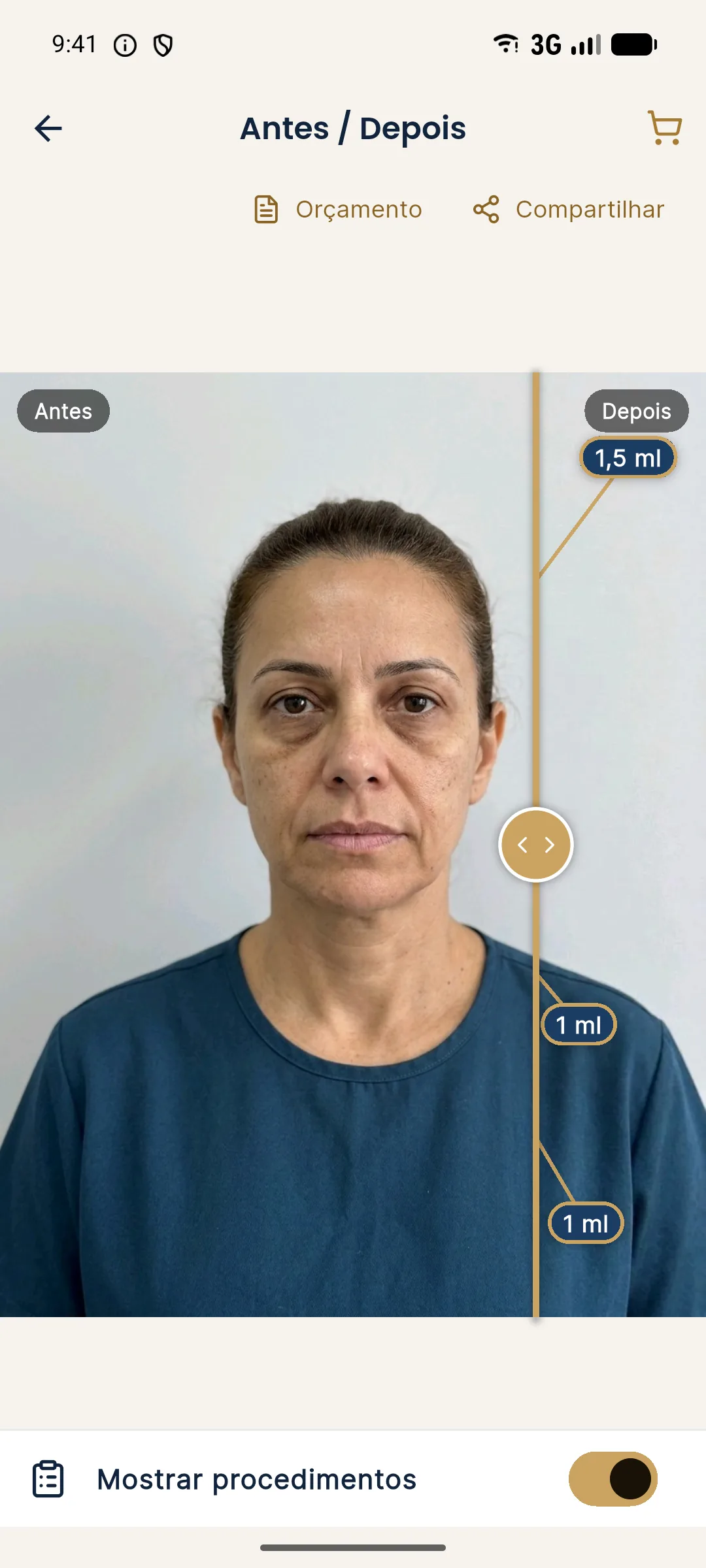
See the notice that accompanies the simulation in illustrative simulation notice for the patient and the difference in simulation vs actual result.
How do you organize the conversation about limits?
In a short sequence, so it does not turn into a lecture:
Which questions should you expect?
What should you record?
In the patient record, note the limits that were explained, the patient's reaction and the alternatives offered. In the informed consent, include the mention that there is no guarantee of results and that the effects are temporary. Keep the standardized baseline photos. For reading the consent form, see how to explain the informed consent.
Limits stated early are what later sustain the trust that the rest of what you said was true as well.
Frequently asked questions
What does facial harmonization not solve?
It does not solve perfect symmetry, significant laxity, excess skin or relevant bony changes, and it does not change the identity of the face. It also does not stop aging and does not solve self-esteem issues on its own.
When should I talk about the limits of harmonization?
At the assessment, before closing the plan. Talking only after the procedure takes away the patient's chance to decide with information.
Does talking about limits drive the patient away?
In general it builds trust. A patient who hears the limits clearly tends to have more realistic expectations and to come back without frustration.
Do I need to record that I explained the limits?
Yes. Note in the patient record and in the informed consent that the limits were explained, and keep the standardized baseline photos.
Harmy images are illustrative simulations generated by AI from the patient's photo to support the conversation between practitioner and patient. They are not a promise of results. Indication, technique, product and volume are solely the decision of the licensed practitioner. This content is for information only and does not replace a clinical assessment.