
Explaining the difference between simulation and actual result

A patient who sees the simulation tends to keep the image as if it were an agreement. When the actual result shows up, with swelling, temporary asymmetry and a settling time nobody explained properly, the frustration comes from the gap between what was shown and what they understood. Explaining the difference in the consultation, before treating, is the cheapest way to avoid that discomfort.
This page gives you simple language to separate the two things, the biological factors that make results vary and a way to document the conversation. The idea is not to devalue the simulation, which is a great conversation tool, but to put it in its place.
What is each of the two things, really?
The illustrative simulation is a computer-generated image built from a frontal photo and the marked areas. It shows a plausible direction. The actual result is what happens in that person's face, with that product and that technique, after days or weeks of tissue adaptation.
| Aspect | Simulation | Actual result |
|---|---|---|
| Nature | Illustrative image | Clinical effect on tissue |
| Depends on | Photo, areas and ml entered | Anatomy, product, technique and healing |
| When it appears | Instantly, in the consultation | Over days to weeks |
| Can be adjusted | Yes, as many times as you like | Only with a new session, at the professional's discretion |
| Useful for | Aligning direction and proportion | Assessing what was actually achieved |
Which biological factors make the result vary?
Almost everything that determines the outcome is beyond the reach of an image. It is worth having a short list ready, in plain language.
- Skin thickness and quality. Thin skin shows more of the product and the shadow of an area; thick skin hides it.
- Fat layers and compartments. Volume is distributed according to the layers of the face and the position of the fat pads.
- Ligaments and muscles. People with very active expressions may see the product behave differently in the area.
- Skeleton. A jaw or cheekbone with less bone support responds differently to the same volume.
- Metabolism and hydration. How fast the body absorbs the product varies from person to person.
- Individual inflammatory reaction. The initial swelling can hide the effect for days.
- Pre-existing asymmetry. A face that was already asymmetrical stays that way, even if the simulation shows it as more harmonious.
Why doesn't the first day count?
On the day of the procedure, the patient looks in the mirror with swelling, redness and sometimes bruising. The volume seen then is not the final one: part of it is fluid and part is the tissue's reaction. That is why comparing with the simulation only makes sense once the acute phase has passed, at the agreed follow-up, and usually at a different time than the patient imagines. To organize that timeline, see aligning expectations about timing and explaining expected swelling.
How do I present the simulation without creating a promise?
Three habits help. First, say the framing sentence before showing the image: "this is an illustration". Second, show the image together with a conversation about what can vary, and not as a closing note. Third, keep the image on screen briefly and go back to the patient's face: the clinical focus is the face, not the screen.
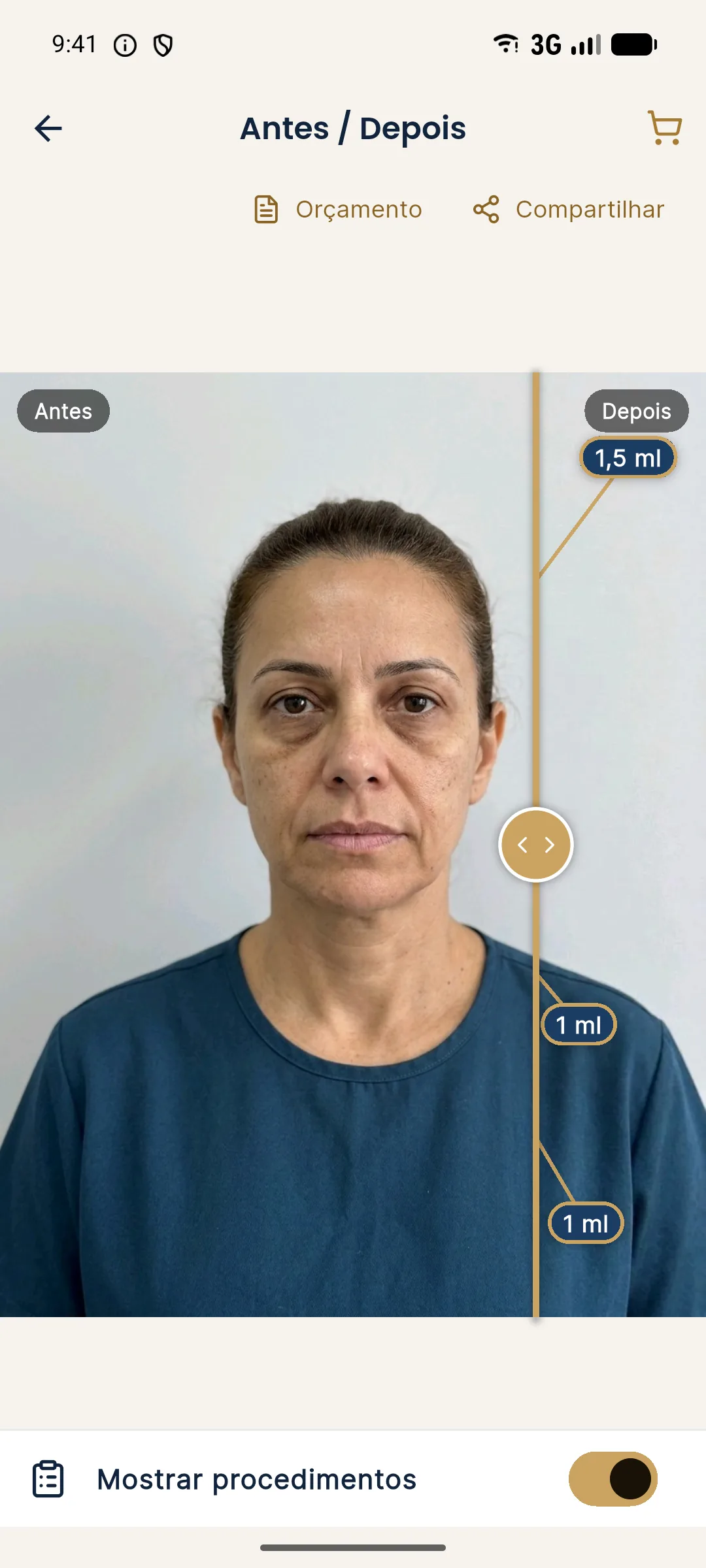
If the patient asks for a stronger version, show that changing ml and intensity is a conversation, not a promise that the body will comply. For this moment, see patient asks for more in the simulation and a simulation is not a guarantee.
What if the patient wants a result identical to the image?
It happens. The honest answer is that the simulation shows a direction, and that the goal of the plan is to bring the face closer to that direction safely, in stages, at the professional's discretion. If the expectation is literal, a longer conversation before treating is worthwhile. The path is in patient wants a result identical to the simulation.
How do I document that the difference was explained?
Record in the patient record that the patient was told the image is illustrative and that the result depends on individual factors. If your practice uses an informed consent form, include a line about this. The record does not replace the conversation, but it shows the conversation took place.
After the procedure, Harmy's actual result feature helps you compare honestly: the "after" photo is aligned by the eyes, and you compare Projection, Actual result and Projection vs Actual. This comparison shows the patient, calmly, how close the outcome came to the agreed direction, or how far it drifted. See comparing the simulation with the after photo and follow-up to compare with the simulation.
In short, the simulation helps the conversation and the actual result teaches how to assess. The clearer the line between the two, the less deceived the patient feels when their face responds in its own way.
Frequently asked questions
What is the difference between simulation and actual result in harmonization?
The simulation is an illustrative image generated from a photo, based on what was marked. The actual result depends on anatomy, product, technique, healing and time, and may differ from what the image showed.
Does the simulation show exactly how I will look?
No. It is meant to discuss direction and proportion, not to promise an outcome. The final result is assessed only after the swelling is gone and the product has settled.
Why can the actual result differ from the simulation?
Because skin, fat, muscle, bone and ligaments respond individually, and the body reacts to the product in its own way. The image does not reproduce those variables.
When can the result be compared with the simulation?
Generally after the initial swelling has passed and the follow-up has taken place, at the professional's discretion. Comparing on the day of the procedure tends to mislead, because swelling masks the result.
Harmy images are illustrative simulations generated by AI from the patient's photo to support the conversation between practitioner and patient. They are not a promise of results. Indication, technique, product and volume are solely the decision of the licensed practitioner. This content is for information only and does not replace a clinical assessment.