
Comparing the Simulation With the Post-Procedure Photo

Quick facts
- Principle
- The simulation was illustrative; the actual result is a different portrait
- Before showing
- Wait for the settling period and photograph to the same standard
- Honesty
- Name the differences and explain why they may exist
- In the app
- Compare Projection, Actual result and Projection vs Actual
Comparing the simulation with the post-procedure photo is one of the most delicate moments in the relationship with the patient. If the result is close, it is a celebration. If it is different, it is a test of honesty. Either way, how you present the two images determines whether the patient feels trust or frustration.
This guide shows how to lead the conversation, especially when the actual result does not match the image shown earlier.
Why compare?
There are good reasons to make this comparison:
- Close the loop. The patient sees what has changed since the start.
- Assess the plan. You check what worked and what can be adjusted.
- Adjust expectations. If there were unrealistic ideas, the comparison helps reset them.
- Document. The history is on record.
But the comparison also carries risks. The main one is that the patient reads the simulation as a promise and treats any difference as a failure.
What is the simulation, and what is it not?
It is worth repeating before showing anything: the simulation image is an illustration generated from a frontal photo, with the volume and intensity entered. It represents a hypothesis, not a result. The concept is explained in illustrative simulation and the difference from the actual result in difference between simulation and actual result.
When should the comparison happen?
Timing matters. Photographing too early shows swelling, not the result:
The settling period varies with the procedure and the patient, and should be set at the professional's discretion. See swelling (edema) to understand why the contour changes in the first few days.
How do I make sure the comparison is fair?
The comparison is only honest if the conditions are similar.
Without that care, the difference may come from the photo, not the face. The method is in standardized clinical photography.
How do I present the images?
The order affects the interpretation. An honest sequence:
- Show the starting photo, recalling the initial point.
- Show the post photo, without comment.
- Ask what the patient notices.
- Only then, if useful, show the simulation as a reference for what was discussed.
- Talk about the differences and similarities.
What if the result turned out different from the simulation?
It happens, and the worst reaction is to deny or get defensive. A candid approach:
- Acknowledge. "You're right, it's different from the image I showed you."
- Recall without making excuses. "The simulation was illustrative. A real face responds in its own way."
- Explain the factors. Anatomy, tissue response, settling time, asymmetries.
- Propose an assessment. "Let's look at what can be adjusted, if you're interested."
- Record. What was discussed and decided.
For situations where the result fell short of expectations, the full script is in communicating a result below expectations. And if the patient wants a result identical to the image, see the patient wants a result identical to the simulation.
How does Harmy help with this comparison?
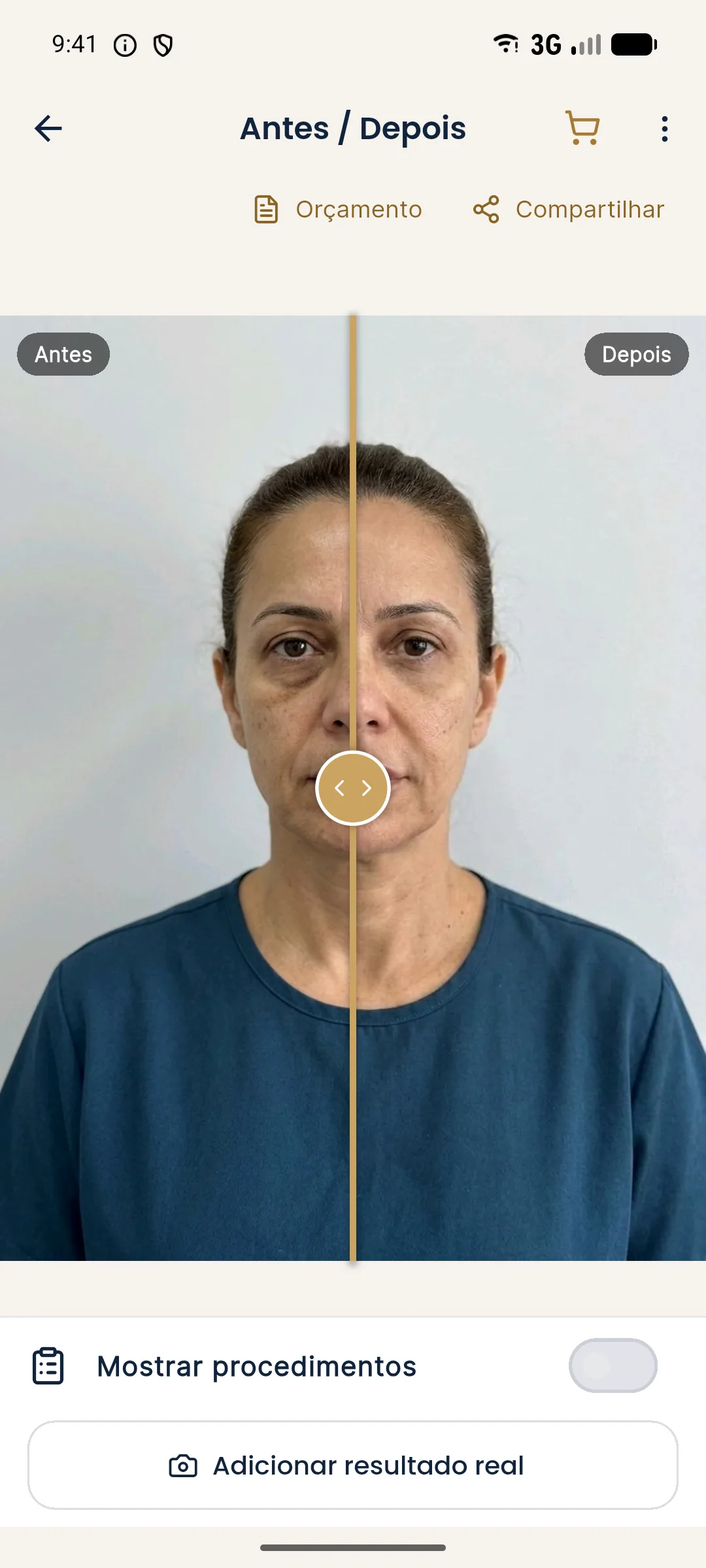
When you talk with the patient, explain that this screen compares two different things: an illustration and a photo. The second is the one that reflects what happened.
What about marketing use?
Showing the comparison to the patient is one thing. Using it on social media is another, and it depends on specific consent and on the rules of your professional council and CONAR. The simulation must never be advertised as if it were a result. See what you may advertise.
What if the result turned out better than the simulation?
That can happen too. Resist the urge to take the credit; explain that results vary, up or down, and that the simulation is only a reference. That keeps expectations healthy for the next procedures.
An honest comparison strengthens the bond: the patient understands that the image was an illustration, that you treated it as one and that the conversation is transparent.
Frequently asked questions
Should I show the patient the comparison between the simulation and the post-procedure photo?
It can be useful, as long as there is consent, the settling period has passed and you explain that the simulation was illustrative, not a fixed target.
What should I say when the result turned out different from the simulation?
Acknowledge the difference, recall that the simulation was illustrative, explain individual factors and propose a joint assessment of adjustments, if appropriate.
When should I take the post-procedure photo for comparison?
After the initial swelling and the settling period, which varies by procedure. Photograph with the same light, distance and position as the starting photo.
Can the comparison be used in marketing?
Only with the patient's specific consent and in line with the rules of your professional council and CONAR (Brazil's advertising self-regulation body). The simulation must not be advertised as a result.
Harmy images are illustrative simulations generated by AI from the patient's photo to support the conversation between practitioner and patient. They are not a promise of results. Indication, technique, product and volume are solely the decision of the licensed practitioner. This content is for information only and does not replace a clinical assessment.