
How to explain to the patient that every face is asymmetric

- Nerve
- Highlighted area
Quick facts
- Goal
- Help the patient see natural asymmetry before the plan
- Best resource
- Standardized front photo with a reference line
- Timing
- At the assessment, before proposing any volume
- Record
- Objective description and photo in the patient record
Almost every patient believes there is a "right" face and that theirs departs from it. What they usually see in the mirror is their own reversed face, so they have never seen the image others see. When you explain that facial asymmetry is the rule, not the exception, you take a weight off the conversation and make room for an honest plan. This page brings together an explanation script, the use of the front photo and what to record.
Why explain natural asymmetry before the plan?
There are three practical reasons to address the topic at the assessment:
- Informed decision. If one side has less volume, the plan may treat the sides differently, and the patient needs to understand why.
- Correct attribution. A difference that already existed, if it was not shown, tends to be read as a flaw of the procedure at the follow-up.
- Realistic expectation. No injectable makes the face symmetrical. Anyone expecting perfect symmetry leaves frustrated with any result.
For the version on how to bring up the subject without offending, see how to point out an asymmetry without offending. Here the focus is the explanation: how to get the patient to understand that asymmetry is natural.
How do you start the explanation?
Start with the general, then move to the particular. Patients accept "faces are like this" better than "yours is like this."
Then ask: "Is there a side you think looks different from the other?" The answer shows how much they already notice and keeps you from presenting a problem they have never seen.
How do you use the front photo to show it?
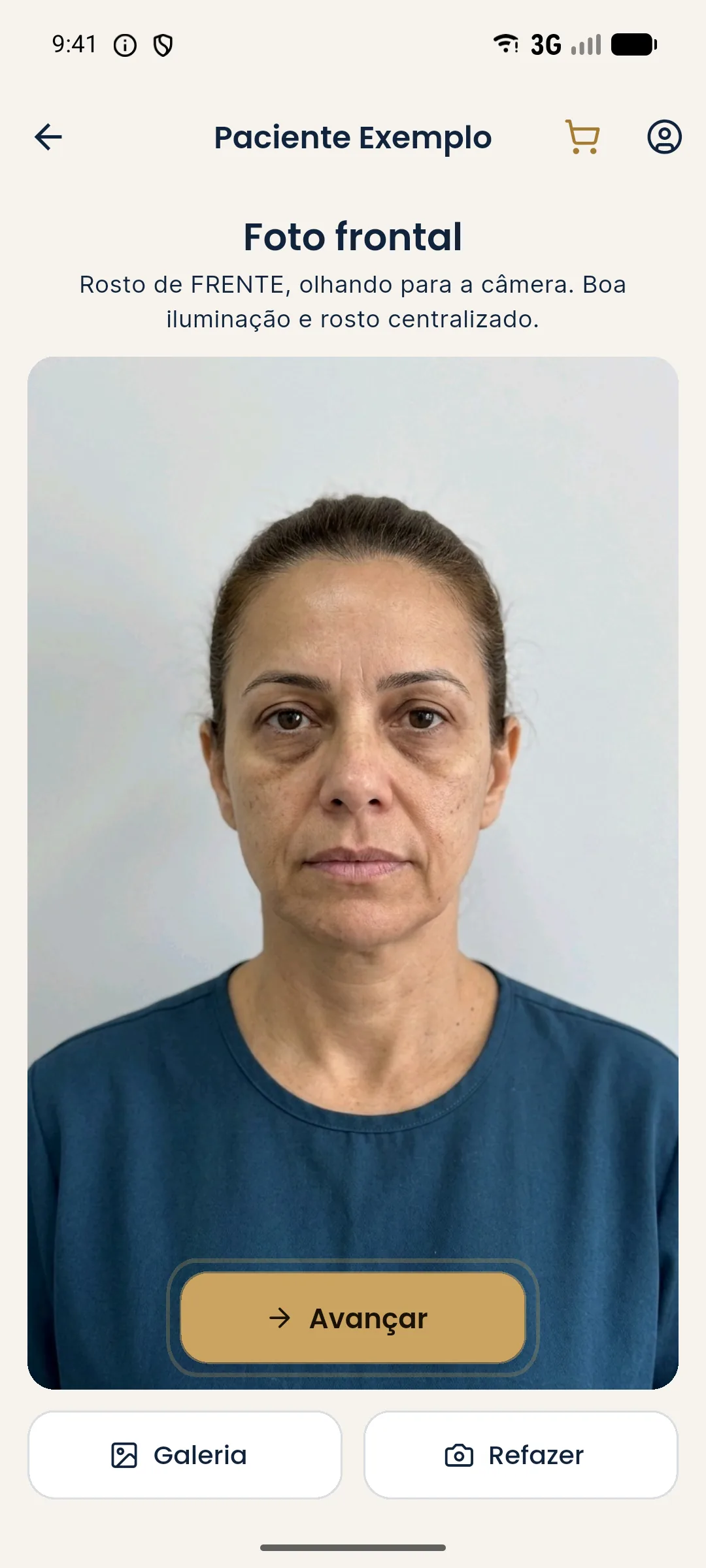
The photo is worth more than the mirror, because it fixes the expression and lets you both look together. Follow the standard for standardized clinical photography: diffuse light, head straight, neutral expression, hair away from the face.
A vertical reference line through the facial midline helps show what each side does. Point to facts, not adjectives: "here the eyebrow is a little lower," not "this side has dropped."
Which asymmetries are most common?
The list below works as an observation guide, always with a neutral expression and at the professional's discretion after assessment:
| Area | What tends to vary |
|---|---|
| Eyebrows | Height and arch |
| Eyes | Opening of the eye fissure and position of the corner |
| Cheekbone | Projection and volume on each side |
| Lips | Height of the corners and of the Cupid's bow |
| Chin | Deviation of the tip to one side |
| Jaw | Width and angle on each side |
When the difference is in the bone, filler can disguise it a little but not correct it. It is worth saying this clearly.
What does harmonization change and what does it not?
Be direct: treatment can improve the harmony between the sides in some areas, but it does not promise symmetry.
In some cases, treating the sides with different volumes is exactly what preserves balance. Explain this beforehand, so the patient does not think there was a mistake when they see the plan with different ml per side.
What about the asymmetry the patient doesn't notice?
Some people notice nothing and others fixate on a tiny detail. Both cases call for care:
- Those who don't notice: show it calmly, without insisting. Record that they were informed and move on.
- Those who exaggerate a detail: acknowledge the concern, show the real scale of the difference and avoid agreeing that "it looks bad." If the worry seems disproportionate, it is worth watching for other signs of an altered self-image.
How does the simulation help the conversation?
Harmy's projection shows the before and the simulation side by side, on a person the patient can compare with their own photo. Because the app changes only the marked areas and leaves the rest of the face as it is, it makes clear that the baseline asymmetry is still there. This helps anchor expectations: the simulation is illustrative and does not promise results. See also presenting the projection in the consultation.
How do you record the conversation?
In the patient record, write objectively: area, side and characteristic, with no value-laden adjectives. Include the standardized photo and a statement such as "patient informed about pre-existing asymmetry and aware that the procedure does not promise symmetry." The informed consent text can then reinforce the same point, and the topic connects with aligning expectations about asymmetry.
What if the asymmetry is recent or has a clinical cause?
An asymmetry that appeared suddenly, with difficulty moving one side of the face, a drooping eyelid or a change in speech, is not an aesthetic matter. In that case your role is to refer for medical assessment, not to treat. For other patient questions on the subject, there is the questions page on natural facial asymmetry.
Explaining natural asymmetry well costs no extra time: it is a short conversation that reduces return visits caused by frustration and gives meaning to the plan by side.
Frequently asked questions
Does every face have asymmetry?
Generally yes. Slight differences in eyebrow height, cheek volume, chin position or the corner of the mouth are common and part of anatomy. What varies is how much each person notices.
Does facial harmonization make the face symmetrical?
That is not a possible promise. Procedures modulate volume and movement and can improve harmony, but they do not change bone structure or muscle position.
How do you show asymmetry using the photo?
Use the standardized front photo, with a neutral expression, and draw a reference line down the middle of the face. Ask what the patient sees before pointing out what you see.
Do I need to record the asymmetry I explained?
Yes. Record the objective description, the photo and the statement that the patient was informed. This helps compare progress and clear up questions at the follow-up.
Harmy images are illustrative simulations generated by AI from the patient's photo to support the conversation between practitioner and patient. They are not a promise of results. Indication, technique, product and volume are solely the decision of the licensed practitioner. This content is for information only and does not replace a clinical assessment.