
How to point out an asymmetry to the patient without offending
Talking about asymmetry is one of the most delicate conversations in the consultation. The patient arrives wanting to hear that their face will improve, and you have to tell them one side differs from the other. Said carelessly, it becomes an insult; left out, it becomes a problem at follow-up, when the patient swears the "crooked" look is the procedure's fault. The way forward is to speak early, neutrally and with visual support.
Why talk about asymmetry before the procedure?
Mild facial asymmetry is the rule, not the exception. What varies is how much the patient notices it. Three reasons to bring it up:
- Safe decision-making. The plan may need to treat the sides differently, and the patient should know why.
- Correct attribution. Without a record, any difference after the procedure is read as a defect of the treatment.
- Expectations. A face does not become symmetrical with injectables. The topic is covered further in aligning expectations about asymmetry and explaining natural asymmetry to the patient.
What is the right moment?
After hearing the concern and taking the medical history, before proposing the plan. The patient already feels heard, and you have not sold anything yet. Avoid the mirror moment after the injection, with a swollen face, and avoid speaking with the syringe in your hand.
How to talk? Four steps
- Normalize. "Practically every face has one side that differs from the other."
- Ask before asserting. "Had you already noticed anything different between the sides?"
- Show without judging. Use the frontal photo and the mirror, point to the fact, not the adjective.
- Connect to the plan. "That is why I will assess each side separately."
What to say and what to avoid?
| Avoid | Prefer |
|---|---|
| "Your face is crooked." | "Both sides have small natural differences." |
| "This side is worse." | "This side has a little less volume in this area." |
| "We can fix that." | "We can improve harmony, without promising symmetry." |
| "Everyone has it, it's nothing." | Validate: "It's common, and I understand it bothers you." |
| "After the procedure it will be even." | "It may look more harmonious, but there will always be differences." |
How to use the mirror and the photo?
Show with the standardized photo (see standardized clinical photography) rather than the mirror: the photo freezes the expression and lets you share attention, while the mirror creates anxiety because the patient twists to see. If you use a mirror, ask for a neutral expression and point with a finger or pen, without touching the face.
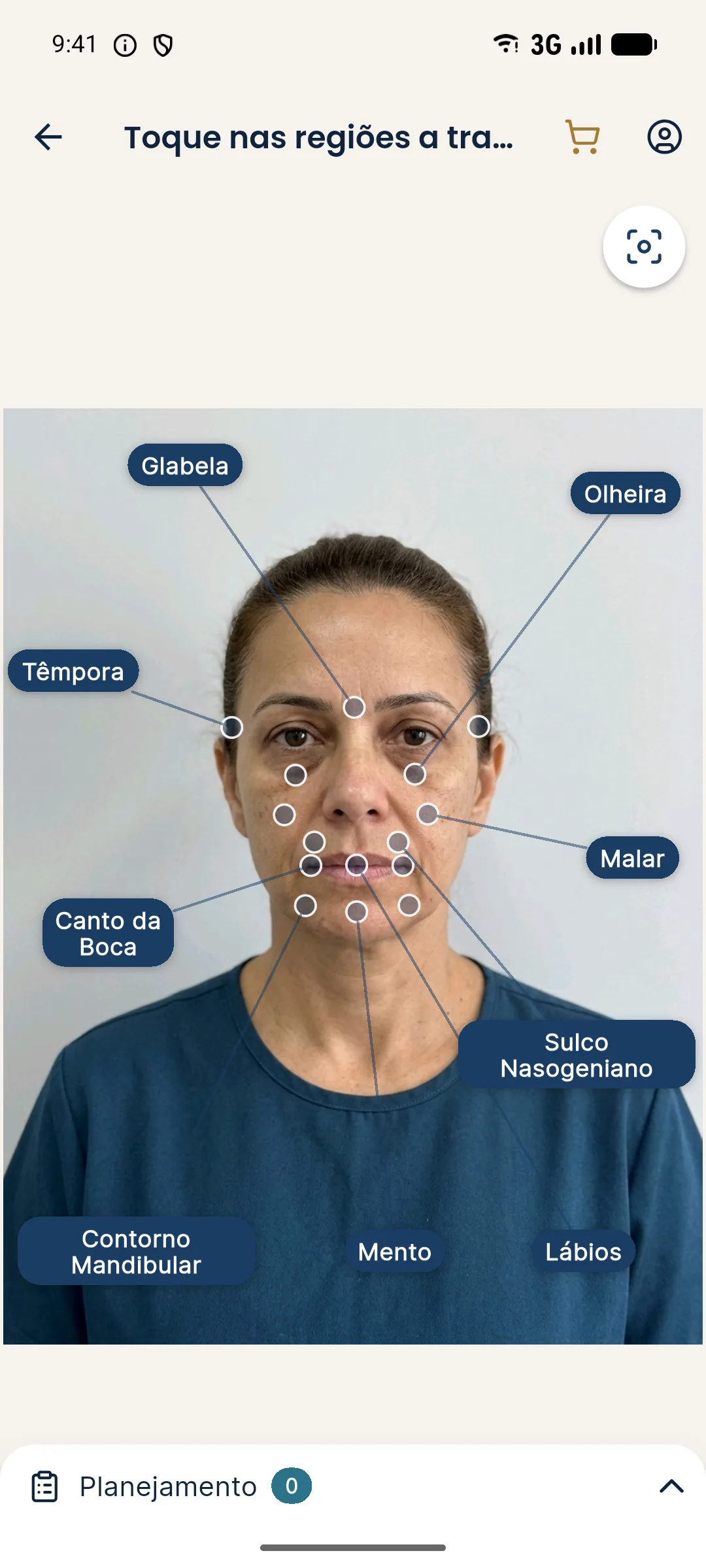
In Harmy, the frontal photo that is the basis of the projection is the same one that helps you talk about proportion. The simulation keeps the rest of the face as it is, which shows that it does not "correct" asymmetry; it only changes the marked areas.
What if the patient is upset?
Stop, validate and give them time. "I can see that was hard to hear, and I said it because I want to make an honest plan." Offer a pause, some water, and resume with what can be done. If the reaction is out of proportion to the difference, consider whether there is a bigger self-image issue (see body dysmorphic disorder in HOF). The broader approach is covered in nonviolent communication at the consultation.
What if the asymmetry appears after the procedure?
Then the conversation is different: clinical assessment, comparison with the starting photo and possible action. Having recorded the earlier state makes all the difference. See communicating post-procedure asymmetry and, for the dissatisfied patient, dissatisfied patient: how to handle.
How to record it?
In the patient record: an objective description (side, area, feature), a standard photo, and a sentence such as "patient informed about previous asymmetry, aware that the procedure does not promise symmetry". No adjectives, no judgment. This protects the patient from being labeled and you from being accused.
And when the patient denies there is asymmetry?
It happens. You point it out, they do not see it or do not accept it. Do not argue. Record that they were informed and move on: "That's fine, I want to note it so we can follow it together." Another path is to show the same photo with a reference line down the middle of the face, always asking "what do you see here?". When patients reach the conclusion on their own, acceptance is usually better than when they hear the verdict from you.
Is there asymmetry that deserves clinical attention?
Yes. A recent-onset asymmetry, with a drooping part of the face, difficulty moving one side or a change in speech, is not an aesthetic matter: it calls for medical assessment. This is one of the cases where your role is to refer, not to treat. For lip asymmetries, see asymmetrical lips: assessment.
Frequently asked questions
Should I point out facial asymmetry even if the patient hasn't complained?
Generally yes, gently, because natural asymmetry influences the plan and expectations. Pointing it out before the procedure prevents the patient from blaming the treatment for something that was already there.
How do I talk about asymmetry without offending the patient?
Use neutral, descriptive language, talk about faces in general before talking about theirs, show with a mirror or photo and ask what they had already noticed. Avoid adjectives like crooked, ugly or disproportionate.
What is the best moment to talk about asymmetry?
At the assessment, after the patient's account and before defining the plan. Talking during the procedure, or only afterward, removes the chance of an informed decision.
Do I need to record the asymmetry in the chart?
Yes. Describing the previous asymmetry, with a standardized photo, protects the relationship and the professional, and helps compare progress.
Harmy images are illustrative simulations generated by AI from the patient's photo to support the conversation between practitioner and patient. They are not a promise of results. Indication, technique, product and volume are solely the decision of the licensed practitioner. This content is for information only and does not replace a clinical assessment.