
Patient asks how many ml will be used: how to respond
Quick facts
- Situation
- The patient wants to know, right at the start, how many ml they will get
- Risk
- The number becomes a target or a price comparison
- Principle
- Volume is a consequence of the plan, not a starting point
- Tool
- Show the ml per area in the plan
"Doctor, how many ml will it be?" is one of the first questions from someone who has already researched online. The temptation is to answer with a quick number, because it seems transparent. The problem is that, before the assessment, any number is a guess dressed up as a promise, and the patient will cling to it.
Why does the patient ask this?
At least four different reasons hide in the same question.
- Comparing prices. They want to know whether a quote from somewhere else is fair.
- Sizing up the change. They link more ml to more change.
- Having control. Someone who fears overdoing it wants a visible limit.
- Checking whether you are upselling. A trust test.
How to explain that volume is a consequence of the plan?
The core idea is simple: you do not decide the ml and then fit the face to it; you assess the face and the ml emerges as a result. Each area has a need, and the total volume is the sum of small decisions made with judgment.
What if they insist on a number?
You can give a range in general terms, not tied to the person, and make clear what it means: "In general, areas tend to use small amounts, and the final volume is only set after the examination." Do not tie it to timing, price or result.
What not to say about ml
| Avoid | Reason | Alternative |
|---|---|---|
| "It will be 4 ml." (before assessing) | Becomes a promise and a demand | "After the assessment I'll give you the plan by area." |
| "The more, the better." | Encourages excess | "The right amount is what the area can take naturally." |
| "It's what everyone uses." | Ignores anatomy | "Every face calls for its own volume." |
| "Less than that isn't worth it." | Pressures the sale | "We can start gradually and reassess." |
How does Harmy make the volume concrete?
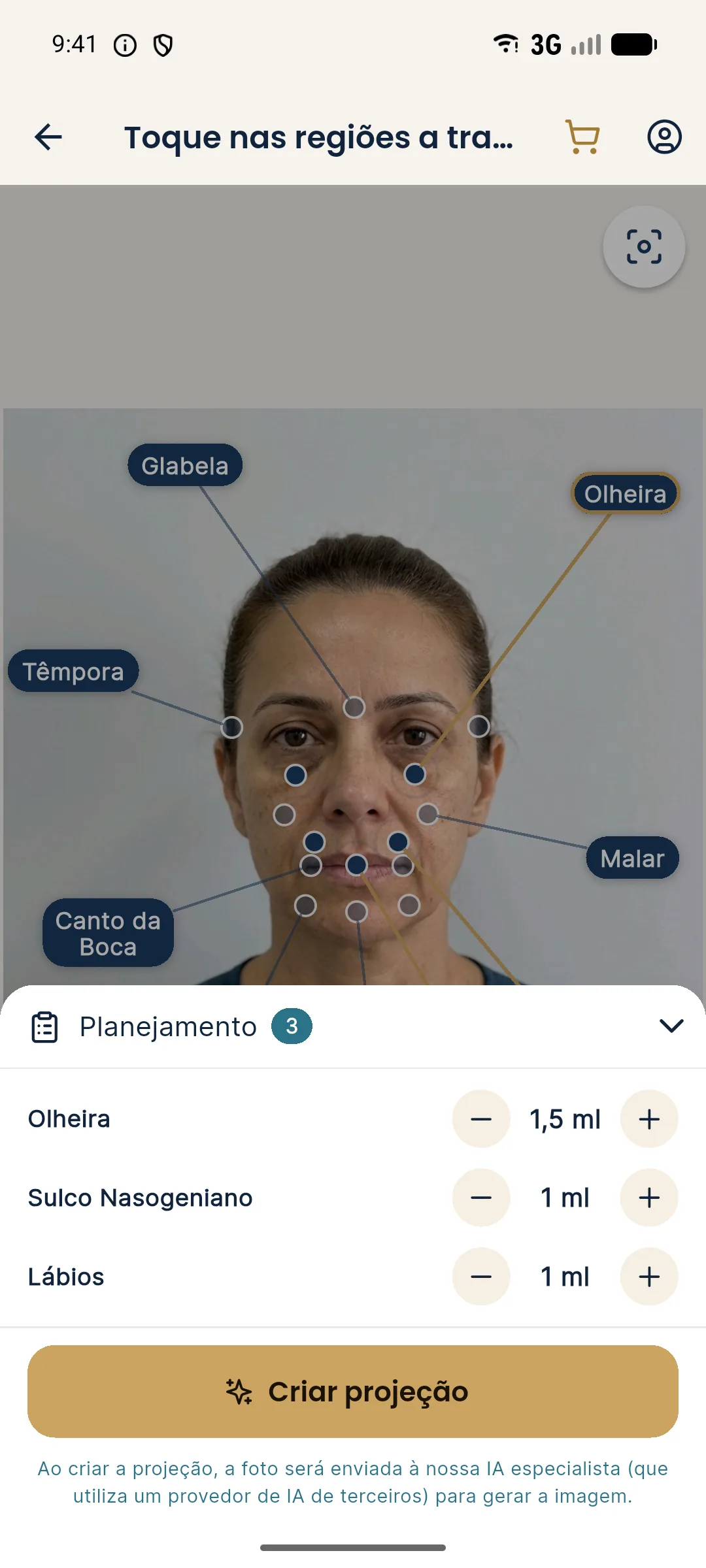
On the plan screen, you set the ml for each area, in steps of 0.5 ml, from 0.5 to 5 ml. The more ml, the more noticeable the projection, and in a bilateral area the ml is the total, split between both sides. With "Show procedures," each area's ml appears over the After image, and the patient sees that the volume is distributed across areas, not concentrated in a single point.
And when the patient wants to know in order to compare prices?
If the question comes from a quote elsewhere, avoid getting into the fight over the lowest price. Explain that ml is just one factor: there are also the product, the assessment, the follow-up and what is included. Do not cite other people's prices or criticize your colleague. Show your quote by area and let the patient compare calmly, if they wish. The page how to explain the quote by area covers this path in detail.
And when they think it is too little or too much?
If the patient thinks it is too little, remind them that the gradual approach lets you reassess and touch up later, more safely. If they think it is too much, reinforce that nothing is mandatory and that you can prioritize. In both cases, the decision goes back to the face and the goal, not the number. For a patient who insists on more, read patient who asks for too much.
How to record it?
Note the planned volume per area and any change made during the visit, with the reason. If the patient asked for a number and you explained it was an estimate, it is worth recording that guidance. Combine it with the informed consent so the document reflects the real plan and not a loose expectation.
In short: ml is part of the plan, not a promise. The sooner you shift the conversation from the number to the face, the less likely the consultation is to turn into a negotiation per syringe.
How to build a short answer for a busy day?
Having a sentence ready avoids improvising. The answer below fits in ten seconds and can be repeated by anyone on the team without creating the wrong expectation.
After it, return to the face: "Tell me what you would like to improve." This shift of focus usually ends the insistence on the number, because the patient sees the conversation is going to be more useful.
What if the sales team answers before you?
Agree with reception and front-desk staff that ml and price only come out with the plan. An answer such as "the doctor sets that at the assessment" prevents the patient from arriving with a fixed number in mind. See training the team in patient communication.
Frequently asked questions
Can I give a number of ml before assessing the patient?
In general, no. Without an assessment, any number becomes a promise. You can talk about usual ranges in general terms and make clear that the actual volume is set after the examination, at the professional's discretion.
Why does the patient insist on knowing the ml?
Almost always they want to compare prices, understand how much will change or feel in control. Identifying which of these reasons lies behind it helps you answer better than a bare number.
Does more ml mean a better result?
Not necessarily. The right volume depends on the area, the product, the anatomy and the goal. More ml can mean excess, and less can be enough in a gradual approach.
How does Harmy help talk about ml with the patient?
In the plan you set the ml per area, in steps of 0.5 ml, and the projection shows the illustrative effect. This makes the volume concrete without turning it into a promise.
Harmy images are illustrative simulations generated by AI from the patient's photo to support the conversation between practitioner and patient. They are not a promise of results. Indication, technique, product and volume are solely the decision of the licensed practitioner. This content is for information only and does not replace a clinical assessment.