
How to explain the quote by area to your patient

Quick facts
- Principle
- Each line of the quote answers a concern the patient brought
- Order
- Concern, area, what will be done, price, validity
- Avoid
- Talking about price before the plan makes sense
- In the app
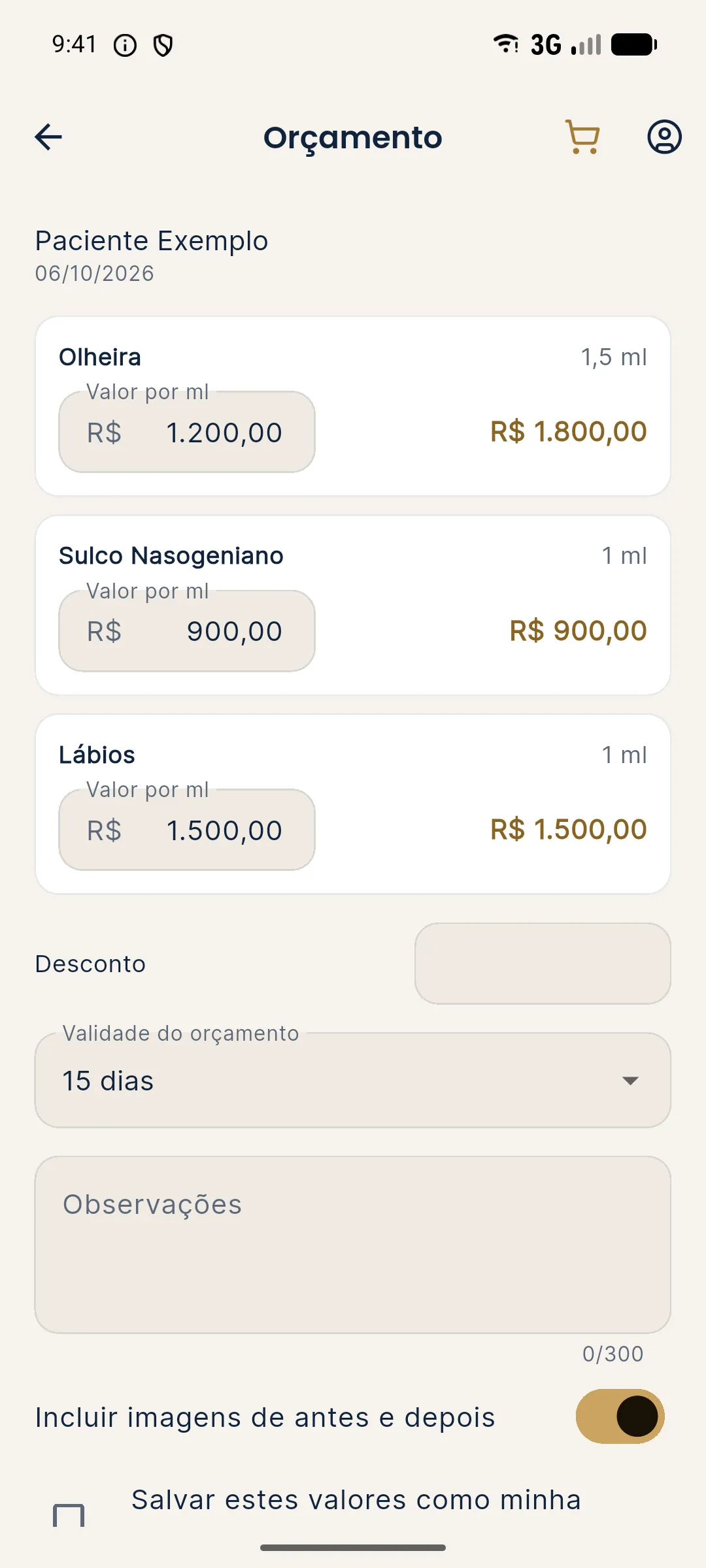
- PDF quote with price per ml by area
The moment of the quote is, for many professionals, the most uncomfortable part of the consultation. The clinical conversation was flowing, and suddenly money enters. The patient shifts posture, and so does the professional. There is a way to make this transition with less friction: tie each line of the quote to something the patient themselves said.
A quote by area is not just a spreadsheet. It is the continuation of the plan, in another language.
Why does a quote by area work better?
A lone total, with no connection to what was discussed, looks like an arbitrary number. When each item is tied to a concern, the patient sees what they are buying and why:
- They can prioritize: what matters most now, what can wait.
- They understand the effect of each decision: removing an item changes the plan, not just the price.
- They feel the price came from an assessment, not from a generic price list.
- You feel more comfortable explaining, because every number has a reason.
In what order should you present it?
An order that tends to work:
- Recall the concerns in the patient's own words.
- Show the plan by area, tying each area to the concern.
- Explain what each item does and does not do, without promises.
- Only then give the price, area by area.
- State the validity and conditions, making clear they can take it home to think.
What should you say on each line of the quote?
For each area, use a three-part sentence: the concern, what will be done, the limit.
Notice what the sentence avoids: promise, exact timeline, sales language. It describes what will be done and what will not.
How do you present the price without sounding pushy?
A few choices help:
- Show the quote in writing, so the patient can read it calmly.
- Speak in real prices, with no "today's promotion."
- Avoid the question "shall we close?" Prefer "would you like to take it home to think, or would you rather book now?"
- If there is a discount, explain the criterion and do not use it as an urgency trigger.
How do you let the patient remove items?
Giving the patient freedom is part of respect. But removing an item calls for an explanation, because some combinations depend on each other. One way to handle it:
If the change affects the expected result, document it. Using the area map as a visual aid is covered in how to use the area map in the conversation. To split into stages, see staged simulation for the patient.
What is the difference between price per ml and price per area?
| Format | Advantage | Caution |
|---|---|---|
| Price per ml | Transparent and proportional to what is used | The patient may start "haggling over ml" |
| Price per area | Simple to understand | Needs a clear criterion to adjust when volume changes |
| Package price | Makes the decision easier | May hide the cost of each item |
Whatever the format, what matters is that the patient can connect the price to the plan. See pricing per ml for the logic on the professional's side.
How do you review the quote before presenting it?
When should the quote wait?
If the patient is still confused about the plan, anxious or full of questions, the quote is premature. In that case, it is worth ending with a summary and booking a follow-up. There is a script for this in how to close the consultation without selling and in simulation and quote in the same conversation.
A well-explained quote needs no insistence. A patient who understood what they are buying, and why, decides with more peace of mind, and the decision, whatever it is, is theirs.
Which phrases help when the patient says it is expensive?
The comment "that's expensive" is rarely about the number. It may be about priority, insecurity or not understanding what is included. Before any discount, ask and listen.
Instead of lowering the price, reorganize the plan: prioritize the main concern, split into stages or leave areas optional for another time. That preserves the value of your work and respects the patient's capacity. Avoid comparing with the prices of other professionals or clinics: each plan has its own conditions.
Frequently asked questions
Should I give the price before or after explaining the plan?
After. When the patient understands what will be done and why, the price reads as the counterpart of a plan and not as a loose price tag.
Can I show the quote broken down by area?
You can, and it tends to help. Each area tied to a concern makes clear what is essential, what is optional and what can wait for another time.
Can the patient remove items from the quote?
Yes. It is worth explaining the effect of removing each item on the plan, at the professional's discretion, and not pressuring them to keep everything.
How do I talk about installments without seeming pushy?
Present installments as information, after explaining the plan, and make clear that the patient can take the quote home to think it over.
Harmy images are illustrative simulations generated by AI from the patient's photo to support the conversation between practitioner and patient. They are not a promise of results. Indication, technique, product and volume are solely the decision of the licensed practitioner. This content is for information only and does not replace a clinical assessment.