
Aging of the chin and jaw
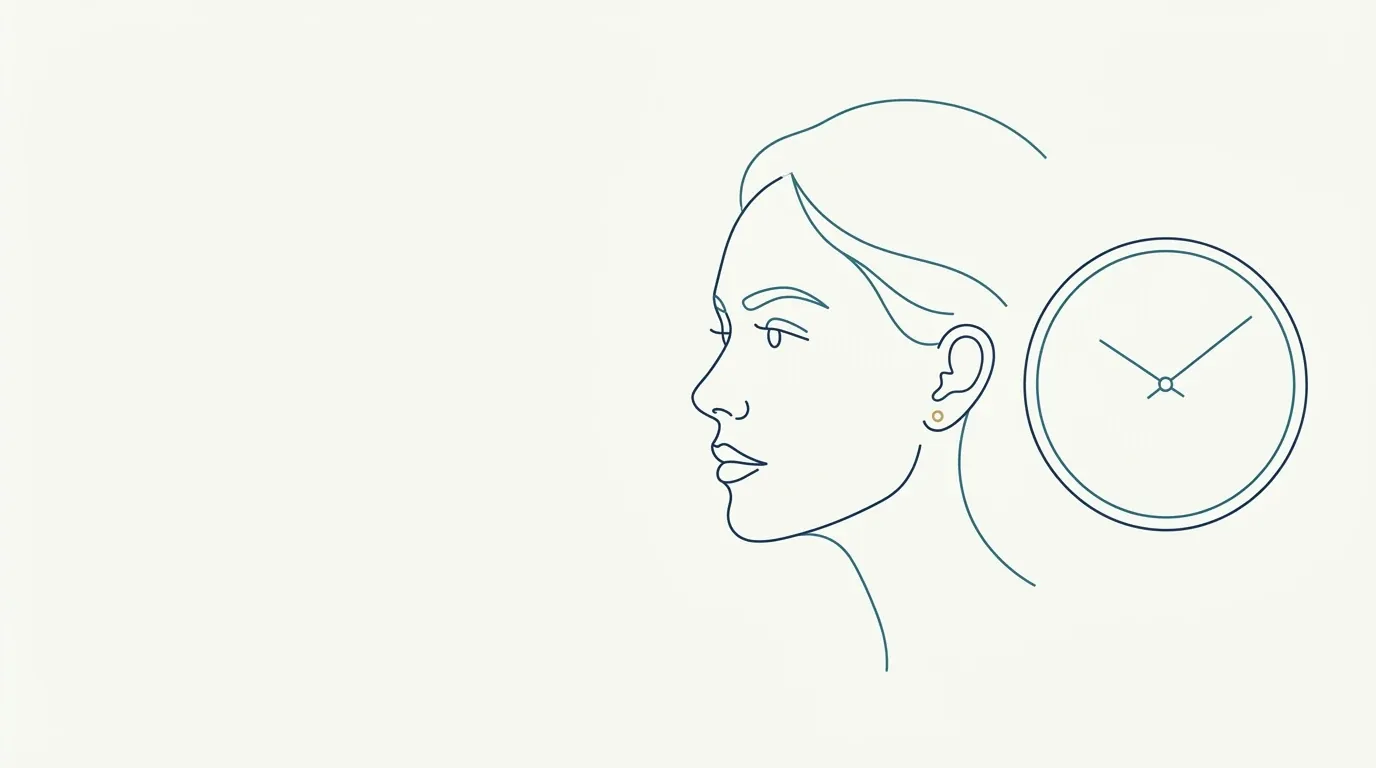
- Highlighted area
Quick facts
- What happens
- The jaw resorbs, fat descends, ligaments loosen and the contour loses definition, with jowl formation.
- Typical changes
- Less projected chin, pre-jowl sulcus, deep labiomental fold, less defined mandibular angle.
- Clinical trap
- The concern may be laxity, but the cause may be bone volume, and the approach changes.
- Assessment
- Profile, three-quarter and frontal views, with palpation and a reading of the facial thirds.
The lower third of the face holds a person's visual identity: the chin puts the final point on the profile, and the jawline defines the transition between face and neck. Over time these two structures lose their shape. The contour softens where it used to be sharp, a lateral accumulation called a jowl appears and the neck stands out. The patient describes it as a "falling face" or "double chin".
This page is a review of aging of the chin and jaw, with no injection technique. It organizes the reasoning behind the assessment. The approach rests with the qualified professional, in line with the rules of their professional council in Brazil and the product label.
What happens to bone, fat and ligaments?
The explanation for the "sagging" face is not only gravity. The jaw and chin are bones, and they change.
| Structure | Change with age | Visual consequence |
|---|---|---|
| Mandible | Resorption of the body and ramus | Loss of contour and angle definition |
| Pogonion and chin | Resorption and reduced projection | Less defined profile, deep labiomental fold |
| Fat | Descends and redistributes | Jowl formation, volume loss in the cheekbone |
| Ligaments | Loosen, including the mandibular ligament | The jowl descends and the pre-jowl sulcus forms |
| Platysma | Loses tone, may form bands | Less defined cervicomental contour |
| Skin | Loses elasticity | Laxity and folds |
The result is the "bulldog face" some patients describe. The descent of soft tissue happens over a bony base that has also shrunk, which makes the concern more complex than it seems. The ligament anatomy and the grooves are covered in hyaluronic acid in the pre-jowl sulcus and in the glossary entry on jowl.
Jowl and associated grooves
The jowl is the soft-tissue bulge that projects over the jawline, lateral to the chin. It usually comes with two grooves:
- Pre-jowl sulcus: the depression just in front of the jowl, between it and the chin.
- Labiomental fold: the crease between the lower lip and the chin, which deepens with chin retrusion.
- Marionette line: the crease that runs down from the corner of the mouth toward the chin.
These elements add up and give the lower third its sagging look. Treating just one of them rarely solves the picture, and the professional needs to think about the whole.
The chin's role in the profile
The chin influences the shape of the profile and the harmony of the lower third. A retruded chin (retrogenia) makes the nose and lips look bigger and the double chin more evident. With age, bone resorption worsens this relationship. Assessing the profile, including its relation to the nose and lips, is part of the reading. See retrognathic profile: assessment.
Assessing the lower third
Also consider occlusion and the TMJ. Dental and bone changes can explain part of what is seen, and referral to a dentist or maxillofacial surgeon may be needed. Laxity assessment is in lower third laxity: assessment and contour assessment in double chin: assessment.
What usually enters the discussion
The table is a map of categories discussed, not a protocol.
| Concern | Categories discussed | Points of attention |
|---|---|---|
| Poorly projected chin | Fillers, surgical assessment | Assess the profile and occlusion |
| Softened jawline | Fillers, biostimulators | Support and volume |
| Jowl and laxity | Threads, biostimulation, surgery | Depends on the degree |
| Deep labiomental fold | Volumization of the chin and fold | Consider bone projection |
| Double chin and bands | Fat, platysma, skin | Differential diagnosis |
For product and area details, see hydroxyapatite in the jawline, biostimulator in the jawline, biostimulator in the chin and PDO threads in the neck and lower third. Hyaluronidase must be available whenever hyaluronic acid is used.
How to talk to the patient
Avoid promising a return to a youthful appearance. The most honest approach talks about softening and balance.
Test your review
Teeth, occlusion and the jaw
The jaw is part of the masticatory system, and tooth loss, periodontal disease and wear of the dental arch change the contour of the lower third. A patient who lost posterior teeth may have reduced facial height and a chin that projects further forward, with deeper grooves and mouth corners.
So it is worth asking about teeth, dentures, bruxism and orthodontic treatment, and referring to a dentist when the cause of the concern is suspected to be in the mouth. The integration of aesthetics and dentistry is covered in HOF integrated with dentistry. In some cases, the best result comes from treating the dental cause before thinking about volume.
Gender, ethnicity and aesthetic references
The shape of the chin and jaw varies between men and women and between groups. In men, the jaw tends to be read as more angular and the chin wider. In women, the line tends to be softer. These references are not rules, and the patient may have different preferences. The conversation should start from what the patient wants, not from an external standard.
In gender-affirming contexts, the approach is individual and requires sensitivity and preparation, as discussed in facial feminization with injectables and male orofacial harmonization. A projection on a frontal photo can help align expectations, as long as it is clear what it shows and what it does not.
In summary
Aging of the chin and jaw involves bone, fat, ligament and skin, and reading the whole is more useful than reading the detail. Profile assessment, investigating the cause of the concern and an honest conversation about limits guide the decision. When bone is the main component, expectations need to be adjusted from the start.
Frequently asked questions
Why does the jaw lose definition with age?
Because the jawbone resorbs, fat and skin descend under gravity and the retaining ligaments loosen. As a result, the once-straight contour drops at the level of the jowl.
What is a jowl?
It is an accumulation of soft tissue that descends beside the chin and forms a bulge over the jawline, also called a lateral double chin. It is usually associated with a groove just in front of it.
Does filling the chin improve the contour?
In some cases, chin projection improves the proportion of the lower third and softens the transition to the jowl. The indication depends on the profile assessment and expectations, and is at the professional's discretion.
Does laxity of the lower third always require surgery?
No. The indication depends on the degree of laxity, skin quality and the patient's expectations. In mild to moderate cases other approaches can be discussed, and in advanced cases surgery enters the conversation.
Harmy images are illustrative simulations generated by AI from the patient's photo to support the conversation between practitioner and patient. They are not a promise of results. Indication, technique, product and volume are solely the decision of the licensed practitioner. This content is for information only and does not replace a clinical assessment.