
Chin and jaw: why combine them in the HOF plan

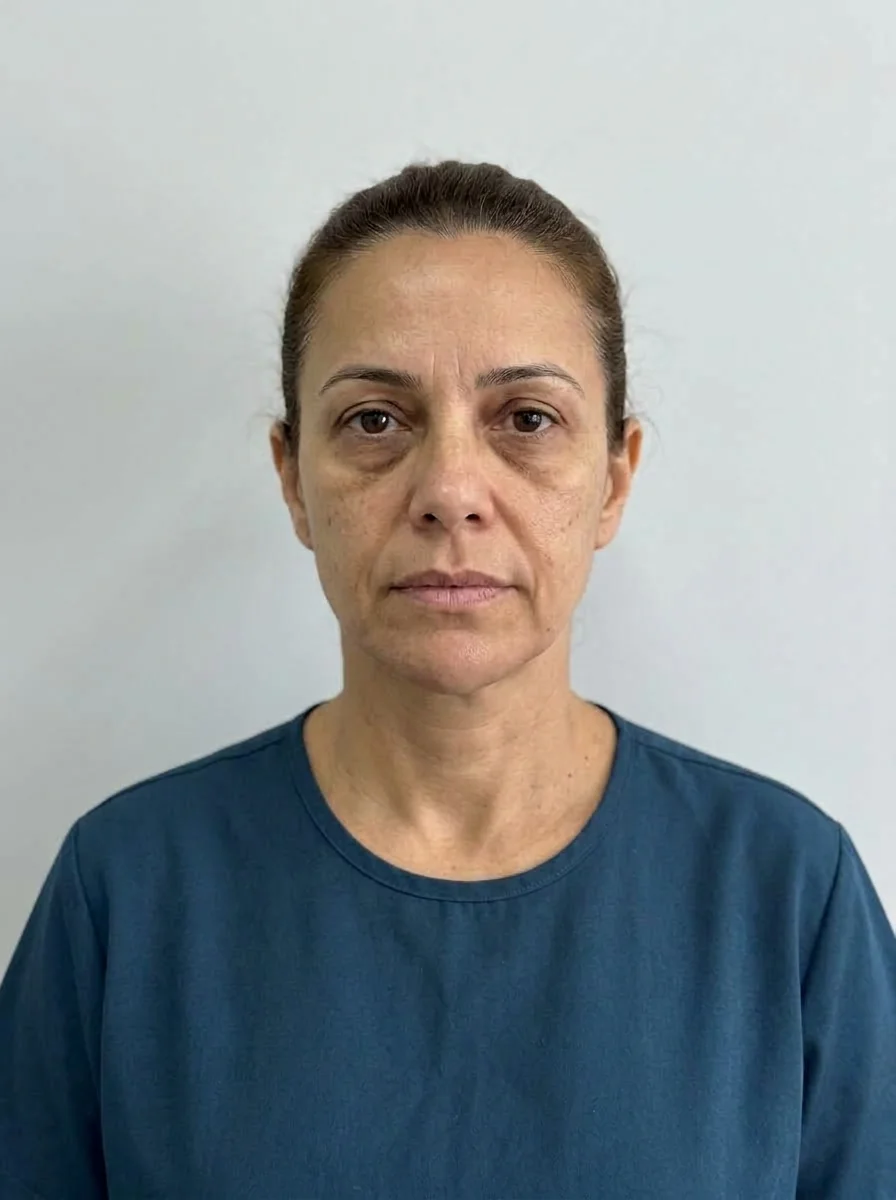 BeforeSimulation
- Nerve
- Highlighted area
Quick facts
- Topic
- The lower contour as a single line from the chin to the jaw angle
- Central question
- Is the flaw in chin projection, in the jawline, or in both
- Deciding view
- Profile for projection, frontal for width and continuity
- Caution
- Treating one stretch of the line without looking at the other breaks continuity
When a patient says they want "a more defined chin and jaw", they are describing a line, not two areas. The lower contour of the face runs from the chin to the jaw angle in one continuous curve, and that continuity is what the eye reads as definition. Planning one stretch without looking at the other is like fixing one letter of a word without reading the word.
This page organizes the decision: how to assess the whole line, when chin projection takes priority, how the jaw fits in, what the volume limits are and how the simulation helps the conversation. For the reasoning behind combining areas, see domino effect between facial areas.
How do you assess the whole contour line?
The contour line is read in two views. In profile, you see chin projection relative to the lip and nose, and how clear the angle is between the chin and the neck. From the front, you see chin width, symmetry and the continuity of the jawline up to the angle.
| View | What to observe | What it tells the plan |
|---|---|---|
| Profile | Chin projection, relation to the lips, angle with the neck | Whether the chin needs projection |
| Frontal | Chin width, symmetry, jawline | Whether the contour is continuous or broken |
| Three-quarter | Transition between chin and angle | Whether there is a step between the two stretches |
A common mistake is assessing only from the front. A recessed chin barely shows in that view, and the jaw seems to be the problem when what is actually missing is chin projection. See profile facial analysis: checklist and three-quarter facial analysis.
When does the chin come before the jaw?
If the chin is poorly projected, the lower line loses its anchor, and the jaw, however defined, looks short. In those cases, discussing chin projection first usually clarifies what the jaw still needs. The opposite also happens: with a strong jaw and a neutral chin, the whole is already balanced, and only the jaw may deserve attention.
One way to organize it is to ask, in this order:
- Does the chin have adequate projection relative to the lips and nose?
- Does the chin width match the width of the jaw angle?
- Is the line between the two continuous, or is there a step or depression?
- Is the patient's concern about projection, width or definition?
The skeleton comes up again here: a small chin is a bony matter, and soft tissue only compensates up to a point. See facial skeleton before injecting and plan to project the chin.
What risks and limits exist?
The chin and jaw demand mastery of anatomy. There are vessels and nerves in the area, such as the mental nerve, and the risk of asymmetry and irregularity exists. Hyaluronidase should be available when hyaluronic acid is used, and the indication and technique belong to the qualified professional, according to the rules of their professional board. The overview is in safety and complications in HOF.
As for volume, the app's visual planning works in steps of 0.5 ml, from 0.5 to 5 ml per area. The "Full harmonization" shortcut uses chin 1.5 ml and jaw 2 ml, both at Moderate, as a starting point and not as a prescription. In delicate contours, smaller volumes and more follow-ups are usually safer. See ml per area: ranges used in visual planning.
How does the simulation help with the contour line?
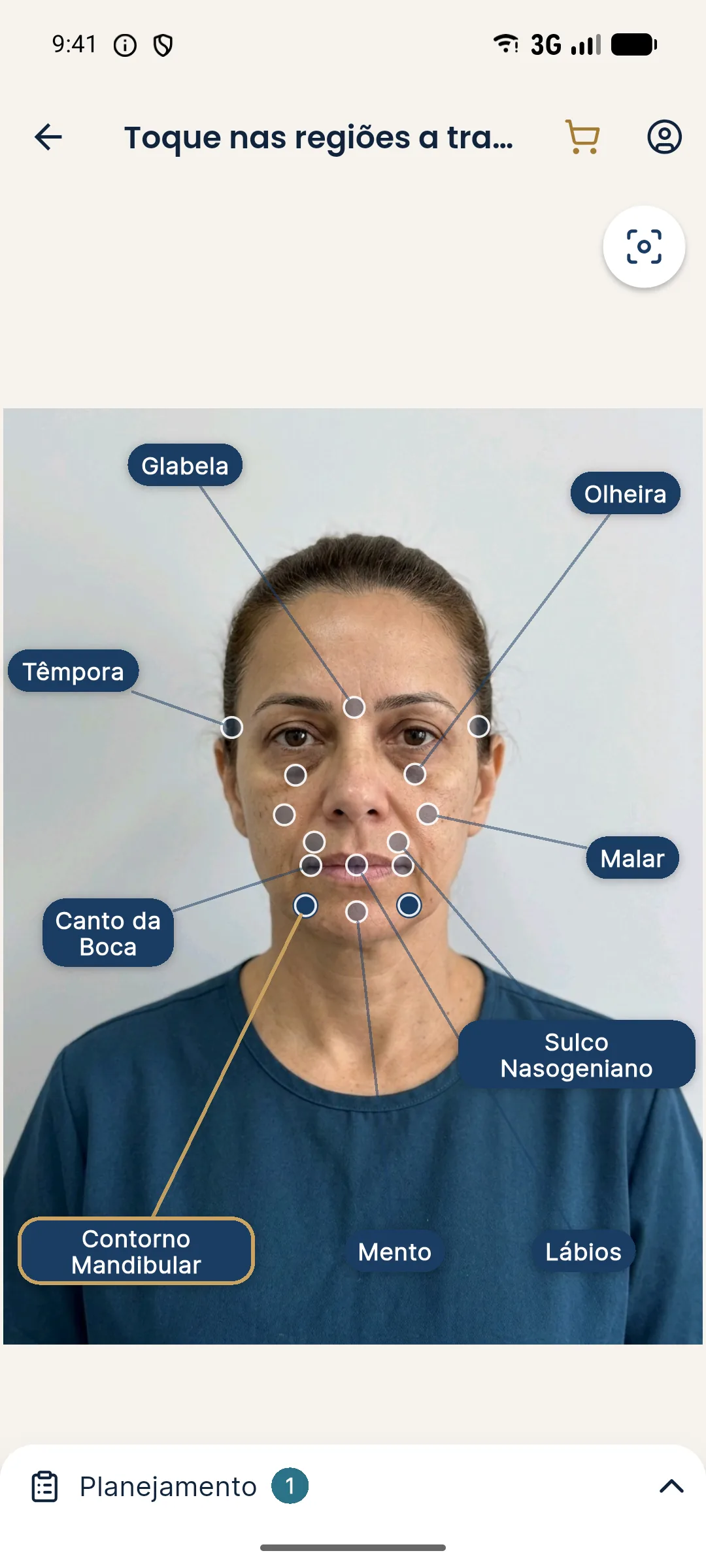
The simulation shows the patient what they cannot imagine alone: the continuity of the line. In Harmy, after the frontal photo, the app detects the face on the device and shows labeled points. Tap Chin and Jawline, set the ml for each area and choose the intensity (Subtle, Moderate or Pronounced).
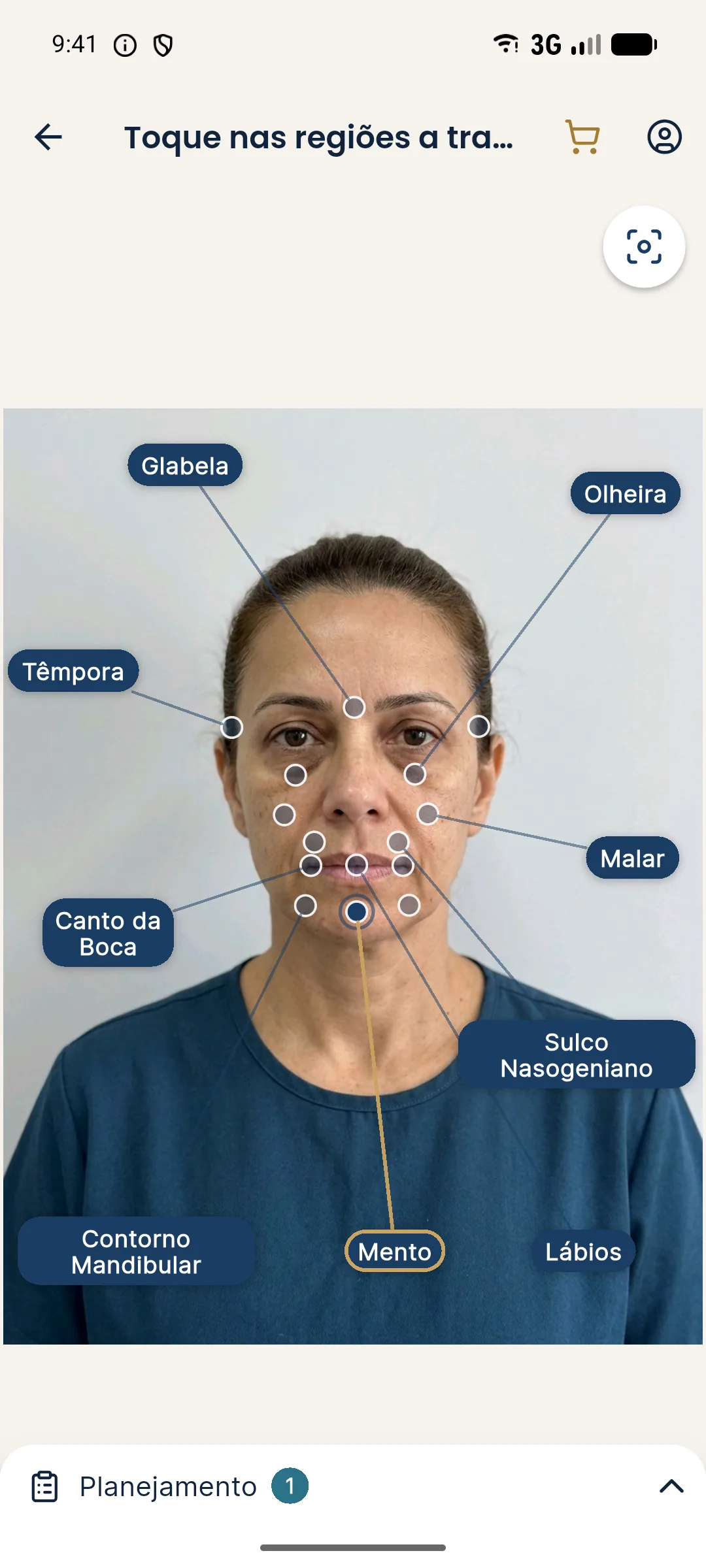
This limit deserves emphasis. Since chin projection is a profile matter, and Harmy only works with the frontal view, the image shows the effect on width and on the continuity of the line, but not the projection. Tell the patient. The conversation about the profile remains clinical, supported by the profile photo you took. To talk about this clearly, see explaining that a simulation is not a guarantee.
When should you treat only one of the stretches?
Combining in the plan does not oblige you to treat both. There are clear situations:
- Chin only: well-defined jaw and a concern about projection or little support.
- Jaw only: balanced chin and a concern about a faded line.
- Neither for now: contour compromised by laxity, double chin or fat, where another approach comes first; see chin and double chin: when the plan needs both.
- Jaw and masseter: muscle width enters the equation, as in jaw and masseter: filling and relaxing in the same plan.
For the relation with the widths above, read cheekbone and jaw: balance of the V-shaped contour.
Every decision on product, volume and technique belongs to the qualified professional, after assessment, and the simulation is always illustrative.
Frequently asked questions
Should the chin and jaw be planned together?
Since they form a single contour line, it is useful to assess them together. That does not mean treating both, but deciding with the whole line in view.
Which do you assess first, the chin or the jaw?
In general you start with chin projection in profile, because it changes how the jaw is perceived. The actual order is the professional's decision.
Does a more projected chin improve the look of the jaw?
It can change the perception of the contour and of the proportion of the lower third, but it depends on anatomy. It is not a rule, and the assessment of the whole is what decides.
Does Harmy simulate the chin and jawline together?
Yes. You mark Chin and Jawline, set the ml and intensity for each and generate the frontal projection, which is illustrative and does not promise results.
Harmy images are illustrative simulations generated by AI from the patient's photo to support the conversation between practitioner and patient. They are not a promise of results. Indication, technique, product and volume are solely the decision of the licensed practitioner. This content is for information only and does not replace a clinical assessment.