
Plan to project the chin: how much and with what

 BeforeSimulation
- Nerve
- Highlighted area
Quick facts
- Topic
- Planning chin projection
- Central question
- Is it projection, height, width or bone that is lacking?
- Usual strategy
- Conservative volume, in stages, with a profile reading
- Key relationship
- Lips, nose and mentolabial angle
- Limit
- Injectables do not replace bone correction when that is what is indicated
The chin is the anchor of the lower third and of the profile. Too little projection makes the nose look bigger and the lips look out of place; too much leaves the face elongated and artificial. Planning chin projection well means deciding what is lacking (projection, height, width or bone), how much and with what, always in relation to the rest of the face. This page organizes that reasoning.
What does "projecting the chin" mean?
It means giving the chin more presence in the sagittal plane, that is, bringing it further forward relative to the lips and nose. But a patient who says "my chin is small" may be talking about different things: a receding chin (lack of projection), a short chin (lack of height), a narrow chin (lack of width) or a weak chin because of double chin and laxity. Each calls for a different approach. See small chin, receding chin and retrogenia.
How do you assess the chin before planning?
The exam is done in profile and from the front, at rest with the mouth relaxed, with the head in the Frankfort plane. Observe the most anterior point of the chin (pogonion), the mentolabial angle, the relationship with the lower lip, the occlusion and the height of the lower third. The Ricketts line or other references help name what you see, without becoming a fixed target. See chin profile photo for planning, pogonion and mentolabial angle.
| What you observe | Possible reading | Approach to consider |
|---|---|---|
| Chin recessed relative to the lips | Lack of projection | Chin filler at conservative volume |
| Short lower third | Lack of height | Assess height before projection |
| Narrow, pointed chin | Lack of width | Width and contour plan |
| Double chin and poorly defined line | Fat and laxity | Treat the cause before adding volume |
| Significant class II occlusion | Bone or dental cause | Orthodontic or surgical assessment |
For the reasoning on cause and effect, see chin and double chin: combining in the plan, double chin with a small chin and orthodontics and facial profile in facial harmonization.
Which criteria guide the volume?
Four criteria, in order. Goal: how much change the patient wants (subtle or pronounced). Anatomy: current chin size, skin thickness and soft tissue. Proportion: relationship with the lips, nose and lower third. Risk: tissue tolerance, history and signs of excess. The final volume is a range decided by the professional, and the golden rule is the usual one: start with less and reassess. Men and women usually have different projection goals. See ideal chin projection by sex, volume by sex in planning and chin filler in men.
What about the relationship with the lips and nose?
The chin, lips and nose form a set. A recessed chin makes the lower lip look projected and the nose look bigger. That is why it is common for the chin plan to come before deciding on lips and nose. In many cases, after the chin is projected, the complaint about the lips or nose lessens. See plan to balance the profile, lips and chin: combining in the plan and nose and chin: combining in the plan.
What is the sequence of the plan?
How do you use the simulation, with its limits?
In Harmy, the Chin point simulates the effect of volume from the front. The projection helps show the gain in definition and in lower-third proportion, but it does not show the profile, which is where chin projection shows most, because the app uses only the frontal photo. Explain to the patient that the simulation illustrates what changes from the front and that the conversation about the profile relies on the clinical profile photos.
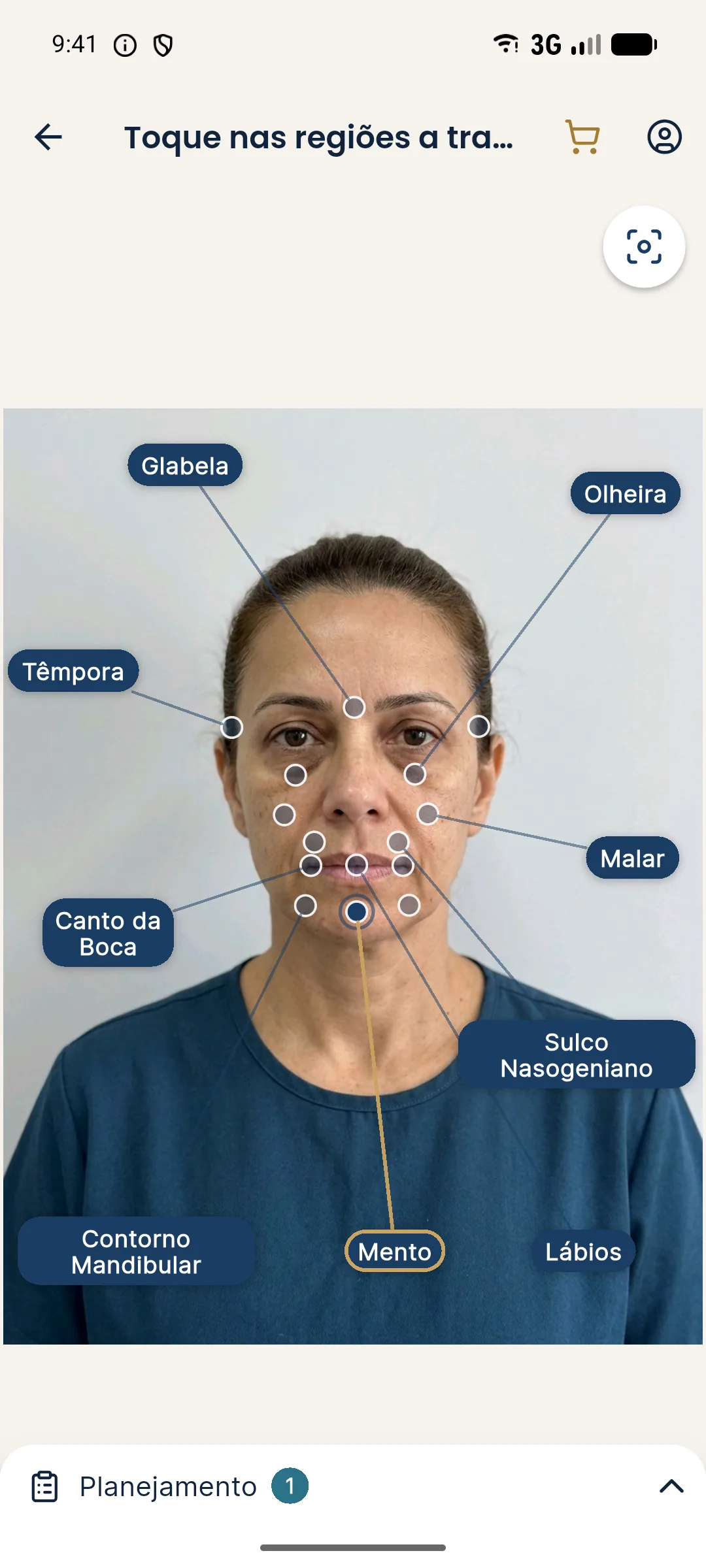
The AI respects the volume entered, without altering skin, expression, lighting or background, which is why the change is discreet. Compare two intensities so the patient understands the difference. See comparing Subtle, Moderate and Pronounced intensities and limits of 2D simulation.
What are the specific risks?
Swelling and bruising are expected. Asymmetry, nodules, irregularities, product migration and an artificial result from excess are also part of the consent form. The chin area has nerve and vascular structures (mental nerve, submental artery), and anatomical knowledge is required. If hyaluronic acid is used, hyaluronidase must be available. See mental nerve, submental artery and asymmetry after chin filler.
Toxin in the mentalis muscle is another path, indicated for specific cases of an "orange peel" chin or hyperactivity. See mentalis toxin and chin with a dimple or orange peel texture.
How do you talk to the patient?
Use the language of proportion. "The chin sits a little back relative to the lips, and that makes the profile look less balanced." Show their profile photo and, if the patient agrees, the reference lines. Say the goal is balance, not "a big chin".
Reasoning quiz
Summary
Projecting the chin is deciding what is lacking, how much and with what, in relation to the lips, nose and profile. Start conservatively, assess in profile, use the frontal simulation as support and recognize the limits of injectables.
Frequently asked questions
How much volume is used to project the chin?
It depends on the size of the chin, the body type, the product and the goal. In general, conservative ranges are used, in stages, at the professional's discretion. There is no fixed number for everyone.
Does projecting the chin change the nose and lips?
Visually, yes: balance is relative. With more chin projection, the nose tends to look smaller and the lips more integrated into the profile.
Is chin filler suitable for someone with retrogenia?
It can help compensate for part of the recession, but significant retrogenia may deserve an orthodontic or surgical assessment. The decision depends on the case.
Does the simulation show chin projection?
It shows the effect from the front, on the frontal photo. It does not show the profile, which is where projection shows most. Use the clinical profile photo for that conversation.
Harmy images are illustrative simulations generated by AI from the patient's photo to support the conversation between practitioner and patient. They are not a promise of results. Indication, technique, product and volume are solely the decision of the licensed practitioner. This content is for information only and does not replace a clinical assessment.