
Small Chin: How to Assess It and When to Fill

 BeforeSimulation
- Nerve
- Highlighted area
Quick facts
- Concern
- Short, narrow or poorly projected chin that makes the face look unbalanced
- Key reading
- Three dimensions decide the volume: projection (forward), height (downward) and width (lateral)
- Supporting measure
- Frontal and profile photo, lower third proportion and pogonion position
- Limit
- Volume simulates size but does not correct bone or the bite, and excess creates an artificial chin
The small chin often arrives in the office as "my chin is weak" or "my face looks incomplete". In many patients it is a legitimate concern, and HOF offers an answer that looks simple, chin filler. In many cases, though, the simplicity is deceptive: the right volume depends on which dimension of the chin is lacking.
This page shows how to assess the three dimensions of the chin before deciding volume and when the decision should be different. For chin recession, see recessed chin, and for the face in which the chin looks small by contrast, full cheeks and weak chin.
What are the three dimensions of the chin?
Saying "small chin" is imprecise. The chin has three dimensions, and the patient may be lacking in one or more:
- Projection: how far the chin comes forward in profile.
- Height: the distance between the lower lip and the tip of the chin, which defines the proportion of the lower third.
- Width: the lateral extent of the chin, which relates to the jaw.
Each dimension calls for a different design. A recessed chin needs projection. A short chin needs height. A narrow chin needs width. Applying the same volume in any case is the most frequent mistake, and reading the pogonion and the lower third helps avoid it.
How to assess step by step
The assessment combines measuring, comparing and talking. Follow a fixed sequence so no item is forgotten:
- Profile photo in the horizontal plane, lips relaxed.
- Pogonion position relative to the lower lip and the nose.
- Mentolabial angle and fold depth. See mentolabial angle.
- Lower third height, compared with the other thirds. See facial assessment by thirds.
- Chin width relative to the jaw.
- Projection test by hand, so the patient can visualize the effect.
- Bite and dental relationship, to identify an occlusal cause.
| Deficient dimension | Clue on the photo | Direction of volume (in general terms) |
|---|---|---|
| Projection | Pogonion behind the lower lip line | Forward |
| Height | Short lower third, deep mentolabial fold | Downward, with care |
| Width | Chin narrow relative to the jaw | Lateral, with care |
| Combined | Several clues | Conservative distribution in stages |
The table describes the reasoning, not a protocol. The injection design is the licensed professional's decision, after an assessment. For reading the profile, see profile facial analysis (checklist).
What changes between a female and a male chin?
The ideal chin design differs. In general, the female chin tends to be more delicate, with a soft tip and a more rounded transition. The male chin is usually wider and more projected, with a squarer contour. A small chin on a male face may call for width and projection, while on a female face the priority is usually subtle projection and softness. This guides the design but does not replace individualization. The detailed reading is in ideal chin projection by sex.
In trans patients, the plan may have specific feminization or masculinization goals, and the conversation must respect the patient's identity. See plan for masculinizing the face and respectful care for trans patients in HOF.
When does filling make sense?
Chin filler tends to make the most sense when the lack is of moderate projection or height, the bite is adequate and the patient has realistic expectations. It can improve the harmony of the profile, soften the mentolabial fold and balance the nose and lip. The basics of the procedure are in chin filler.
It makes less sense when the recession is markedly skeletal, when a bite problem explains the picture or when the patient expects an identity change. It is also wise to postpone when there is active infection, use of anticoagulants without evaluation or an expectation of a permanent effect. For a broader view of the decision, see plan for projecting the chin.
The chin is an area with vessels and with the mental nerve, and possible complications include swelling, bruising, asymmetry, nodules and, rarely, vascular compromise. With hyaluronic acid, hyaluronidase must be available. The risks must be explained and recorded. See safety and complications.
How to define the volume
There is no universal number, and this page does not offer a protocol. What can be said is that the volume should fit the missing dimension, the patient's sex and the patient's face, and that starting low is usually safer. Many professionals prefer a conservative first session and a touch-up after the swelling resolves, based on photos.
Another concern is distribution: projection, height and width call for different reasoning, and mixing all three in a single session can produce a result that is hard to adjust. The idea of splitting the volume appears in when to split the volume across sessions and in conservative volume in the first session.
How does Harmy help?
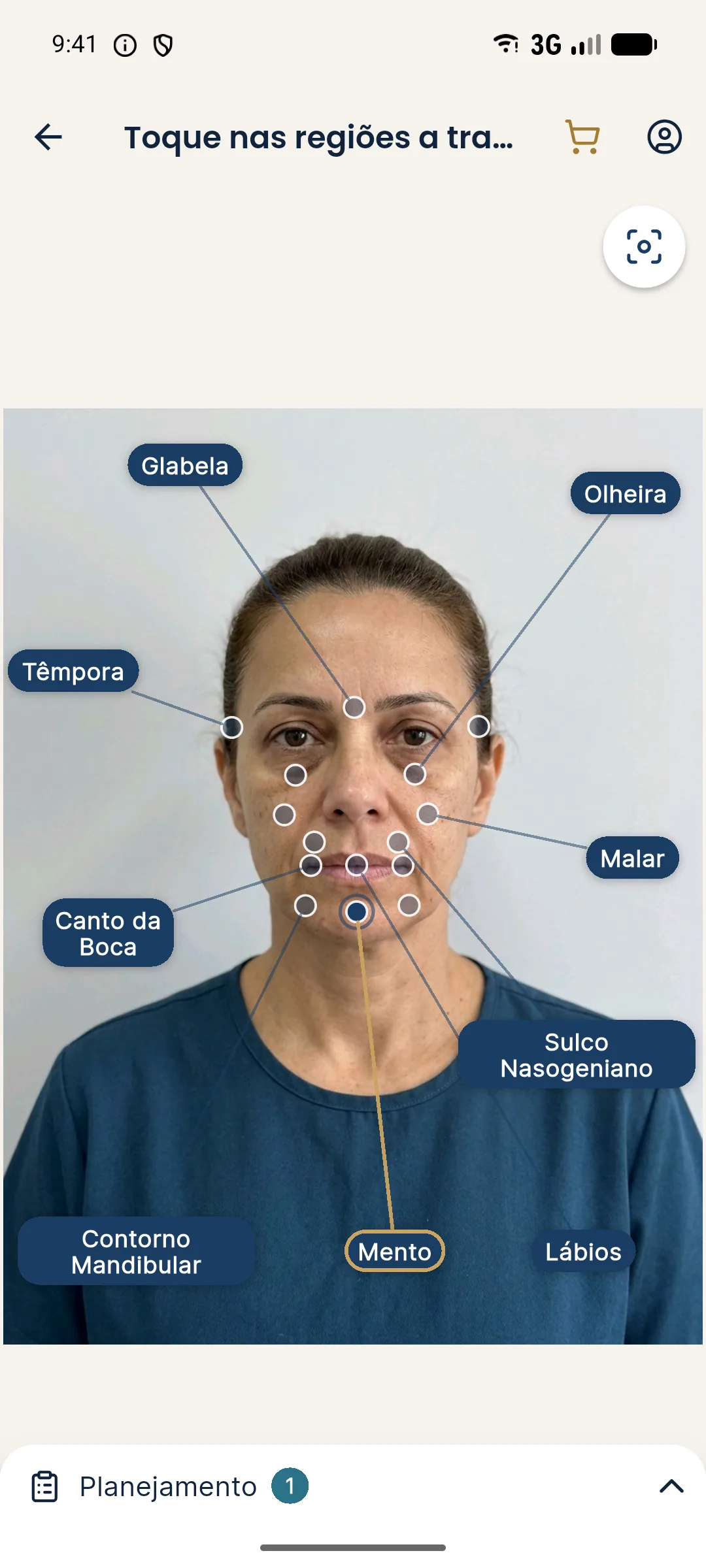
Harmy helps show the patient the proportion of the chin from the front. The projection uses the volume you set on the Chin point and shows a subtle, realistic result, without retouching skin or changing expression. For the small chin, the app gives a good idea of the change in contour and width, but does not show profile projection.
When to refer
When the small chin comes from a significant skeletal disproportion, an altered bite or a breathing condition (such as apnea associated with recession), assessment by the orthodontist, the oral and maxillofacial surgeon or the physician takes priority. See orthodontics and profile change and referring patients in HOF.
Record keeping
Record the measurements, the classification (projection, height, width), the plan as a range, the standardized photos and the patient's acknowledgment of risks and limits. At follow-up, repeat the photos. The history per patient and standardized clinical photography support the method.
Frequently asked questions
How much filler is used for a small chin?
It varies a lot with the dimension that needs adjusting and the patient's sex. In general, conservative volumes in stages are used, at the discretion of the licensed professional after an assessment.
Is chin filler permanent?
With hyaluronic acid, durability is usually from months to about a year and a half, depending on the product and the patient. Other materials behave differently and require a specific assessment.
Are a small chin and a recessed chin the same thing?
Not necessarily. The chin may be small and well positioned, or normal and set back. The profile assessment separates the two situations and guides the plan.
Can chin filler slim the face?
It can visually lengthen the lower third and give the impression of a more tapered face. That depends on the volume design and the proportion of the face, and it is not guaranteed.
Harmy images are illustrative simulations generated by AI from the patient's photo to support the conversation between practitioner and patient. They are not a promise of results. Indication, technique, product and volume are solely the decision of the licensed practitioner. This content is for information only and does not replace a clinical assessment.