
Ideal Chin Projection by Sex in Treatment Planning

 BeforeSimulation
- Nerve
- Highlighted area
Quick facts
- Topic
- How far the chin projects in profile and how references differ between men and women
- References
- Ricketts and Steiner lines, subnasale-to-pogonion line, mentolabial angle and facial convexity
- Trend by sex
- Chin more projected and wider in men; more delicate and rounded in women; large individual variation
- Caution
- A reference is a starting point; bone, occlusion and the patient's identity set the goal
The chin is the anchor of the lower third in profile. When it recedes, the nose looks larger, the lower lip looks heavy and the neckline loses definition. When it projects too much, the face takes on a prominent-chin look that may not match the patient's identity. That is why chin projection is one of the most sensitive decisions in profile planning.
We will cover the most-used references, what changes between sexes, the limits of volume and how the app fits into the conversation, with the caveat that actual projection is assessed in profile and on exam.
How is chin projection measured?
There are classic lines and angles that help you read the profile. All are approximations, taken from photos or from the exam, and none replaces the whole picture.
| Reference | What it measures | How it is read |
|---|---|---|
| Ricketts line | Position of the lips relative to the nose and chin | Lips close to the line joining the nose tip to the pogonion |
| Steiner S line | Position of the lips relative to the nose and pogonion | Chin and lips relative to the curve between the subnasale and the pogonion |
| Subnasale-to-pogonion line | Alignment between the base of the nose and the chin | Lip and chin close to the alignment |
| Mentolabial angle | Depth of the groove between the lower lip and the chin | More closed or more open indicates different relationships |
| Facial convexity angle | Overall profile: straight, convex or concave | Defines whether the chin compensates for a convexity |
Numerical ranges vary between authors and populations, so this page does not fix values. The central point is that the lines are interpreted together with the profile, the occlusion and the full facial profile.
What changes between the male and female chin?
The trend described in textbooks is one of distinct contours. In the male face, the chin tends to be wider, squarer and more projected. In the female face, it tends to be narrower, more rounded and slightly less projected. The difference extends to how it fits with the jaw, covered in ideal jaw angle by sex.
| Aspect | Trend in men | Trend in women |
|---|---|---|
| Width | Wider | Narrower |
| Shape | Squarer | More rounded or oval |
| Projection | May be more projected | Tends to be more delicate |
| Relation to the jaw | More defined contour | Softer transition |
These trends are textbook statistics and do not define what is right for a specific patient. Trans and nonbinary people, for example, may have different goals, and the reference point becomes the person's identity and wishes. See facial harmonization plan for trans women, facial harmonization plan for trans men and differences between the female and male face.
Which individual variations weigh more than the trend?
The trend by sex is a weak starting point. The variables that actually change the goal include:
- Ancestry and facial pattern: nose, lip and chin profiles vary between populations, as in facial proportions vary between populations and respecting ethnic features in the plan.
- Occlusion and jaw position: a class II or III changes the relationship of the chin to the lip. See Angle class II and Angle class III.
- Nose and lips: the chin is read in relation to them. The whole picture is in aesthetic profile: lips, nose and chin and in nose and chin: combining them in the plan.
- Soft tissue: skin thickness, submental fat and double chin change the contour.
- Age: the chin and jaw remodel over time, a subject covered in facial bone resorption and planning.
How does chin filler fit into the plan?
Chin filler is generally used to modulate projection and proportion, at the discretion of the qualified professional, after assessment. The area requires attention to structures such as the rami and the mental nerve, and hyaluronidase must be on hand when the product is hyaluronic acid. Mentalis toxin, on the other hand, treats the muscle, with a different logic. Both appear in chin and jaw: combining them in the plan, and the chin area page gathers the essentials.
The projection plan dedicated to the chin is in plan for projecting the chin. This page covers the goal; that one covers the strategy.
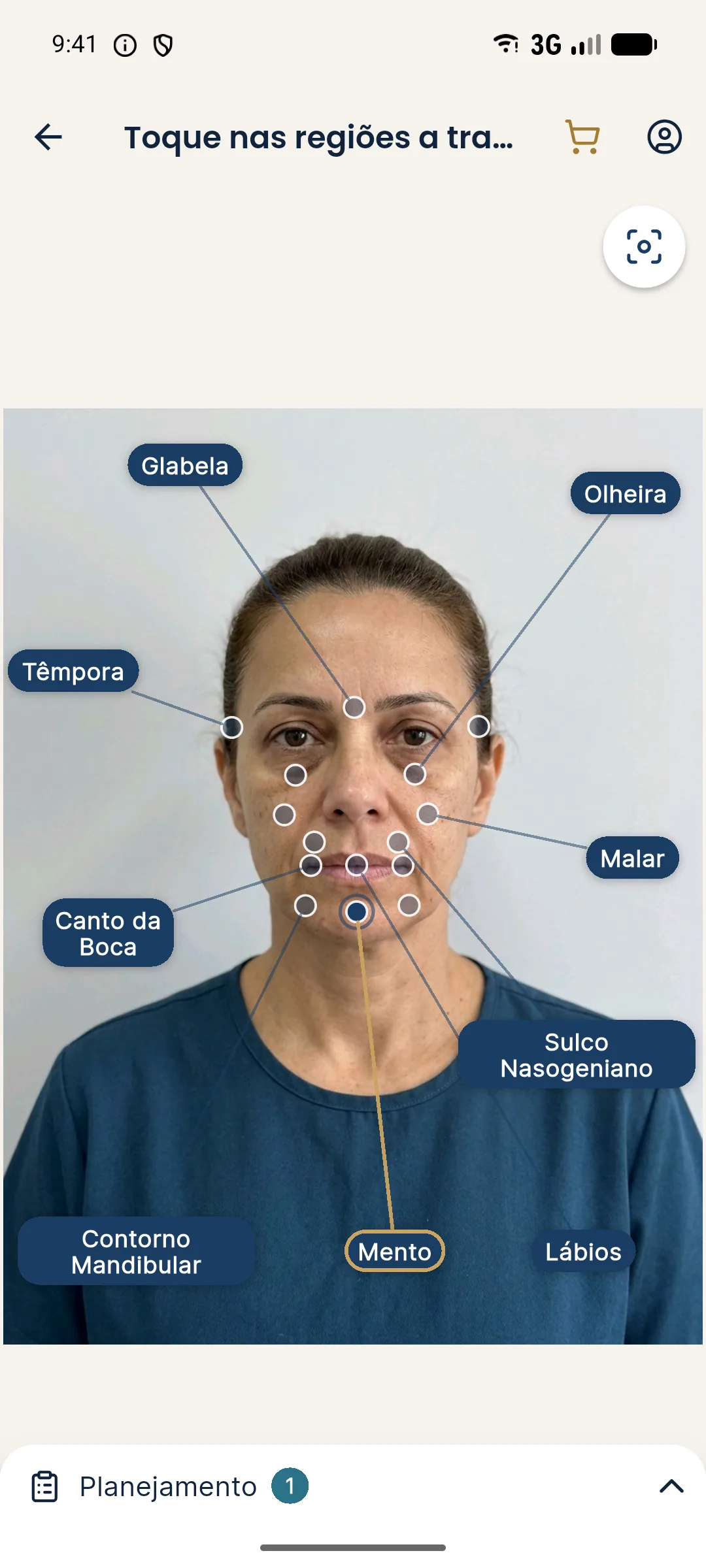
What does the app show and not show about the chin?
The frontal photo shows the width, height and contour of the chin, and the projection reflects those changes. It does not show projection on the anteroposterior axis, which is the decisive measurement in profile. That is why the app is useful for talking about shape and frontal proportion, and the projection goal remains clinical and based on profile assessment, with standardized photos and an exam.
This is part of honest use. The simulation remains an illustration, without replacing the exam, and that limit must be stated. The subject is discussed in limits of 2D simulation.
How to talk about chin projection without offending?
Avoid adjectives such as "weak chin" or "small chin". Talk about proportion and harmony: "your chin sits a little back relative to your nose and lips, and that changes how the profile reads". Patients usually notice the change in the sentence itself, and the conversation stays technical. For the communication itself, see how to point out asymmetry without offending and explaining the chin to the patient.
Frequently asked questions
What is the ideal chin projection?
There is no single number. Reference lines such as Ricketts and subnasale-to-pogonion guide the assessment, but the goal depends on the full profile, the bone, the occlusion and what the patient recognizes as their own.
Is the ideal chin different for men and women?
The described trend is a wider, more projected chin in the male face and a more delicate one in the female face. Many patients do not follow the trend, and the patient's identity prevails.
Does filler fix any chin retrusion?
No. With retrogenia from a bone deficit or a significant occlusal problem, volume has a limit and referral for a specific assessment may be needed.
How does Harmy help plan chin projection?
The Chin marking lets you choose ml and intensity, and the projection shows an approximation on the frontal photo. Since the app uses only the frontal photo, reading projection in profile remains a clinical task.
Harmy images are illustrative simulations generated by AI from the patient's photo to support the conversation between practitioner and patient. They are not a promise of results. Indication, technique, product and volume are solely the decision of the licensed practitioner. This content is for information only and does not replace a clinical assessment.