
How to explain the chin plan to the patient

 BeforeSimulation
- Nerve
- Highlighted area
Quick facts
- Core message
- The chin is assessed from the front and in profile, and it changes the profile more than the front
- App limit
- The simulation uses only the front-facing photo
- Tools mentioned
- Filler, and toxin when the muscle is overactive
- Risk to mention
- Swelling, bruising, asymmetry, nodules and vascular complication
The chin is an area where the concern and the solution are seen from different angles: the patient sees themselves from the front, but the most relevant effect of the treatment shows from the side. If the conversation uses only the front-facing photo, they may not grasp what is being proposed; if it uses only the profile, they may find the image unfamiliar. Explaining the chin needs to connect the two views.
How do you begin the explanation?
Ask first: "What do you notice about your chin, from the front and from the side?" Many patients only look at themselves from the front and discover their profile in the consultation photo, which can surprise them. Prepare them.
What should you explain about the profile?
The facial profile depends on the relationship between forehead, nose, lips and chin. The most prominent point of the chin is the pogonion, and the angle between the lower lip and the chin is the mentolabial angle. In patient language: "When the chin sits further back relative to the rest of the face, we call it retrogenia. It is not a flaw, it is a characteristic that can be balanced in some cases."
| Observation | How to explain it |
|---|---|
| Recessed chin | The chin sits behind the line of the rest of the face |
| Short chin | The height of the lower part of the face is smaller |
| Wide chin | The base of the chin is broader at the front |
| Overactive mentalis muscle | The chin "wrinkles" when the mouth closes |
Each row leads to a different approach: filler for projection, toxin for the mentalis muscle, and so on. See chin filler and mentalis toxin.
How do you handle the limit of the simulation?
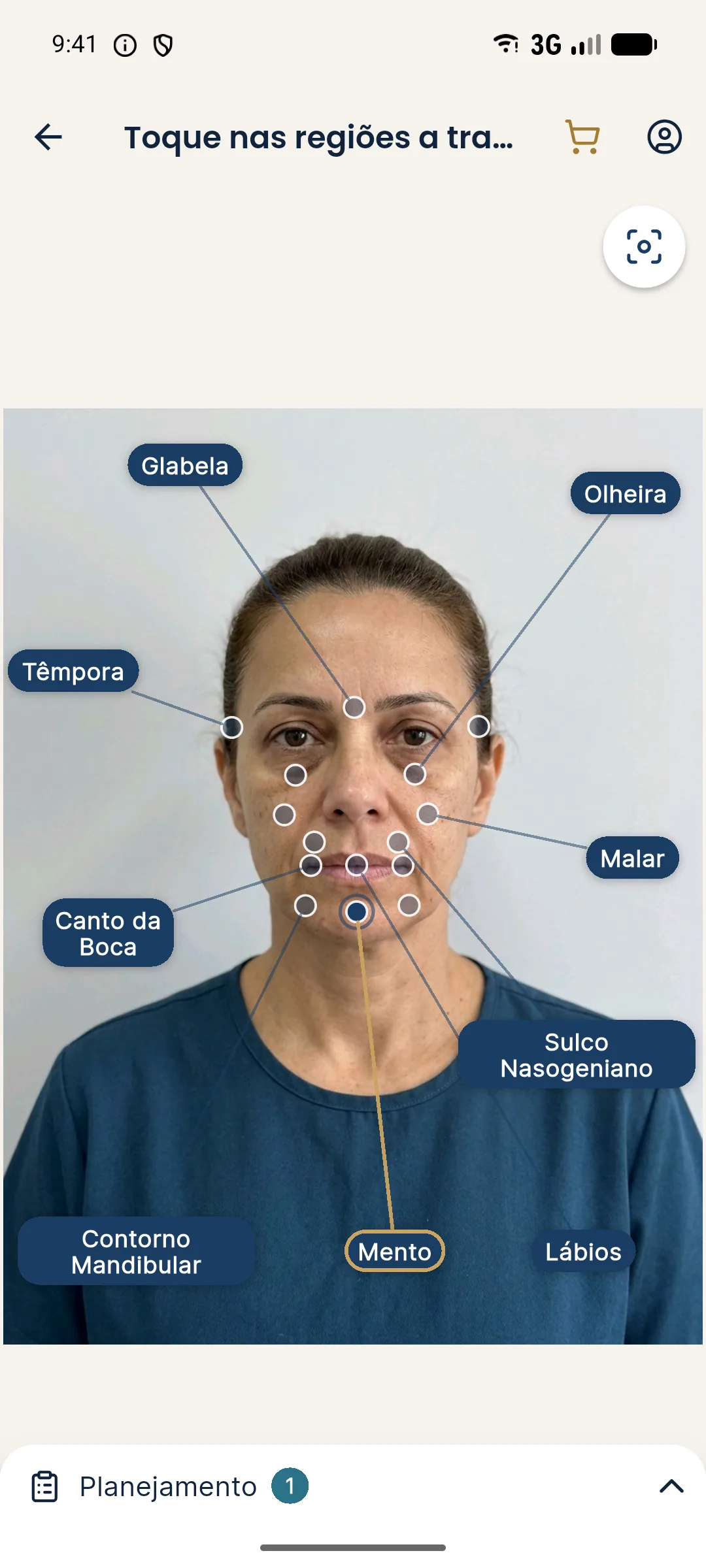
This is where transparency makes a difference. Harmy generates the projection from one front-facing photo, so it shows the effect of volume as seen from the front. There is no profile or 45-degree photo in the app. Tell the patient so.
How do you combine the front photo and the profile in the conversation?
Place the two photos side by side, full screen, with the patient and the photo mirror. Point out what changes with the proposal, using facts and not adjectives: "here, from the side, the line of the chin sits a little behind the lip." Then use the Harmy simulation to show the frontal change and say that the profile change is explained by anatomy, not by the image.
Which limits and risks should you explain?
Chin filler does not change the bone, and a significant bony change may call for another approach, such as surgery. There are also risks to mention:
- swelling and bruising, which usually pass;
- asymmetry or deviation of the tip of the chin;
- palpable nodules or irregularities;
- more rarely, a vascular complication;
- temporary change in sensation, when nerves are compressed.
When hyaluronic acid is used, hyaluronidase should be available. In the chin area, the mental nerve and the submental artery are points of anatomical attention. For the professional, see asymmetry after chin filler and the glossary entry on the mental nerve.
What can you say about the timing of the result?
Which questions should you expect?
What should you record?
Record the concern, the assessment from the front and in profile, the standardized photos (front and profile), the proposed plan, the limits explained and the informed consent. This protects the patient from an expectation based only on the front image, and protects you from a complaint about something the simulation did not show.
Explaining the chin is, at heart, teaching the patient to look at their own face from another angle, and so to decide with more information.
Frequently asked questions
How do I explain the chin plan to the patient?
Say the chin influences the profile and the balance of the face, and that you assess it from the front and from the side. The plan aims at proportion, and the intensity is agreed with them.
Does the Harmy simulation show the chin profile?
No. Harmy uses only the front-facing photo and does not show profile or 45-degree views. For the profile, use a standardized profile photograph in the patient record and explain the limitation to the patient.
Does chin filler replace surgery?
No. It can improve projection and proportion to varying degrees, but cases with a significant bony change may call for another approach. Explain the limit beforehand.
Can I talk about retrogenia with the patient?
Yes, in plain language. Retrogenia is a chin set back relative to the rest of the face, and it is a clinical observation, not a flaw. Describe it neutrally.
Harmy images are illustrative simulations generated by AI from the patient's photo to support the conversation between practitioner and patient. They are not a promise of results. Indication, technique, product and volume are solely the decision of the licensed practitioner. This content is for information only and does not replace a clinical assessment.