
Lips and Chin: Balancing the Lower Profile

 BeforeSimulation
- Nerve
- Highlighted area
Quick facts
- Core idea
- The relationship between the lower lip and the chin defines the profile of the lower third
- References
- Mentolabial angle, mentolabial sulcus, Ricketts line, pogonion projection
- Common mistake
- Enlarging the lip without assessing a retruded chin, and losing profile balance
- Warning
- Also assess the bony relationship: not everything is solved with volume
Few patients ask for "a more balanced profile." They ask for bigger lips, a more defined chin or "a mouth that sticks out less." But the professional knows the lower lip and the chin are part of the same silhouette. When one projects too far relative to the other, perception shifts: a normal lip looks big next to a retruded chin, and a good chin looks small beside a very projected lip.
This page shows how the relationship between lips and chin defines the lower profile, which references to use for assessment, how to combine the two in the plan and what to remember about the limits of volume. It is planning content, with no application protocol.
What defines the profile of the lower third?
The lower third runs from the base of the nose to the chin. Its profile results from the position of the upper lip, the lower lip, the sulcus between the lower lip and the chin, and the chin itself. The most used references:
| Reference | What it describes |
|---|---|
| Mentolabial angle | Angle of the sulcus between the lower lip and the chin |
| Mentolabial sulcus | Depth of the fold below the lower lip |
| Pogonion | Most projected point of the chin |
| Ricketts line | Line joining the tip of the nose to the pogonion, used to assess lip position |
| Retrogenia | Chin retruded relative to the norm |
These references are reading guides and vary between people and populations; they are not rigid targets. The full reading of the profile is in aesthetic profile: lips, nose and chin and that of the chin in ideal chin projection by sex.
Why does the chin change how the lip reads?
The eye judges projection relative to what is beside it. A lower lip that comes forward a few millimeters in front of a retruded chin looks fuller than it is. The same lip, in front of a well-projected chin, looks proportionate. In practical terms:
- A retruded chin makes the lower lip look big and heavy, and the mentolabial sulcus deep.
- A projected chin balances the lip and gives definition to the lower third.
- A thin lip with a well-projected chin can look hard, so lip volume is added with care.
That is why a patient who asks for more lip with a retruded chin may in fact need chin projection. And one who asks for a bigger chin may be reacting to a very projected lower lip. Assessment of the chin alone is in plan to project the chin and chin filler.
When is the problem bony rather than volume?
Not everything is solved with filler. Significant retrognathia, a misaligned bite or a small mandibular structure have a bony basis, and volume only masks part of the problem. In such cases, it may be appropriate to assess with other professionals, such as orthodontists and oral and maxillofacial surgeons, before deciding.
Signs that the basis may be bony:
- a clearly misaligned relationship between maxilla and mandible;
- chin projection far below the norm, with a functional complaint;
- a history of orthodontics or orthognathic surgery;
- a disproportion that would require a very large amount of volume.
The discussion is in when the problem is the bone, not the volume and retrognathic profile: assessment. An honest plan acknowledges the limit of volume.
How do you combine lips and chin in the plan?
The general logic is to assess the profile first, decide which element is the priority and plan in stages.
Decisions can follow four steps: identify the concern, measure the relationship, prioritize the element that weighs most and reassess after the first stage. In many cases, projecting the chin slightly already reduces the sense of excess in the lip, and the plan can do without lip volume. In others, the lip is the genuine concern, and the chin comes in only for balance.
The relationship between lip and chin in the lower third connects to 1/3 to 2/3 proportion in the lower third and chin and jaw: combining them in the plan.
What precautions are necessary?
Both areas have their own risks. The chin involves the mental nerve and the submental artery; the lips have the labial arteries and high mobility. Possible complications include swelling, bruising, asymmetry, nodules and vascular complications. With hyaluronic acid filler, hyaluronidase must be available. Details are in lip vascular occlusion and safety and complications: overview.
The decision on each technique and volume belongs to the qualified professional, after assessment, following the rules of their professional council in Brazil.
What should you tell the patient?
A visual explanation with the profile is usually more convincing than any speech. Show, on a side photo, the line between nose, lips and chin and explain how the pieces influence each other.
The conversation about the chin is in I want a bigger chin and about the lips in I want bigger lips.
How does Harmy fit in here?
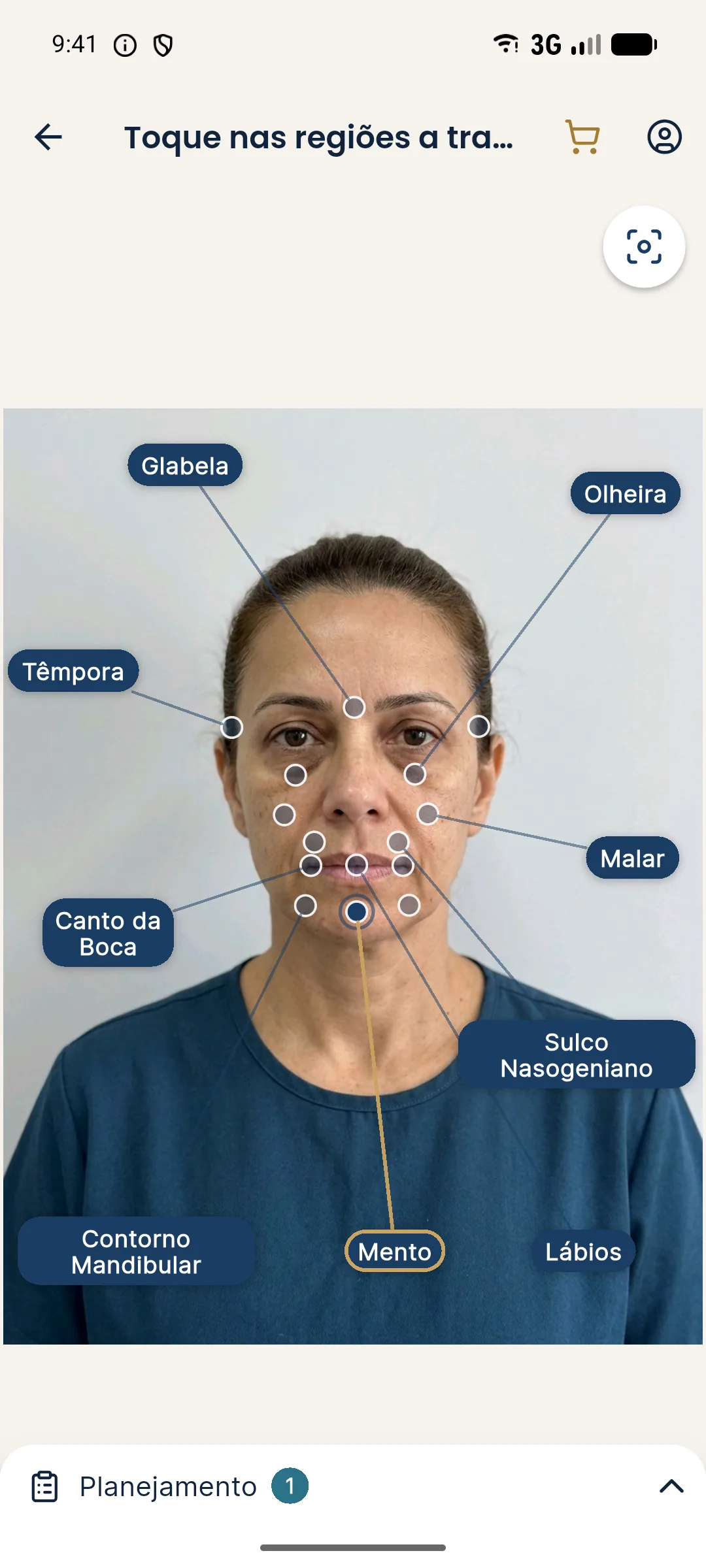
The steps in the app are in marking the chin in Harmy. Remind the patient that the frontal projection does not represent the profile, and that it is an illustrative simulation, not a promise of results.
Quiz: lips and chin
Summary
- The lower lip and chin together define the profile of the lower third.
- A retruded chin makes the lip look bigger and the mentolabial sulcus deep.
- Assess the profile on a side photo and use the mentolabial angle, Ricketts line and pogonion as guides.
- Not everything is volume: consider a bony cause and refer when indicated.
- Plan in stages and prioritize the element that weighs most in the concern.
- Harmy simulates only the frontal view and does not show the profile.
Frequently asked questions
Why plan lips and chin together?
Because the projection of the lower lip relative to the chin defines the profile of the lower third. Changing one without looking at the other can upset the harmony.
Does a small chin make the lip look big?
It can. When the chin is retruded, the lower lip looks more projected and the profile loses balance. Assessing the relationship between the two is part of the plan.
Does chin filler replace surgery?
No. It can improve projection in mild to moderate cases, but significant bony deficiencies may call for assessment by other specialties.
Does the app show the profile?
No. The Harmy projection uses only the frontal photo. The profile should be assessed outside the app, with side photos and at the consultation.
Harmy images are illustrative simulations generated by AI from the patient's photo to support the conversation between practitioner and patient. They are not a promise of results. Indication, technique, product and volume are solely the decision of the licensed practitioner. This content is for information only and does not replace a clinical assessment.