
Chin: Anatomy, Filler, and Botulinum Toxin

The chin is the base of the lower third and one of the main balance points of the facial profile. A retruded chin makes the nose look bigger and the neck less defined; a well-positioned chin organizes the relationship between nose, lips, and jaw. In orofacial harmonization, the area can be treated with filler, botulinum toxin, or both.
What are the anatomical boundaries of the chin?
The chin corresponds to the anterior, central portion of the mandible, below the lower lip. The practical boundaries are:
- Superior: the labiomental crease, below the lower lip.
- Inferior: the lower edge of the mandible, at the transition to the submental region.
- Lateral: the continuity with the jawline and the marionette line area.
Under the skin are the mentalis muscle, which raises and protrudes the lower lip and wrinkles the chin skin, and the lower lip depressor muscles. The bone has the mental protuberance at the center.
Vessels and nerves to watch
- Mental foramen and nerve, usually below the premolar region, on each side.
- Mental artery, which exits through the foramen along with the nerve.
- Inferior labial artery and submental artery, branches of the facial artery.
- Marginal mandibular branch of the facial nerve, more lateral.
The vascular risk in the chin is considered lower than in the midface, but it is not zero. A vascular occlusion in this area can lead to skin necrosis.
What do patients usually ask for?
Concerns show up like this:
- "I don't have a chin."
- "My nose looks big in profile."
- "My chin gets wrinkled when I talk."
- "I want a more defined face."
- "My chin is crooked."
During the assessment, look at the profile with the patient's head in its natural position and the lips relaxed. Assess the chin projection relative to the lower lip and the nose, the height of the lower third, and the dental occlusion. Significant skeletal changes may call for an orthodontic or surgical assessment before any filler.
Which procedures can be done on the chin?
The two main procedures:
- Chin filler, with high G' hyaluronic acid for projection and definition. Some professionals use calcium hydroxyapatite for the same purpose.
- Mentalis toxin, with botulinum toxin to reduce the overactivity of the mentalis muscle, which causes the "orange peel" look and can tense the lower lip.
The chin is usually planned together with jaw filler, because the chin and jaw form one continuous contour. Technique, plan, and instrument are the decision of the licensed professional, according to the rules of their professional council in Brazil.
What are the usual volumes and doses for the chin?
Usual ranges, at the discretion of the licensed professional, after assessment:
| Indication | Usual range | Note |
|---|---|---|
| Fine-tuning of projection | 0.5 to 1 ml | Patients with a slight retrusion |
| Moderate projection | 1 to 2 ml | Most common case |
| Greater retrusion | 2 to 3 ml, in sessions | Assess the limits of filler |
| Toxin in the mentalis | Label range, in toxin units | Units are not equivalent between products |
| Filler durability | Generally 12 to 18 months | Varies with product and patient |
| Toxin durability | Generally 3 to 6 months | Varies with dose and patient |
In greater retrusions, treating in stages helps assess the profile at each session.
Care, contraindications, and complications
General contraindications: active infection, pregnancy and breastfeeding, uncontrolled autoimmune disease, allergy to the components, and unrealistic expectations. For toxin, also consider neuromuscular diseases and medications that interfere with neuromuscular transmission.
Reported complications:
- Swelling and bruising.
- Chin asymmetry.
- Excess projection or widening, with an artificial look.
- With toxin: altered movement of the lower lip and smile asymmetry.
- Vascular occlusion, with a risk of necrosis.
For chin treatment with hyaluronic acid, hyaluronidase must be within reach before starting. The safety and complications guide summarizes what to look for.
How to assess the chin in profile?
Because the chin changes mainly the profile, the assessment needs to go beyond the frontal view. Some practical points:
- Natural head position: photograph and assess the profile without the patient tilting the face, so the retrusion is not masked.
- Relationship with the lower lip: in many balanced faces, the chin sits close to the vertical line of the lower lip. A visible retrusion in this relationship is the starting point for the indication.
- Labiomental crease: a very deep crease changes how the volume will look.
- Dental occlusion: bite problems can change the diagnosis and call for assessment by another specialty.
- Mentalis contraction: ask the patient to close the mouth tightly and see whether the "orange peel" look appears.
See also facial assessment by thirds.
How does the chin appear in Harmy?
In Harmy, the area is the Chin point in the marking step. The same point represents chin filler and mentalis toxin in the app's catalog. After the frontal photo, the app detects the face on the device and shows the points with labels; tap Chin to include it in the plan.
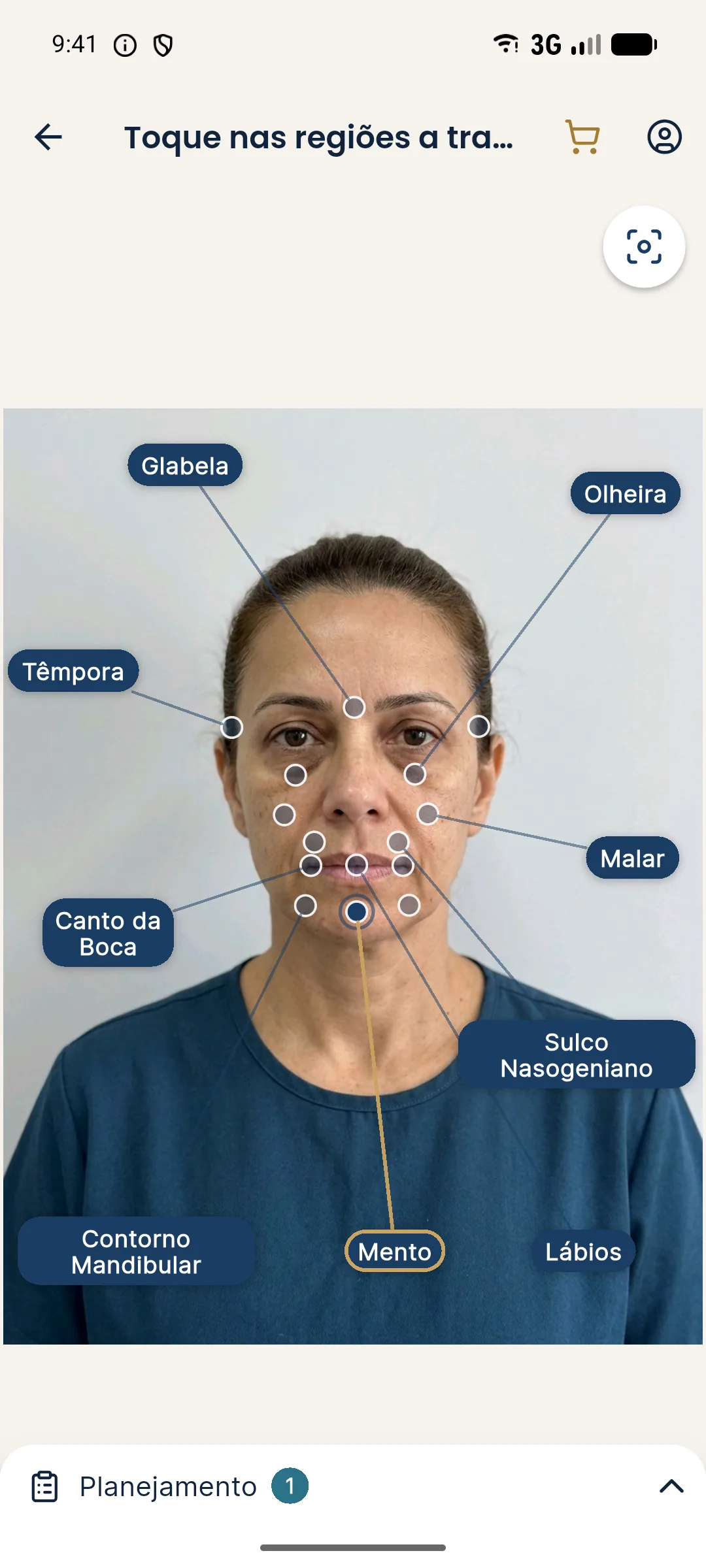
In the Plan, set the volume in ml (0.5 ml steps, from 0.5 to 5 ml). The simulation on this site used 1 ml. Because Harmy works with a frontal photo, the projection shows the chin from the front: the profile change, which is very important for the chin, you explain in the conversation.
See the step by step in marking areas and volumes and the tips on standardized clinical photography.
How to talk to the patient about the chin
Many patients have never thought about the chin and arrive asking for nose or lip work. Showing an illustrative simulation of the chin on their own photo helps explain how the chin changes the balance of the face, including how the nose is perceived.
Present the projection as a support tool, without promising results. To build the proposal in stages, see how to increase plan acceptance.
Frequently asked questions
Does chin filler change the profile?
It can. Projecting the chin usually balances the relationship between nose, lips, and chin in profile, but the result depends on each patient's anatomy and dental occlusion.
How much filler is used in the chin?
Generally 1 to 3 ml, at the discretion of the licensed professional after assessment. Larger retrusions are often treated over more than one session.
What is botulinum toxin used for in the chin?
It reduces contraction of the mentalis muscle, which causes the "orange peel" look in the chin and can pull on the lower lip. The dose is set by the professional after assessment.
Does chin filler replace surgery?
Not in every case. Significant retrognathia and occlusion problems may need an orthodontic or surgical assessment.
How do I simulate the chin in Harmy?
Mark the Chin point on the frontal photo and set the volume in ml in the Plan. The projection shows the change only in the chin.
Harmy images are illustrative simulations generated by AI from the patient's photo to support the conversation between practitioner and patient. They are not a promise of results. Indication, technique, product and volume are solely the decision of the licensed practitioner. This content is for information only and does not replace a clinical assessment.