
Treatment Areas in Orofacial Harmonization: An Overview

The face treated in orofacial harmonization (HOF) is usually divided into anatomical areas, each with its own structures, concerns and risks. Knowing the full map helps you plan globally, instead of responding only to the patient's isolated request ("I want lips", "I want to get rid of my smile lines").
This article is the entry point to the pages for each area. It organizes the regions by facial third, summarizes the most common concerns and associated procedures, and highlights where attention to safety must be doubled.
How is the face divided for planning?
The most widely used division in the clinic is the horizontal thirds:
- Upper third: from the hairline to the glabella.
- Middle third: from the glabella to the base of the nose.
- Lower third: from the base of the nose to the chin.
Beyond the thirds, the assessment considers symmetry between the sides, the profile view and the relationship among bone structure, fat, muscle and skin. The article facial assessment by thirds covers this method in depth.
Map of treatment areas
| Third | Area | Common concern | Frequent procedures | Page |
|---|---|---|---|---|
| Upper | Glabella | Lines between the eyebrows, a tired or angry look | Botulinum toxin | Glabella |
| Upper | Forehead | Horizontal forehead lines | Botulinum toxin | Forehead lines |
| Upper | Temples | Lateral hollowing, a gaunt-looking face | Filler | Temples |
| Upper and middle | Periorbital region | Tired look, crow's feet, loss of support | Toxin and filler, depending on the area | Periorbital |
| Middle | Under-eye area (tear trough) | Dark, deep groove under the eyes | Filler | Under-eye area |
| Middle | Lower eyelid | Marked transition between eyelid and cheek | Filler | Lower eyelid |
| Middle | Cheekbone | Loss of volume in the apple of the cheek | Filler, biostimulation | Cheekbone |
| Middle | Zygomatic | Little lateral projection of the arch, flat face | Filler | Zygomatic |
| Middle | Nose | Irregular dorsum, drooping tip | Filler (nonsurgical rhinoplasty) | Nose |
| Middle and lower | Nasolabial fold | Marked smile lines | Filler, treatment of the middle third | Nasolabial fold |
| Lower | Mouth corners | Drooping corners, sad expression, marionette lines | Filler, toxin depending on the case | Mouth corners |
| Lower | Lips | Thin or asymmetric lips, poorly defined contour | Filler | Lips |
| Lower | Chin | Retruded, short or orange-peel chin | Filler, toxin | Chin |
| Lower | Jawline | Poorly defined jaw, visible double chin, loss of the angle | Filler, biostimulation | Jawline |
The table is an overview. Indication, product, technique and volume are always the decision of the qualified professional, after assessment, in line with the rules of their professional board.
Which substances appear most often?
The areas above are mostly treated with three groups of resources:
- Hyaluronic acid: a filler used to restore volume and add projection and contour. It is reversible with hyaluronidase, which weighs in the choice for risk areas.
- Botulinum toxin: acts on muscle contraction and is mainly indicated for dynamic wrinkles of the upper third and some points of the lower third.
- Collagen biostimulators: stimulate collagen production over time, aimed more at quality and support than at immediate volume.
Static wrinkles, present even at rest, usually call for a combination of approaches.
Which areas require more safety care?
Every area carries risk. Some, however, concentrate vessels of relevant caliber in shallow planes or with a connection to the circulation of the eyes, and are cited as high vascular risk for filler:
- Glabella: a region classically associated with vascular occlusion events with filler.
- Nose: terminal circulation and little room to accommodate product.
- Nasolabial fold: course of the facial artery and its branches.
- Temples: superficial and deep temporal vessels.
- Tear trough (under-eye area): close to the periorbital circulation, with thin skin.
In these areas, mastery of anatomy, careful choice of product and instrument at the professional's discretion, and having hyaluronidase in the clinic are essential. In any area treated with hyaluronic acid, hyaluronidase must be available. See the overview of safety and complications.
Why think of the face as a whole?
Areas do not work in isolation. Some examples of interactions that often come up in assessment:
- Loss of support in the cheekbone can deepen the nasolabial fold and the tear trough. Treating only the fold, in that case, tends to weigh down the lower third.
- A retruded chin changes how the lips and nose read in profile.
- Hollow temples accentuate a tired look together with the periorbital region.
- A poorly defined jawline changes the perception of the entire lower third.
That is why the plan usually prioritizes structure and support before details, and spreads treatment over stages. This logic also helps explain to the patient why the plan may include areas they did not ask about.
Does the priority of areas change with age and profile?
It does, and understanding this avoids standardized plans. In younger patients, demand tends to focus on contour and proportion: lips, chin, jawline and cheekbone projection. Over the years, loss of volume and support gains weight, and areas such as the temples, tear trough, nasolabial fold and mouth corners enter the plan more often.
Profile also matters. A retruded chin can make the nose look bigger and the lips more projected than they are. A middle third with little projection can deepen shadows under the eyes. In such cases, treating structure first usually calls for less volume in the detail areas.
The practical point is to record, in the assessment, the reason each area enters the plan. This helps explain the sequence to the patient and makes it easier to compare photos in later stages.
How do the areas appear in Harmy?
In Harmy, after the front photo, the app detects the face on the device itself and shows labeled points over the regions. You tap the points for the regions to treat and set the volume in ml for each one in the Plan.
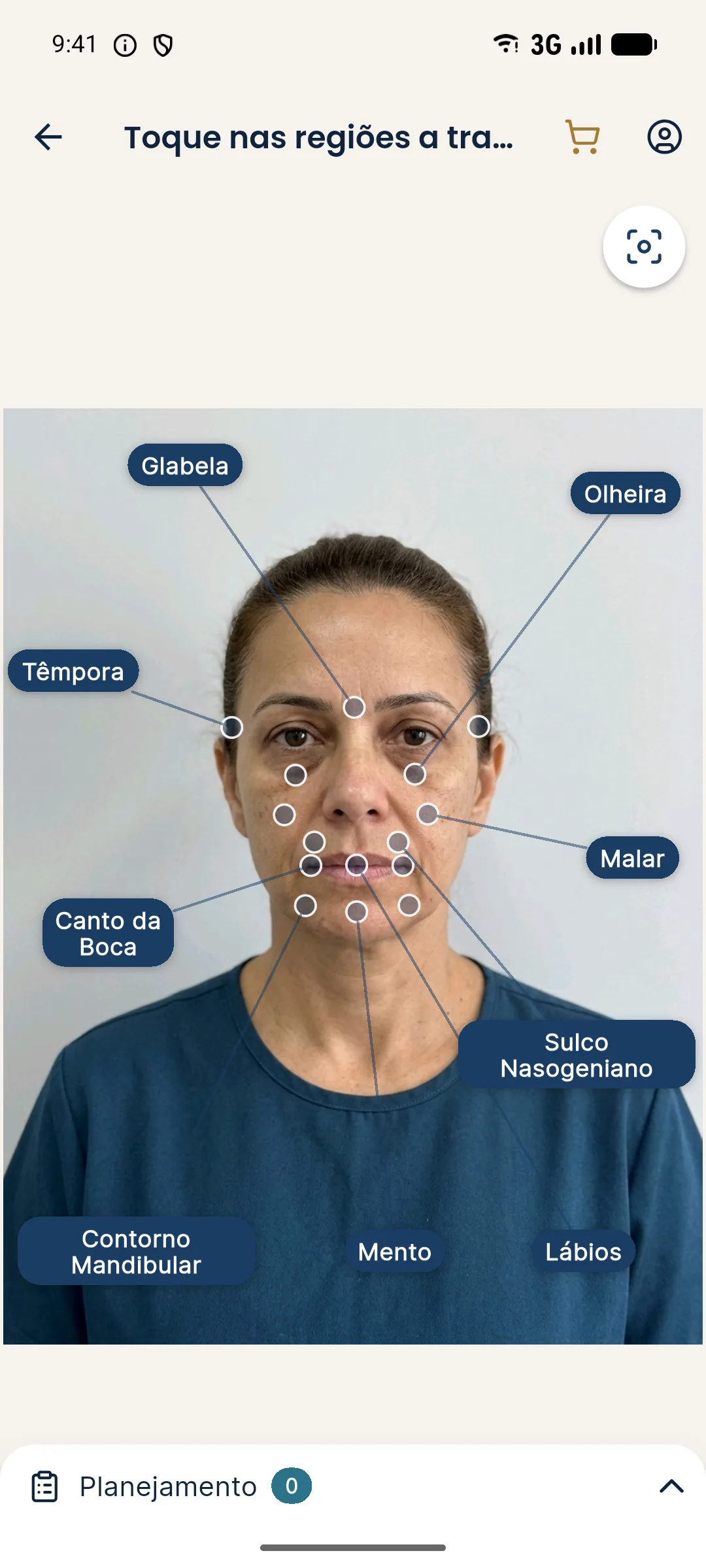
The available points are:
| Point in Harmy | Related areas | Related procedures |
|---|---|---|
| Glabella | Glabella | Glabella toxin |
| Temple | Temples | Temple filler |
| Tear Trough | Under-eye area, lower eyelid | Under-eye filler, lower eyelid smoothing |
| Cheekbone | Cheekbone, zygomatic | Cheekbone filler, zygomatic filler |
| Nasolabial Fold | Nasolabial fold | Nasolabial fold filler |
| Mouth Corner | Mouth corners | Mouth corner filler |
| Lips | Lips | Lip filler |
| Chin | Chin | Chin filler, mentalis toxin |
| Jawline | Jawline | Jawline filler |
Volume ranges from 0.5 to 5 ml per region, in 0.5 ml steps. For bilateral regions, the value is the total, split between the two sides. The projection changes only what was marked, without retouching skin, expression, background, hair or lighting, and the effect is more noticeable the larger the volume. Forehead, nose and the broad periorbital region do not have their own point in the app today.
The step by step is in marking areas and volumes.
How do you use this map at the consultation?
A sequence that tends to work:
- Listen to the patient's main concern in their own words.
- Assess the face by thirds, from the front and in profile, and note the areas involved.
- Explain the relationship between the concern and neighboring areas, using the map.
- Define priorities and stages, with the volume range and the product at clinical discretion.
- Show the illustrative simulation of the plan, making clear that it is not a promise of results.
- Record the plan, the consent and the photos.
Review checklist by area
Before including an area in the plan, check:
- Does the patient's concern relate to this area, or is it a consequence of another?
- Is the area high vascular risk? Does the clinic have hyaluronidase and a complication protocol?
- Is there a local contraindication (infection, inflammation, recent procedure)?
- Is the planned volume within a usual range for this area, at clinical discretion?
- Does the patient understand what the treatment can and cannot change?
Each area page covers anatomy, concerns, procedures, precautions and how the region appears in Harmy's marking. Start with the third that weighs most on your patient's concern and navigate from there.
Frequently asked questions
What are the main areas of orofacial harmonization?
The most commonly treated are the glabella, forehead, temples, periorbital region and tear troughs, cheekbone and zygomatic area, nose, nasolabial fold, mouth corners, lips, chin and jawline, organized into upper, middle and lower thirds.
Which areas of the face carry the highest vascular risk?
The glabella, nose, nasolabial fold, temples and tear trough are cited as high vascular risk regions for filler. In them, anatomical knowledge and having hyaluronidase on hand are essential.
Where should harmonization planning start?
Generally with a global assessment of the face, by thirds and in profile, before looking at isolated areas. Treating the supporting base (cheekbone, temples, chin, jaw) often changes how neighboring areas look.
Which areas can I mark in Harmy?
Glabella, Temple, Tear Trough, Cheekbone, Nasolabial Fold, Mouth Corner, Lips, Chin and Jawline. At each point you set the volume in ml, from 0.5 to 5 ml.
Harmy images are illustrative simulations generated by AI from the patient's photo to support the conversation between practitioner and patient. They are not a promise of results. Indication, technique, product and volume are solely the decision of the licensed practitioner. This content is for information only and does not replace a clinical assessment.