
How Hyaluronic Acid Filler Varies From One Facial Area to Another
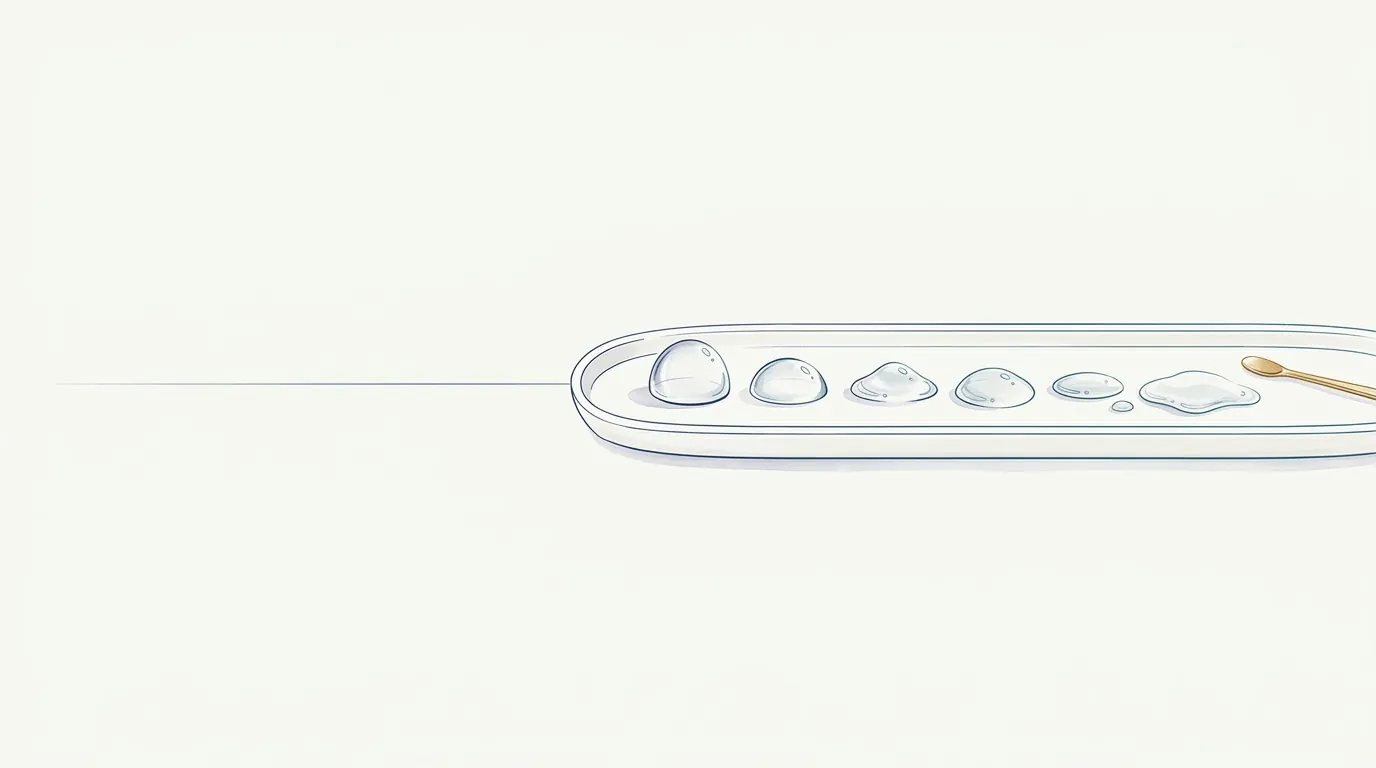
Hyaluronic acid is not a single product. Under the same name there are gels with very different behaviors: some firm, made to support and project; others soft, made to blend into thin, mobile tissue. Choosing the right gel for each area is one of the decisions that most influences the result and the safety of the filler.
This guide explains, at a review level, which gel properties matter, which characteristics of each area weigh on the choice and how this translates into a map of the face. It names no brands, teaches no technique and sets no volumes: product, plane and amount are decisions for the licensed professional, after assessment, according to the product label and the rules of their professional council in Brazil.
Which gel properties change its behavior?
Manufacturers describe their gels with a set of rheological and formulation properties. The names vary, but the concepts repeat.
| Property | What it describes | Practical effect |
|---|---|---|
| Cross-linking | Bonds between the hyaluronic acid chains | More cross-linking tends to give a firmer, longer-lasting gel |
| G prime (G') | Elasticity, resistance to deformation | High G' supports and projects; low G' is softer and more pliable |
| Cohesivity | How well the gel holds together | Influences how the gel spreads in the tissue |
| Concentration | Amount of hyaluronic acid per ml | Affects firmness and water absorption |
| Particle size or gel technology | Particulate or more homogeneous gel | Changes the feel to the touch and the integration |
| Water absorption capacity | How much the gel "swells" after placement | Matters in areas where swelling and extra volume appear easily |
No property is better in itself. What exists is suitability: the right gel for what the area needs and for what it tolerates.
Which characteristics of the area weigh on the choice?
Before thinking about the gel, it helps to describe the area. Five questions help:
- What is the goal? Volumization, support, projection, contour, hydration or softening of a sulcus.
- What is the covering skin like? Thin skin shows irregularities and can reveal the gel; thick skin disguises it.
- How much does the area move? High-movement areas call for a gel that follows the expression without showing.
- What is the deep support? Over bone, the gel finds support; in soft tissue, it behaves differently.
- What is the vascular risk? Areas with relevant vessels call for more care with product, instrument and technique.
What does the map of the face look like?
The table summarizes general tendencies cited in the literature and on product labels. It is not a prescription: individual cases may call for different choices.
| Area | Usual goal | Skin and movement | Gel tendency | Special attention |
|---|---|---|---|---|
| Temples | Volumization, transition to the forehead | Thin skin, little movement | Gel that fills without showing | High vascular risk |
| Cheekbone and zygomatic | Midface projection and support | Medium skin, moderate movement | Medium to high firmness | Avoid excess weight in the midface |
| Under-eyes (tear trough) | Soften the transition between eyelid and cheek | Very thin skin, tendency to swell | Soft gel with low water absorption | High vascular risk, Tyndall effect |
| Nasolabial fold | Soften the fold | Medium skin, a lot of movement | Intermediate firmness | High vascular risk |
| Lips | Volume, contour, hydration | Mucosa, intense movement | Soft to intermediate gel | Labial arteries, swelling |
| Mouth corners | Soften the droop of the corner | Thin skin, a lot of movement | Soft to intermediate gel | Naturalness of the expression |
| Chin | Projection and lengthening | Thick skin, bony support | Firm gel | Proportion with the nose and lips |
| Jawline | Definition and contour | Thick skin, bony support | Firm gel | Proportion and unwanted masculinization |
Why does thin skin call for a soft gel?
In thin-skinned areas, such as the tear trough and the temples, a firm gel can become palpable or visible, and a gel placed superficially can produce the bluish tone of the Tyndall effect. Gels that absorb a lot of water also tend to accumulate volume and swelling in these areas. That is why soft, low-water-absorption gels in conservative volumes are usually prioritized there, at the professional's discretion. The details of each area are in under-eye filler and temple filler.
Why do support areas call for a firm gel?
In the chin and along the jawline, the goal is usually to project or define the contour over bony support. A soft gel tends to spread and lose shape. High-G' gels with good cohesivity usually hold projection better. Because the skin is thicker, the risk of the gel showing is lower. See chin filler and jawline filler.
What about high-movement areas?
The lips, mouth corners and nasolabial fold move all the time. A gel that is too firm can become evident when smiling or talking; one that is too soft can migrate or last a short time. The choice usually looks for a gel that follows the expression, and durability tends to be lower than in static areas. For the lips, there is also the choice between volume, contour and hydration, which may call for different gels within the same plan. See lip filler.
Does durability also change with the area?
Yes. The durability of a filler depends on the product, the volume, the plane, the patient's metabolism and local movement. In general:
- static areas with bony support tend to keep the result longer;
- high-movement areas tend to last less;
- the same product can last different lengths of time in different areas.
When explaining to the patient, speak in ranges and in "in general" terms, never a guaranteed duration. The usual ranges per procedure are on the pages for each procedure.
Does safety change with the gel?
Safety depends mainly on anatomy, plane, instrument and technique, more than on the gel. But the choice of product enters the equation:
- all hyaluronic acid can be broken down by hyaluronidase, which must be available in the practice; the setup is in hyaluronidase in the practice;
- different gels may respond differently to the enzyme, depending on the manufacturer;
- in high vascular risk areas, reversibility weighs more in the choice.
How does this show up in planning with the patient?
The patient does not need to know what G prime is. They need to understand that each area has a goal, that the product is chosen for that goal and that the result is gradual and subtle when the volume is moderate.
In Harmy, the Plan records the volume in ml per area (from 0.5 to 5 ml, in 0.5 ml steps) and the projection changes only the marked areas, with an intensity proportional to the volume. In a bilateral area, the ml is the total, split between both sides. The app does not choose the product or assess anatomy: that part is yours. But seeing side by side the effect of 1 ml in the lips and 2 ml in the cheekbone helps the patient understand why the plan has different volumes for each area. The step by step is in marking areas and volumes.
Which choice mistakes appear most often?
- Firm gel in thin skin. It can become palpable, visible or give the bluish tone of the Tyndall effect.
- Soft gel in a support area. It spreads, does not project and leads to adding volume to compensate.
- High water-absorption gel under the eyes. It tends to accumulate volume and persistent swelling.
- A single product for everything, for stock convenience, without considering the goal of each area.
- Choosing by the promised duration and not by suitability for the area.
- Ignoring what already exists in the area, such as product placed earlier at another practice.
A simple way to avoid these mistakes is to write down, before opening any product, the goal of each area in the plan and the gel characteristic it calls for. Product choice comes afterward.
Checklist for choosing the gel by area
- Goal of the area defined (volume, support, projection, contour, softening).
- Skin thickness and local movement assessed.
- Deep support considered (bone or soft tissue).
- Vascular risk of the area considered in the choice of product and instrument.
- Product label read, with indication of area and plane.
- Volume planned as a conservative range, at the professional's discretion.
- Hyaluronidase available and compatible with the product, per the manufacturer.
- Product, lot, volume and area recorded in the patient chart.
For the overall view of the areas, see the overview of treatment areas.
Frequently asked questions
Is there a different hyaluronic acid for each area of the face?
There is no fixed rule, but each area calls for different properties. Support areas, such as the chin and jaw, usually use firmer gels; thin-skinned, high-movement areas, such as the lips and under-eyes, usually use softer gels. The choice belongs to the licensed professional.
What is G prime in hyaluronic acid?
G prime (G') is a measure of the gel's elasticity, tied to its ability to resist deformation and support tissue. A high G prime gel tends to give more projection; a low G prime gel, more softness and integration.
Why does filler last longer in one area than in another?
Durability depends on the product, the volume, the plane, the patient's metabolism and the movement of the area. High-movement areas, such as the lips, usually last less than more static ones.
Can I use the same hyaluronic acid on the whole face?
Some professionals work with a few versatile products, but using the same gel in every area is usually a compromise. A gel that is too firm in thin-skinned areas can become visible; a gel that is too soft in support areas may not project.
Harmy images are illustrative simulations generated by AI from the patient's photo to support the conversation between practitioner and patient. They are not a promise of results. Indication, technique, product and volume are solely the decision of the licensed practitioner. This content is for information only and does not replace a clinical assessment.