
Cannula or needle: differences, advantages and limits
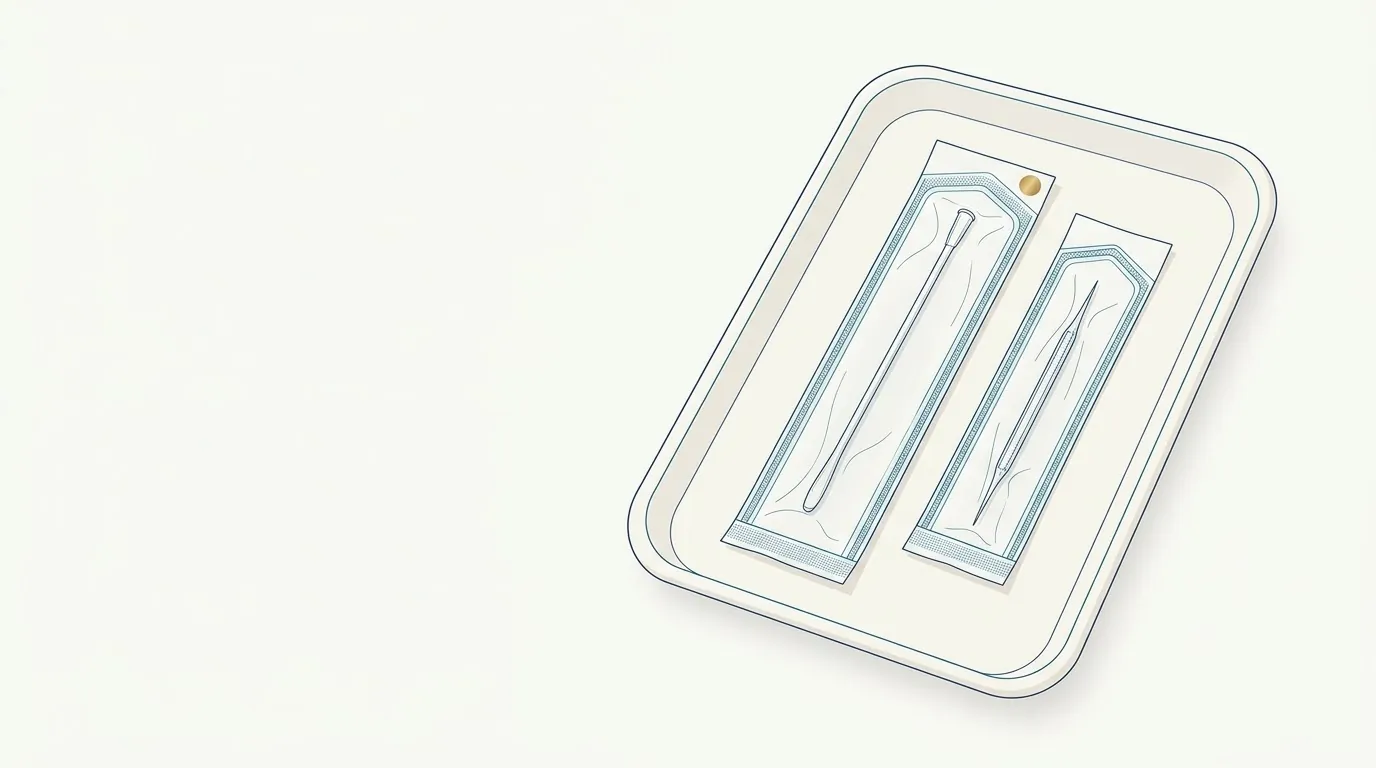
The choice between a cannula and a needle is one of the most frequent conversations in orofacial harmonization (HOF). Each instrument has real advantages, and neither is universally better. The decision depends on the area, the product, the goal, the patient's anatomy and the experience of the person injecting.
This guide compares the two instruments at a review level. It does not teach technique or prescribe planes, points or depths: those choices belong to the qualified professional, in line with the rules of their professional board in Brazil and the training they received.
What is the basic difference between a cannula and a needle?
A needle has a cutting tip (bevel) and goes straight into the tissue. A cannula has a blunt tip and a side opening, and it needs an entry hole, usually made with a needle, through which it is introduced and guided through the tissue.
| Feature | Needle | Cannula |
|---|---|---|
| Tip | Cutting (bevel) | Blunt, with a side exit |
| Entry | Direct, at each injection point | Through an entry hole, from which a larger area is reached |
| Entry points | Usually more | Usually fewer |
| Precision at small points | High | Lower |
| Tendency to bruise | Higher | Lower |
| Tendency to puncture vessels | Higher | Lower, but present |
| Feel for the patient | More pricks | Fewer pricks, a sensation of pressure |
| Learning curve | Specific to each technique | Specific to each technique |
What are the advantages of the cannula?
- Fewer entry points. From a single hole, the cannula reaches a larger area, which usually means less discomfort and fewer marks.
- Less bruising and swelling. The blunt tip tends to deflect off vessels instead of cutting them.
- Lower tendency to puncture vessels. This is the most cited reason for using it in areas of vascular risk.
- More even distribution in wide areas, such as the cheekbones and temples, at the professional's discretion.
What are the limits of the cannula?
- It does not eliminate the risk of vascular occlusion. It lowers the chance of puncture, but the product can still compress vessels or, in some situations, enter them. A cannula is no substitute for anatomical knowledge or for having hyaluronidase available.
- Gauge matters. Very fine cannulas behave more like needles.
- Lower precision at small, well-defined points.
- It requires an entry hole, which is also a point of trauma and needs asepsis.
- A false sense of security. The risk of the professional relaxing their attention because they are "using a cannula" is cited as a contributing factor in complications.
What are the advantages of the needle?
- Precision. To deposit small amounts at exact points, the needle is generally more precise.
- Bone contact. For injections over the periosteum, at the professional's discretion, the needle is often used.
- Simplicity. It does not need a separate entry hole.
- Indispensable for toxin. Botulinum toxin is injected with a needle, because it is a point injection into muscle, with no volume to spread.
What are the limits of the needle?
- More entry points, with more discomfort and marks.
- More bruising, mainly in highly vascularized areas.
- Greater tendency to puncture vessels, which weighs heavily in areas of high vascular risk.
How does the area influence the choice?
The table shows choice tendencies that are cited often. It is not a rule: many professionals combine both instruments in the same area, depending on the goal of each step.
| Area | Most cited tendency | Why |
|---|---|---|
| Temples | Both, depending on plan and technique | Wide area, high vascular risk |
| Cheekbone | Both | Point projection with a needle, distribution with a cannula |
| Under-eye area | Cannula, often | Thin skin, high vascular risk, tendency to bruise |
| Nasolabial fold | Cannula, often | High vascular risk |
| Lips | Needle for the border, both for volume | Precision at the border, labial arteries |
| Chin | Both | Projection over bony support |
| Jawline | Both | Defining the contour over an extensive area |
| Glabella and nose, with filler | Very careful decision | High vascular risk areas, with communication to the ocular circulation |
Does cannula or needle change the aesthetic result?
The instrument changes how the product is distributed, but the result depends above all on the indication, the product, the volume and the technique. Used well, both can reach similar results in many areas. What tends to change more is the patient's experience on the day (pricks, discomfort, bruising) and recovery over the following days.
How do you explain the difference to the patient?
Many patients arrive asking "do you use a cannula?", because they heard it is safer. It is worth explaining honestly:
- both instruments are used and each has its indication;
- a cannula usually causes less bruising, but it does not make the procedure risk-free;
- the choice is made for each area, with safety and results in mind;
- the office has a protocol for complications, with hyaluronidase available.
Avoid using the instrument as a sales pitch ("only cannula here, no risks"). Besides being inaccurate, it conflicts with health advertising rules. See what you may advertise under the professional boards and CONAR (CONAR is Brazil's advertising self-regulation council).
And vascular anatomy, how does it factor into the decision?
Choosing the instrument only makes sense alongside knowledge of the vascular anatomy of the area. Vessels such as the facial artery and its branches have known courses, but with important variation between people. No instrument makes up for a lack of that knowledge. That is why the anatomical review comes before the choice between cannula and needle, not after.
What myths come up often?
| Myth | What is usually true |
|---|---|
| "With a cannula there is no risk of occlusion" | A cannula lowers the chance of puncture, but vascular occlusion remains possible |
| "A needle is always riskier" | Risk depends on area, plane, gauge, product and technique, not only on the instrument |
| "A cannula gives a more natural result" | Natural-looking results depend on indication and volume; both instruments can achieve them |
| "A thinner cannula is more comfortable and safer" | Thinner may be more comfortable, but it behaves more like a needle |
| "Whoever uses a cannula doesn't need hyaluronidase" | Hyaluronidase must be available whenever hyaluronic acid is used |
How does the professional's experience enter the choice?
Each instrument has its own learning curve. A professional with a lot of experience with a needle in a given area may get safer results with it than with a cannula they rarely use, and the reverse is also true. Switching instruments in a risk area calls for supervised training and practice, not just a change of material.
It is also worth remembering that the choice can change within the same plan. In a cheekbone filler, for example, the professional may use one instrument for one step and another for the next, depending on the goal of each. What matters is that the decision is conscious and recorded, not an automatic habit.
Common mistakes
- Choosing the instrument by the patient's preference rather than by indication.
- Relaxing observation of the skin during injection because a cannula is being used.
- Using a very fine-gauge cannula in a high-risk area without considering how it behaves.
- Not recording the instrument, which makes it harder to review the case later.
What should go in the patient record?
The instrument is part of the procedure record, together with the product, lot, volume and area. In case of a complication, this information helps with management and with reviewing the case.
| Field | Example entry |
|---|---|
| Area | Cheekbone, bilateral |
| Product and lot | Trade name and vial lot |
| Volume | Total and per side |
| Instrument | Cannula or needle, with gauge and length |
| Complications | None, or a description |
And in Harmy?
Harmy does not record instrument, plane or technique. The Plan stores the marked areas and the volume in ml for each one, and the projection shows the likely visual effect of that volume, as an illustrative simulation, not a promise of results. How to get there, with a cannula, a needle or both, is a clinical decision and stays in your patient record.
Checklist for deciding the instrument
- Goal for the area defined.
- Vascular anatomy of the area reviewed.
- Product and volume compatible with the chosen instrument.
- Gauge and length suited to the goal.
- The professional's experience and training with that instrument in that area.
- Hyaluronidase available whenever hyaluronic acid is used.
- Patient informed about what to expect on the day and in the following days.
- Instrument recorded in the patient record.
To understand how the gel changes from area to area, see how hyaluronic acid varies from area to area. For the signs of a complication, see the safety and complications overview.
Frequently asked questions
Is a cannula safer than a needle for filler?
A blunt-tip cannula tends to lower the risk of puncturing vessels and usually causes less bruising, but it does not eliminate the risk of vascular occlusion. Safety depends on anatomy, gauge, plane and technique, at the discretion of the qualified professional.
When is a needle preferred over a cannula?
A needle is usually preferred when precision is needed at small points, such as the lip border, and for injections over bone, at the professional's discretion. Botulinum toxin is injected with a needle.
Does filler with a cannula hurt less?
Many patients report less discomfort and less bruising with a cannula, because there are fewer entry points. Perception varies from person to person and with the area treated.
Does cannula gauge make a difference?
Yes. Very fine-gauge cannulas behave more like a needle and can puncture vessels more easily. Choosing the gauge is part of the professional's technical decision.
Harmy images are illustrative simulations generated by AI from the patient's photo to support the conversation between practitioner and patient. They are not a promise of results. Indication, technique, product and volume are solely the decision of the licensed practitioner. This content is for information only and does not replace a clinical assessment.