
Jawline Contour: Anatomy and Jaw Filler
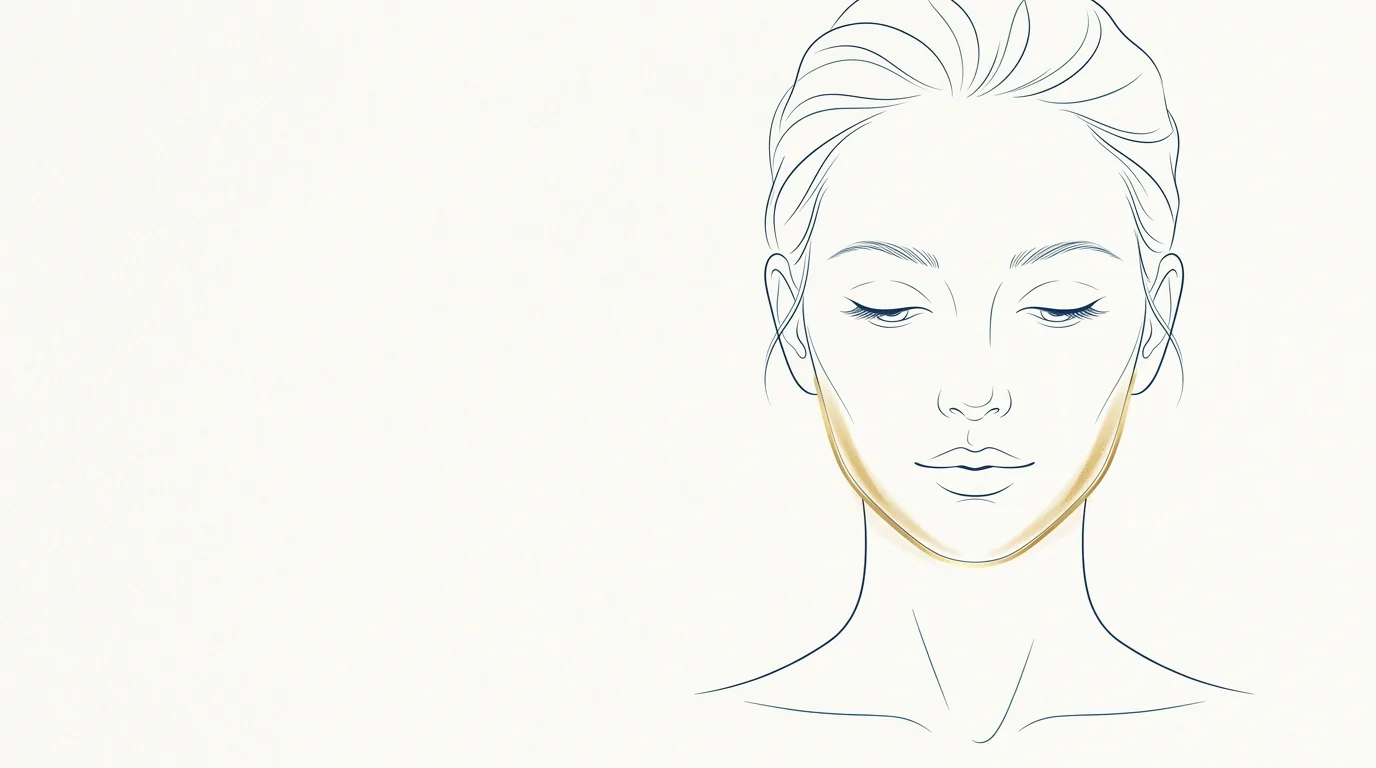
The jawline contour is the frame of the lower third. The jawline defines the separation between face and neck, and the mandibular angle gives the width and shape of the lower face. With aging, or in faces with little bony structure, this frame loses definition, and the face starts to look heavier or less firm.
What are the anatomical boundaries of the jawline contour?
The jawline contour follows the lower edge of the body of the mandible, from the chin to the angle, and rises along the ramus of the mandible toward the ear. For assessment, the area is usually divided into:
- Mandibular angle: the posterior corner, below the ear.
- Body of the mandible: the lower edge between the angle and the chin.
- Pre-jowl region: the depression in front of the jowl, at the transition to the chin.
Over the bone sit the masseter muscle (at the angle), the platysma, the parotid gland in the posterior portion, and the fat compartments of the area, including the jowl fat, which descends with age.
Vessels and nerves to watch
- Facial artery and vein, which cross the edge of the mandible in front of the masseter, at the so-called antegonial notch.
- Marginal mandibular branch of the facial nerve, which runs close to the edge of the mandible and supplies the lower lip depressors.
- Parotid gland and its duct, in the posterior and upper portion.
- Mental foramen and nerve, in the anterior portion.
The point where the facial artery crosses the edge of the mandible calls for special attention. A vascular occlusion in this area can lead to skin necrosis.
What do patients usually ask for?
Requests tend to come in like this:
- "I want my face more defined."
- "I've lost the contour of my face."
- "I have a double chin and my face looks round."
- "I want a sharp jawline."
- "I'm getting jowls."
During the assessment, look at the patient from the front, in three-quarter view, and in profile, with the head in a natural position. Distinguish loss of bony contour (which filler can treat) from skin laxity, excess submental fat, and masseter hypertrophy, which call for other approaches. Also consider the goal: some patients want to soften, others want to sharpen.
Which procedures can be done on the jawline contour?
The main procedure is jaw filler with high G' hyaluronic acid, suited to support and definition. Some professionals use calcium hydroxyapatite or other collagen biostimulators, focusing on structure and skin quality.
Other procedures in the plan:
- Chin filler, because the chin and jaw form one continuous contour.
- Mouth corner filler, when the marionette line adds to the loss of contour.
- Botulinum toxin in the masseter, when muscle hypertrophy widens the lower third.
Technique, plan, and instrument are the decision of the licensed professional, according to the rules of their professional council in Brazil.
What are the usual volumes for the jawline contour?
Usual ranges in ml of hyaluronic acid, at the discretion of the licensed professional, after assessment:
| Goal | Usual range (total, both sides) | Note |
|---|---|---|
| Subtle definition | 2 to 3 ml | Young patients or fine-tuning |
| Moderate contour | 3 to 4 ml | Most common case |
| Significant loss of contour | 4 to 6 ml or more, in sessions | Splitting helps assess the result |
| Durability | Generally 12 to 18 months | Varies with product and patient |
The jawline is one of the areas that uses the most product. Planning in stages helps the patient organize the investment and helps you assess the response.
Care, contraindications, and complications
General contraindications: active infection, pregnancy and breastfeeding, uncontrolled autoimmune disease, allergy to the components, and unrealistic expectations. Record any medications that increase the risk of bleeding.
Reported complications:
- Swelling and bruising.
- Pain when chewing in the first few days, because of the proximity to the masseter.
- Facial asymmetry between the sides.
- Excessive widening of the lower third or an artificial look.
- Palpable lumps and irregularities.
- Vascular occlusion, with a risk of necrosis.
If the product is hyaluronic acid, keep hyaluronidase at hand during the visit. For warning signs and management, read the overview of safety and complications.
How to tell loss of contour from other causes?
In the consultation, many patients describe as "undefined jawline" conditions that have different causes. Separating these causes before proposing filler avoids frustration:
- Loss of bony structure or deep support: the contour looks faded even in thin patients. This is the classic indication for filler.
- Submental fat: the edge of the jaw is there, but it is hidden by volume under the chin.
- Skin laxity and jowls: the tissues descend and create the jowl, which can get worse if volume is placed in the wrong spot.
- Masseter hypertrophy: the lower third looks wide and square, and the case may call for toxin instead of volume.
Many patients combine more than one cause. Assessing the face by thirds helps you see the lower third within the proportions of the whole face.
How does the jawline contour appear in Harmy?
In Harmy, the area is the Jawline point in the marking step. After the frontal photo, the app detects the face on the device and shows the points with labels. Tap Jawline to include it in the plan.
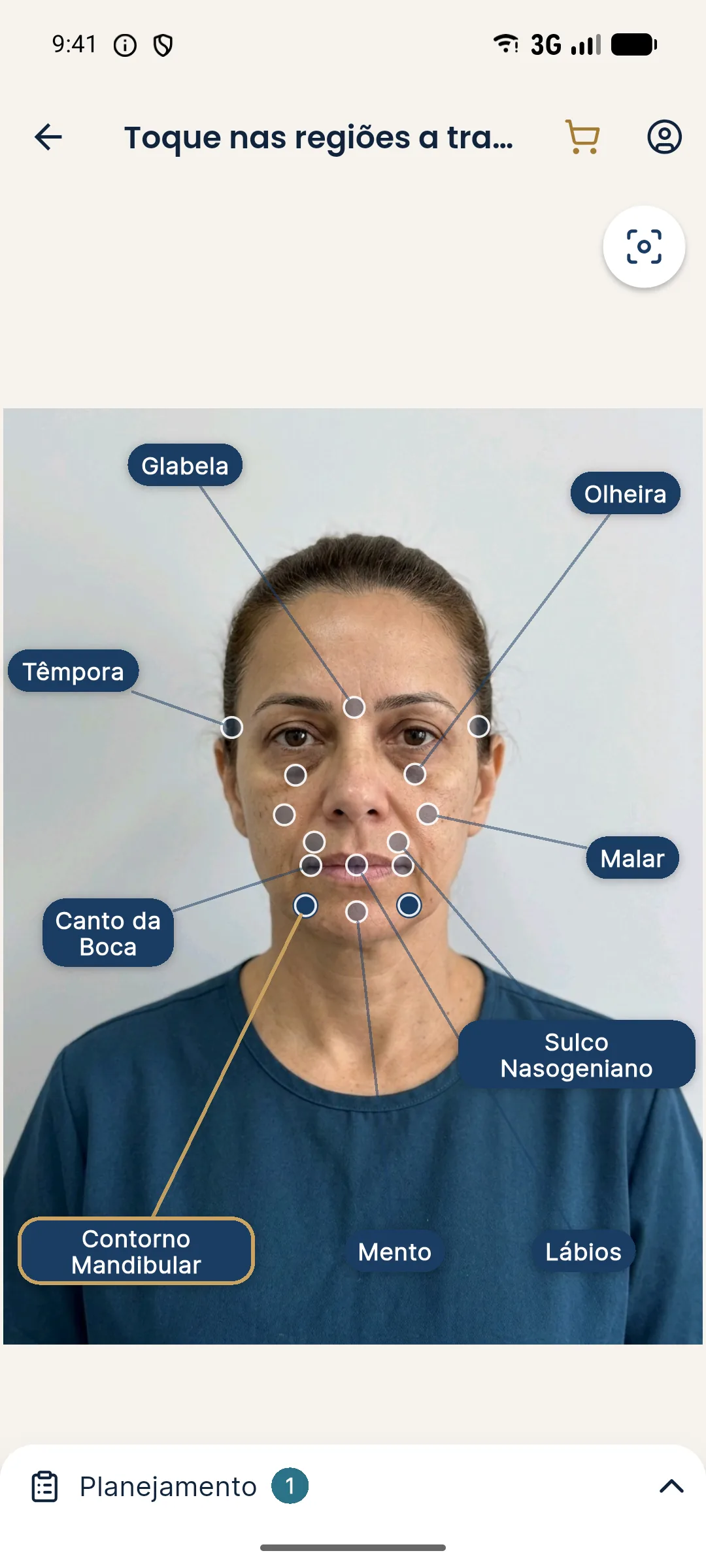
In the Plan, set the volume in ml (0.5 ml steps, from 0.5 to 5 ml). Because it is a bilateral area, the value is the total, split between both sides. The simulation on this site used 4 ml in total. The AI respects the volume and changes only the marked area, without altering the background, hair, lighting, or expression.
See the step by step in marking areas and volumes.
How to talk to the patient about the jaw
Because the jaw calls for larger volumes, the conversation about investment usually comes along with it. An illustrative simulation on the patient's photo helps show what changes with the proposed volume, and Harmy's PDF quote lets you present the price per ml clearly.
Use the projection as a support tool, make clear it is not a promise, and agree on the stages of the plan. To build the price from the volume, see pricing per ml.
Frequently asked questions
What is jaw filler for?
To define the jawline, mark the mandibular angle, and soften the transition to the neck. It may be indicated for loss of contour with age or for a wish for a more defined face.
How much filler is used in the jaw?
Generally 2 to 6 ml in total, split between both sides, at the discretion of the licensed professional after assessment. Larger losses are often treated over more than one session.
How long does jaw filler last?
Generally 12 to 18 months with high-support hyaluronic acid, depending on the product and the patient.
Does jaw filler fix sagging?
Not by itself. It defines the bony contour, but significant skin laxity or a double chin may call for other approaches. The assessment determines what suits each patient.
How do I simulate the jawline contour in Harmy?
Mark the Jawline point on the frontal photo and set the total volume in ml in the Plan. The app splits the volume between both sides.
Harmy images are illustrative simulations generated by AI from the patient's photo to support the conversation between practitioner and patient. They are not a promise of results. Indication, technique, product and volume are solely the decision of the licensed practitioner. This content is for information only and does not replace a clinical assessment.