
Jawline Filler (Mandibular Contour)

 BeforeSimulation
Jawline (mandibular contour) filler aims to define the line of the jaw, from the chin to the angle, and mark the separation between face and neck. Requests for it have grown a lot in orofacial harmonization (HOF), both among women who want a sharper contour and among men who want a more structured face. The concern is usually "my face has no contour" or "my face blends into my neck."
On this page you will find the indication, usual volumes, durability, risks and how to simulate it in Harmy.
What is jawline filler?
It is the placement of supportive hyaluronic acid, or another structural filler, along the jawline and, when indicated, at the jaw angle. The goal is to create or restore a more defined edge that separates the lower third from the neck.
The effect depends heavily on distribution. Volume at the angle changes the width and how masculine the face reads; volume along the body of the jaw and at the transition to the chin changes the continuity of the line. It is a design procedure, not just a volume one.
Who is jawline filler usually indicated for?
Generally, for patients with:
- a poorly defined jawline at rest;
- age-related loss of definition, with irregularities in the line (early jowls);
- a softly marked jaw angle, when the patient wants more structure;
- an imbalance between chin and jaw.
People with significant submental fat, marked skin and neck laxity or excess tissue below the jaw respond poorly or need another approach. In those cases, adding volume can make the lower third look heavy. General contraindications include active infection, active autoimmune disease, pregnancy, breastfeeding and allergy to the product. The decision belongs to the qualified professional, in line with the rules of their professional council in Brazil.
Which areas are involved?
The main area is the jawline. It forms a unit with the chin, and the two are usually planned together. The mouth corners also come into play, because loss of support in the lower face accentuates downturned commissures and marionette lines.
Which product is used?
Generally, high-G' hyaluronic acid, with good projection capacity and resistance to deformation. Calcium hydroxyapatite and other biostimulators are also used in the area, alone or combined. The reversibility of hyaluronic acid is an advantage when working on contour design. Product, instrument and plan are technical decisions for the professional.
What volumes are usual?
The jawline is one of the areas that consumes the most volume. The ranges below are general references; the final volume is set by the qualified professional after assessment.
| Goal | Usual range per side | Usual total range |
|---|---|---|
| Discreet definition | 1 ml | 2 ml |
| Moderate definition | 1.5 to 2 ml | 3 to 4 ml |
| Pronounced definition or marked angle | 2 to 3 ml, in stages | 4 to 6 ml or more |
Splitting treatment into sessions allows the response to be assessed and spreads out the patient's investment.
How long does jawline filler last?
With supportive hyaluronic acid, usual durability is generally between 12 and 18 months. The area has moderate movement, influenced by chewing and the masseter. Product, volume, metabolism and weight changes influence the duration.
What are the risks and complications?
The most frequent complications are swelling, bruising, pain when chewing in the first days, asymmetry, palpable nodules and, with excessive volumes, a wide or heavy lower face.
The facial artery crosses the border of the jaw in front of the masseter, and there are branches of the facial nerve in the area. An intravascular injection can cause vascular occlusion, with a risk of skin injury. Hyaluronidase must be available whenever hyaluronic acid is used, with a known management protocol. See also safety and complications in facial harmonization.
What care is needed before and after?
Beforehand, the medical history should record anticoagulants, bruxism and temporomandibular joint pain, previous procedures in the area, orthodontic treatment and autoimmune disease. Front, profile and oblique photos help with planning, because the jawline reads better from the side.
Afterward, usual instructions include avoiding pressure and massage in the area, avoiding very hard foods in the first days, and avoiding intense heat and heavy exercise for 24 to 48 hours. Disproportionate pain, pallor or purplish patches call for immediate contact with the professional. A follow-up at about 15 to 30 days allows symmetry to be assessed and the next stage to be planned.
How do you quote a staged jawline plan?
Because it consumes more volume, the jawline is the procedure where the total price weighs most in the decision. Splitting into stages usually helps both patient and professional: the first session sets the base, and the second adjusts based on the response. In Harmy, you can generate the projection for the first stage and build the PDF quote with that stage's volume, noting the planned sequence in the remarks. For the logic of price per ml, see pricing per ml.
What is not promised to the patient
- A "lifting" or surgical effect.
- Elimination of a double chin or neck laxity.
- A specific face shape or one identical to a reference.
- Absolute symmetry.
- An exact duration.
These limitations should be written into the informed consent.
Simulation in Harmy
The image at the top of this page was generated by Harmy itself, using the fictional person we use across all our pages, marking only the Jawline point with 4 ml. Drag the line to compare. The change is subtle on purpose, even with a larger volume: the AI alters only the marked area, respecting the volume, and does not apply contouring makeup, retouch the skin or change lighting, expression or background. It is an honest projection. It is an illustrative simulation, not a promise of results.
The jaw is bilateral. In Harmy, the ml is the total: with 4 ml, about 2 ml on each side. Because the photo is frontal, the definition of the contour shows less than it would in an oblique or profile view, and that is worth telling the patient.
How to simulate in 3 steps
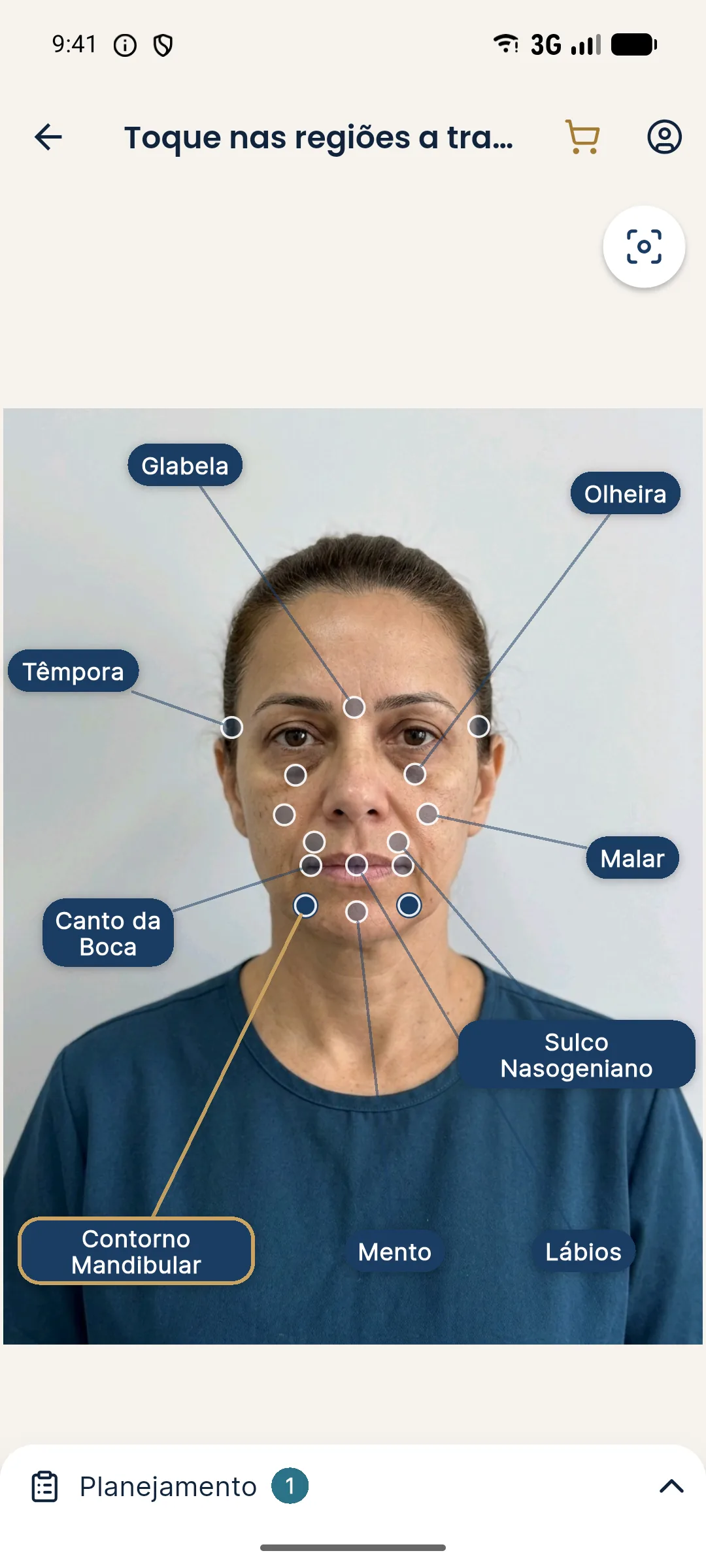
- In New projection, enter the patient's name and use a frontal photo with the face straight, chin neither raised nor lowered and hair pulled back from the jaw.
- In the marking screen, tap the Jawline point and set the total volume in the Plan (from 0.5 to 5 ml, in 0.5 steps).
- Tap Create projection and compare on the Before / After slider.
Details and screenshots in how to mark areas and volumes. The Plan limit is 5 ml per point: for larger plans split into stages, simulate the first stage and explain the sequence to the patient.
Frequently asked questions
How long does jawline filler last?
Generally 12 to 18 months with supportive hyaluronic acid, depending on the product, the volume and the patient's metabolism.
How many ml are used in jawline filler?
Generally 2 to 6 ml in total, often over more than one session, at the discretion of the qualified professional after assessment.
Does jawline filler fix a double chin?
No. Filler can define the jawline, but it does not remove submental fat or treat significant neck laxity.
Does jawline filler make the face look masculine?
It depends on the volume and where it is placed. A very pronounced jaw angle tends to masculinize, so the plan is individual and discussed beforehand.
Harmy images are illustrative simulations generated by AI from the patient's photo to support the conversation between practitioner and patient. They are not a promise of results. Indication, technique, product and volume are solely the decision of the licensed practitioner. This content is for information only and does not replace a clinical assessment.