
Mouth Corners and Marionette Lines: Anatomy and Treatment

The corners of the mouth (oral commissures) are a small area with a big effect on expression. When they droop, the face looks sad or angry even at rest. A marionette line usually appears along with them: the fold that runs from the corner of the mouth toward the chin, in the lower third of the face.
What are the anatomical boundaries of the mouth corners?
The commissure sits where the upper and lower lips meet. For the aesthetic assessment, the area includes:
- The commissure itself, the point where the lips meet.
- The modiolus, the fibromuscular node lateral to the commissure where several muscles cross.
- The marionette line, which runs from the commissure down to the chin and the jawline.
The most important muscles are:
- Orbicularis oris, which encircles the lips.
- Depressor anguli oris, which pulls the commissure downward and is the main cause of the sad expression.
- Elevator muscles (zygomaticus major, levator anguli oris, risorius), which pull the commissure upward and outward.
Vessels and nerves to watch
- Facial artery, which rises from the edge of the mandible and passes lateral to the commissure.
- Superior and inferior labial arteries, branches of the facial artery that arise near the commissure.
- Marginal mandibular branch of the facial nerve, which supplies the lower lip depressors.
- Mental nerve, which emerges through the mental foramen, below the premolars.
The proximity of the facial artery and the origin of the labial arteries calls for care with fillers. A vascular occlusion in this area can lead to skin and lip necrosis.
What do patients usually ask for?
Concerns tend to come in like this:
- "My mouth looks droopy."
- "I look angry all the time."
- "I have lines running from the corner of my mouth down to my chin."
- "My lipstick bleeds into the corners."
During the assessment, observe the patient at rest, while talking, and while smiling. Separate three components: local loss of support, descent of the cheek tissues, and overactivity of the depressor anguli oris. Each calls for a different approach, and they often add up.
Which procedures can be done on the mouth corners?
The direct procedure is mouth corner filler, using hyaluronic acid to restore support to the commissure and soften the marionette line.
Other treatments that often belong in the plan:
- Botulinum toxin in the depressor anguli oris, when it is very active.
- Lip filler, to support the lower lip and the outline.
- Jawline filler, when the marionette line continues into a loss of jawline definition.
- Nasolabial fold filler, when both folds add up.
Technique, plan, and instrument are at the discretion of the licensed professional, according to the rules of their professional council in Brazil.
What are the usual volumes for the mouth corners?
Usual ranges in ml of hyaluronic acid, at the discretion of the licensed professional, after assessment:
| Situation | Usual range per side | Note |
|---|---|---|
| Slightly drooping commissure | 0.3 to 0.5 ml | Often enough |
| Moderate marionette line | 0.5 to 1 ml | Assess the jawline together |
| Significant loss of support | Combine neighboring areas | Treat the lower third as a whole |
| Durability | Generally 6 to 12 months | Area with a lot of movement |
Small volumes are usually enough. Too much product near the mouth can show when talking and smiling.
Care, contraindications, and complications
General contraindications: active infection or active cold sores, pregnancy and breastfeeding, uncontrolled autoimmune disease, allergy to the components, and unrealistic expectations. In patients with a history of cold sores, preventive management is the professional's decision.
Reported complications:
- Swelling and bruising.
- Palpable lumps, more noticeable because this is an area with a lot of movement.
- Smile asymmetry, especially with toxin in the depressor.
- Temporary difficulty moving the lower lip when the toxin diffuses.
- Vascular occlusion, with a risk of necrosis.
With hyaluronic acid, hyaluronidase must be available. See the overview of safety and complications.
When should you think of the lower third as a whole?
The mouth corners rarely droop on their own. In many patients, the drooping commissure is the visible part of a larger picture: loss of support in the chin, a less defined jawline, and descent of the cheek tissues. Treating only the commissure in those cases usually gives a small, short-lived gain.
Before finalizing the plan, it is worth answering three questions:
- Does the marionette line continue to the edge of the mandible, or does it stop halfway?
- Does the chin have adequate support, or is it retruded?
- Does the commissure droop at rest, or only when talking and smiling?
If the answers point to the entire lower third, a staged plan, starting with structure and ending with the fine adjustment of the commissure, tends to be more coherent. Assessing the face by thirds helps organize this reasoning.
How do the mouth corners appear in Harmy?
In Harmy, the area is the Mouth Corner point in the marking step. After the frontal photo, the app detects the face on the device and shows the points with labels. Tap Mouth Corner to include it in the plan.
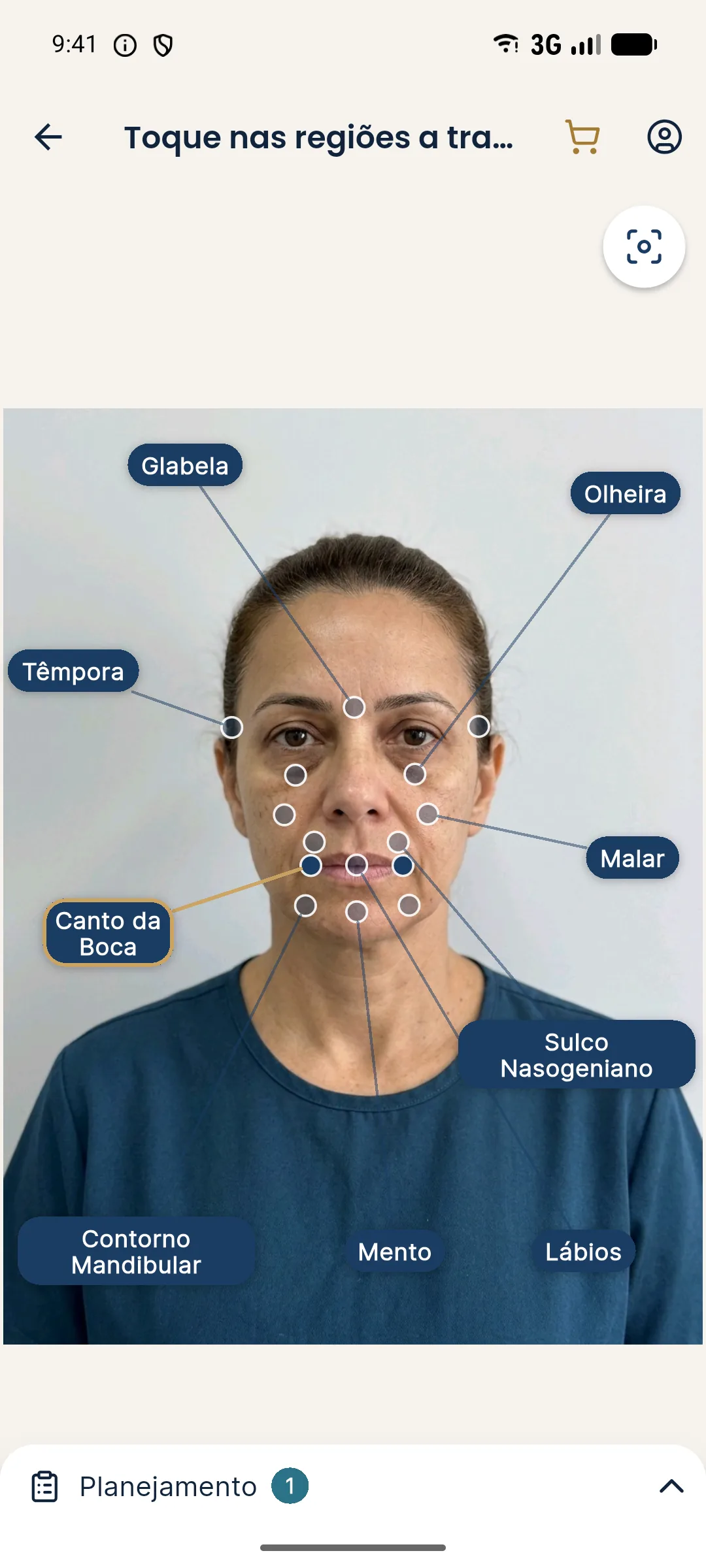
In the Plan, set the volume in ml (0.5 ml steps, from 0.5 to 5 ml). Because it is a bilateral area, the value is the total, split between both sides. The simulation on this site used 1 ml in total. The projection shows the commissure with more support without changing the patient's expression: if they look serious in the photo, they stay serious in the After.
See the step by step in marking areas and volumes.
How to talk to the patient about the mouth corners
The mouth corners are an area patients feel but cannot always name. An illustrative simulation on their own photo, with the slider between before and after, usually makes it clear how a small change alters the expression at rest.
Use the projection as a support tool, without promising results, and schedule a follow-up for reassessment. To organize that conversation and the close, see the first consultation script.
Frequently asked questions
Why do the corners of the mouth droop?
With age there is loss of support in the area, descent of the cheek tissues, and the action of the depressor anguli oris muscle, which pulls the corner of the mouth downward.
What is a marionette line?
It is the fold that runs from the corner of the mouth toward the chin. The name comes from its resemblance to the hinged lines of a puppet's mouth.
How much filler is used in the mouth corners?
Generally 0.3 to 1 ml per side, at the discretion of the licensed professional after assessment. The area is often treated together with the jawline and the lip.
Does botulinum toxin help the mouth corners?
In patients with a very active depressor anguli oris muscle, the toxin can reduce the downward pull. The indication is up to the licensed professional after assessment.
Harmy images are illustrative simulations generated by AI from the patient's photo to support the conversation between practitioner and patient. They are not a promise of results. Indication, technique, product and volume are solely the decision of the licensed practitioner. This content is for information only and does not replace a clinical assessment.