
Areas That Often Go Together in a Facial Harmonization Plan

Quick facts
- Topic
- Affinities between the app's nine areas
- Principle
- Neighboring areas influence each other, so the plan reads them together
- Common combinations
- Cheekbone with tear trough, lips with chin, chin with jawline
- When to split
- High total volume, accumulated vascular risk or a patient who is unsure
- In the app
- Mark the areas in the group and compare with each area alone
The face is not a set of independent parts. The volume that supports the cheekbone changes the shadow of the tear trough, the projection of the chin changes how the lips read, and the jawline decides how the lower third closes the outline of the face. That is why a facial harmonization plan rarely treats an area in a vacuum: it groups the ones that influence each other and decides the order in which each comes in. This page is a map of affinities between the nine areas Harmy marks, meant as planning reasoning and not as a protocol.
Why do some areas go together?
There are three main reasons. The first is anatomical adjacency: areas that share fat compartments, ligaments or the same supporting layer respond together. The second is visual reading: the observer's eye compares what is nearby, so a fuller lip next to a recessed chin draws attention to the imbalance. The third is compensation: treating the support (cheekbone, chin, jawline) can reduce the need for volume in surface areas (tear trough, fold, mouth corners).
This logic underlies structure before detail in a facial harmonization plan and the domino effect between facial areas. Anyone who understands the chain of influence chooses more safely what to treat now and what to wait on.
What is the affinity map between the nine areas?
The table below organizes the combinations that come up most in practice. It is not a list of indications: it is a guide to ask "if I work here, what will the neighbor start to ask for?"
| Area | Usually read together with | Why |
|---|---|---|
| Glabella | Temples and tear trough | The upper third and the gaze form the first impression of tiredness or tension |
| Temples | Cheekbone | The lateral transition between forehead and midface needs to be continuous |
| Tear trough | Cheekbone and nasolabial fold | The infraorbital shadow depends on the support just below |
| Cheekbone | Tear trough, temples and fold | It is the support of the midface and redistributes how the neighbors read |
| Nasolabial fold | Cheekbone and mouth corners | The fold can be an effect of lost support above, not only of the fold itself |
| Mouth corners | Lips and chin | The expression line of the mouth depends on the proportion between lips and chin |
| Lips | Mouth corners and chin | The relationship between lips and chin defines the profile of the mouth |
| Chin | Lips and jawline | Chin projection organizes the lower third |
| Jawline | Chin and cheekbone | Contour definition depends on the balance between the thirds |
For each pair there is a page of its own on the reasoning, such as cheekbone and tear trough, lips and chin and chin and jawline.
Which combinations come up most often?
Midface: cheekbone, tear trough and fold
The cheekbone supports the midface, and the tear trough and nasolabial fold sit at the edges of that support. Many professionals assess the cheekbone first and only then decide whether the tear trough or fold still needs direct intervention. The approach depends on the clinical finding, and the plan usually makes clear that the order may reverse depending on how the tissue responds. See also nasolabial fold and cheekbone and treating the fold or its cause.
Lower third: lips, corners, chin and jawline
Here the logic is proportion. A full lip over an underprojected chin pulls the eye to the mouth and leaves the profile unbalanced; the reverse also happens. The jawline comes in when definition of the lower third is part of the concern. For this group, read the complete lower third in the plan and mouth corners, marionette lines and chin.
Upper third and lateral transition: glabella and temples
The glabella is a high vascular risk area and is usually approached in a plan separate from the others. The temples, also a risk area, appear alongside the cheekbone when the concern is loss of lateral support. See temples and cheekbone and glabella and forehead.
How do you decide what goes together and what waits?
Use a simple six-question filter before finalizing the session's set.
If any answer is "no," the most vulnerable area can wait. The logic on quantity is in how many areas to treat per day and total volume per session: ranges.
How does Harmy help test combinations?
In the app, the set becomes a projection. You mark the areas in the group, set the ml and intensity of each (Subtle, Moderate or Pronounced) and show the Before and After in a slider. To compare alternatives, create a projection with the full set and another with a few areas: the difference between the two helps the patient understand what each area adds.
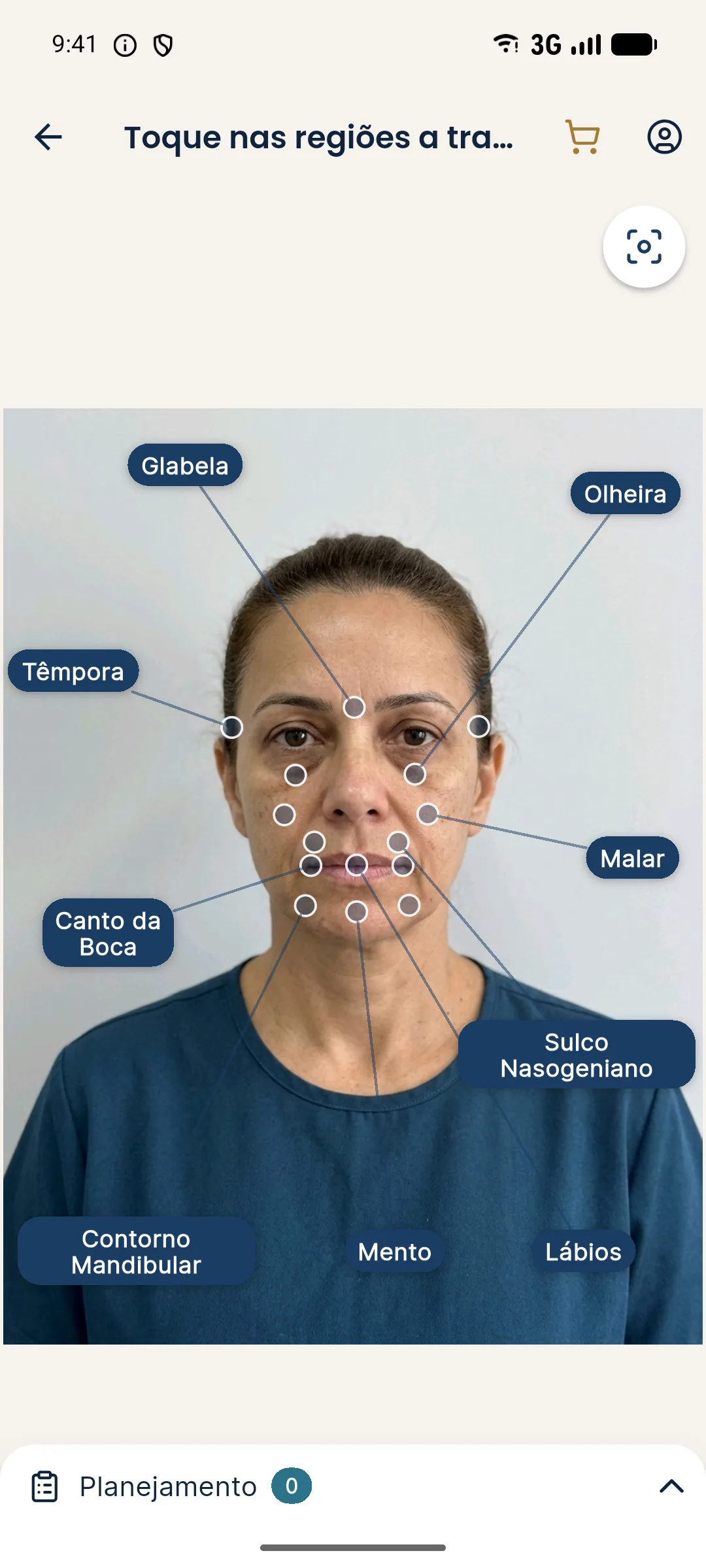
The projection starts from a frontal photo and changes only what was marked, which is why differences are subtle and realistic. It does not show the profile or bone structure. For an honest reading of the image, see limits of 2D simulation and explaining that a simulation is not a guarantee.
What do you tell the patient about combining areas?
Patients often ask for one area and hear that another deserves attention too. Explain why with the image in hand and leave the decision to them, without creating a sense of selling.
How do you record the chosen set?
Note in the patient record which areas were assessed, which were included, which were left for later and why. This avoids the feeling of a plan that "grows on its own" and gives a basis for reassessment. See facial treatment plan form: fields and recording the simulation in the patient record.
Frequently asked questions
Which areas of the face are usually treated together in facial harmonization?
The most common combinations follow anatomical adjacency: cheekbone with tear trough, lips with mouth corners, chin with jawline, and temples with cheekbone. The final choice depends on assessment and the patient's goal, at the discretion of the licensed professional.
Is it mandatory to treat neighboring areas in the same session?
No. Splitting into stages is a frequent and prudent approach, especially when total volume is high or there is accumulated vascular risk. Each combination can be spread across more than one session.
Does Harmy's simulation show several areas at once?
Yes. You mark the areas you want, set the ml and intensity for each, and the projection changes only what was marked. It is an illustrative simulation, not a promise of results.
Does combining areas change the volume each one receives?
It can. When a support area is treated, the neighboring one sometimes needs less volume. That reading is clinical and belongs to the professional, after assessment.
Harmy images are illustrative simulations generated by AI from the patient's photo to support the conversation between practitioner and patient. They are not a promise of results. Indication, technique, product and volume are solely the decision of the licensed practitioner. This content is for information only and does not replace a clinical assessment.