
How many areas to treat per day in the facial harmonization plan
Quick facts
- Question
- How many areas fit in a single session without compromising safety, assessment and a natural look?
- Limits
- Session length and comfort, patient tolerance, cumulative swelling, the professional's attention and the risk of the areas
- Rule of thumb
- A few well-assessed areas are worth more than many rushed ones; higher-risk areas call for a session with fewer variables
- Caution
- There is no universal number; the decision is clinical and should be recorded in the plan
"Since I'm here, can we do everything today?" is one of the most common phrases on the facial harmonization schedule. The temptation to meet the patient's wish, take advantage of the visit and optimize the clinic's day is strong. But there are limits that do not show up on the schedule: session length, patient comfort, cumulative swelling, available attention and the safety of each area.
Below is a way of reasoning to decide how many areas fit in a session, and how to explain that decision to the patient. The text covers planning, at a review level, and the final decision belongs to the qualified professional.
What factors limit the number of areas per session?
Time and comfort
The more areas, the longer the session. Long sessions tire the patient, raise tension and reduce cooperation. The same goes for the professional, whose attention drops over time. The quality of assessment and execution depends on attention, and that is a real limit.
Tolerance for pain and anxiety
The patient's limit varies. Someone who tolerates the first area well may not tolerate the fourth. Topical anesthesia helps but does not eliminate discomfort, and an anxious patient or one afraid of needles needs a pace of their own. See plan for an anxious patient or one afraid of needles and aligning expectations about pain.
Cumulative swelling and assessment
The swelling of each area adds up. With many areas in the same session, the face is deformed that day, and assessing the final result of each area gets complicated. This affects touch-up decisions and comparison with the projection. See swelling gets in the way of comparing results.
Safety and interpreting complications
If something happens, it is easier to interpret when few areas were treated. On a face with several freshly treated areas, a warning sign can be mistaken for an expected effect, or vice versa. Higher-risk areas deserve this care, as in prioritizing by anatomical risk in the plan.
Budget and logistics
The patient may want to concentrate treatment for practical reasons: distance, work, schedule. These reasons are valid, but they do not override clinical limits.
How does combining areas change the decision?
Not all combinations are equal. Some areas complement each other and can be done together; others call for separation. The table is only an aid to reasoning.
| Combination | Planning rationale |
|---|---|
| Neighboring structural areas (cheekbone and jaw) | Can be assessed together, but the total volume of the session counts |
| High-risk area with others | Consider a session with fewer variables for the risk area |
| Patient's first time | Fewer areas, to learn the response to the product |
| Area with marked swelling (lips, under-eye area) | Be careful about overlapping swelling on the same day |
| Touch-up of an area already treated | Short session, assessed without swelling |
Specific combinations are covered in pages such as cheekbone and jaw: combining in the plan, lips and chin: combining in the plan and areas that tend to go together in the plan. The case of two procedures on the same day is in two procedures on the same day: how to decide.
How does this relate to volume per session?
The number of areas and the total volume per session go together. Many areas with little volume each can add up to a considerable volume. The notion of volume per session is in total volume per session: ranges and, for splitting the total, in when to split the volume into sessions.
A practical consequence: as you increase the number of areas in the day, reduce the ambition of each one. The reverse also holds. A session with one area at a larger volume can be safer and easier to assess than one with five areas at smaller volumes.
What about a patient who comes from another city?
It is a common and legitimate case. The solution is usually to negotiate the number of areas possible in one trip and plan the follow-up ahead of time, or to propose consecutive days when the clinic and the case allow it. Record the options and the decision. The topic is in facial harmonization plan for a patient from another city.
How do you explain the limit to the patient?
With safety and result arguments, not schedule arguments. Patients accept "so I can assess each area carefully" better than "we don't have time." Show the plan in stages and the reason for the order. Use the projection of each stage to visualize the path.
What should go in the plan?
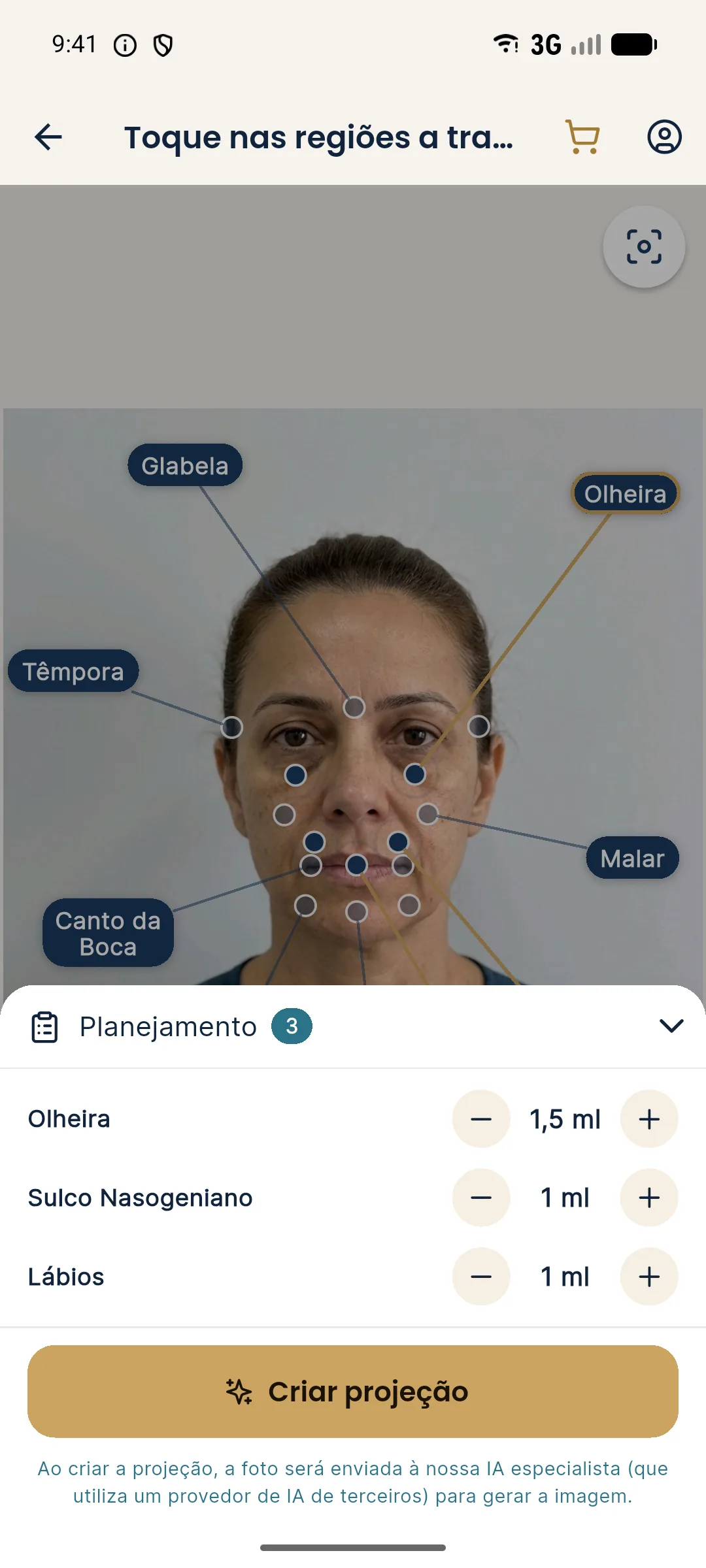
Record the planned number of areas per session, the reason, the interval and the criterion for the next stage. If the actual number differs from the planned one, record the reason, as in recording deviations from the plan during the session. This keeps the plan faithful to reality and feeds the execution analysis, as in plan execution rate.
Frequently asked questions
Is there a maximum number of areas per session?
There is no universal number. The limit depends on the area, the volume, the product, the risk, the patient's tolerance and the professional's capacity to assess during the session.
Does treating many areas at once make the result worse?
It can make assessment harder, because swelling adds up and masks the result of each area. It also increases fatigue for patient and professional.
Can I combine a high-risk area with others on the same day?
The decision is clinical. In general, areas with higher vascular risk benefit from sessions with fewer variables, so that any complication can be interpreted clearly.
Can a patient who travels far do everything on the same day?
It can be discussed, within clinical limits. Splitting across consecutive days or a planned follow-up is usually an alternative, and the patient should be told the options.
Harmy images are illustrative simulations generated by AI from the patient's photo to support the conversation between practitioner and patient. They are not a promise of results. Indication, technique, product and volume are solely the decision of the licensed practitioner. This content is for information only and does not replace a clinical assessment.