
Plan completion rate: a clinic indicator

Quick facts
- What it is
- The share of the proposed plan that the patient actually carries out
- Basic formula
- Items or ml completed divided by items or ml proposed
- What it is for
- Spotting bottlenecks in communication, price and trust
- What it is not
- Not a sales target or proof of clinical quality
- Caution
- Never use the number to push a procedure
Every facial harmonization clinic makes plans, and almost none knows how many of them become sessions. You propose five areas, the patient does two, and the rest stays in a drawer. That can be healthy (the plan was generous and the patient prioritized), or it can be a symptom (the price scared them, trust failed, the follow-up was never booked). The plan completion rate is a simple indicator to tell one from the other. This page teaches how to measure it and, above all, how to interpret it without turning a number into sales pressure.
What exactly is measured?
Pick one unit and stick with it. The three most used are:
- By item. Each proposed area counts as one item. If the plan had four areas and the patient did one, the rate is 25%.
- By ml. You add up the planned volume and the volume actually used. It is the measure most faithful to what was done, but it requires careful recording. The difference between planned and used is covered in planned ml vs. used ml.
- By value. It compares the value of the approved quote with the value carried out. It serves financial management, but mixes pricing decisions with clinical decisions.
Also define the time window: 30, 90 or 180 days after the consultation. Without a window, the number becomes noise, because staged plans only complete months later. For long plans, see 12-month facial harmonization plan.
How do you calculate it, in practice?
The math is simple; the work is in the record. For each planning consultation, note the date, the patient's name, the areas proposed and, later, what was carried out within the window. At the end of a period, add everything up.
Hypothetical example: in one quarter, the clinic proposed 40 items in plans and 22 were carried out within 90 days. The completion rate by item was 55%. The number alone does not say whether that is good or bad. It makes sense when you compare it with the previous quarter and with the causes that come up in conversations.
| Measure | How to calculate | What it is for | Caution |
|---|---|---|---|
| By item | Items completed / items proposed | Quick view of adherence | Items have different weights |
| By ml | ml used / ml planned | Fidelity to the volume plan | Requires recording the actual ml |
| By value | Value completed / value quoted | Financial management | Mixes price and clinical decision |
| By patient | Patients who carried out something / patients assessed | Consultation conversion | Ignores the size of the plan |
What might a low rate be telling you?
A low rate rarely has a single cause. The most common hypotheses, to investigate one by one, are:
- Plan too big. The patient arrives wanting one adjustment and leaves with a long list. Leaner plans tend to be carried out more; see minimum viable plan in facial harmonization.
- Price without context. The quote arrives as a loose number, with no explanation of what each area delivers or how to split it into stages.
- Lack of trust. The patient has not yet understood the professional's reasoning or fears the risk. The consent and limits conversation weighs in here.
- Priorities changed. It happens, and it is not the clinic's fault.
- Follow-up not booked. The plan was in stages, but nobody booked the second one. An active follow-up schedule is usually the cheapest improvement.
To cross-check with what the patient says when declining, see patient objections and answers and patient approval of the plan.
What might a high rate be hiding?
A very high rate also deserves a question. It may be a well-built plan and solid trust, but it may also be closing pressure, a single-session plan with large volumes or patients who had no time to think. If the interval between consultation and treatment is always very short, it is worth checking whether the patient has time to decide. The ethics of proposing a plan are covered in when to say no to the aesthetic plan and prioritizing by the patient's budget.
Also check that the indicator is not being inflated by touch-up sessions by the professional that were not in the original plan. What was proposed and what was done because of a complication should not be mixed.
How do you record this without creating bureaucracy?
The secret is to make the record a byproduct of the routine. Each written plan already has the areas and the ml; each session already generates a note of what was used. A spreadsheet with one row per area and three extra columns is enough: plan date, treatment date and status (done, postponed, declined).
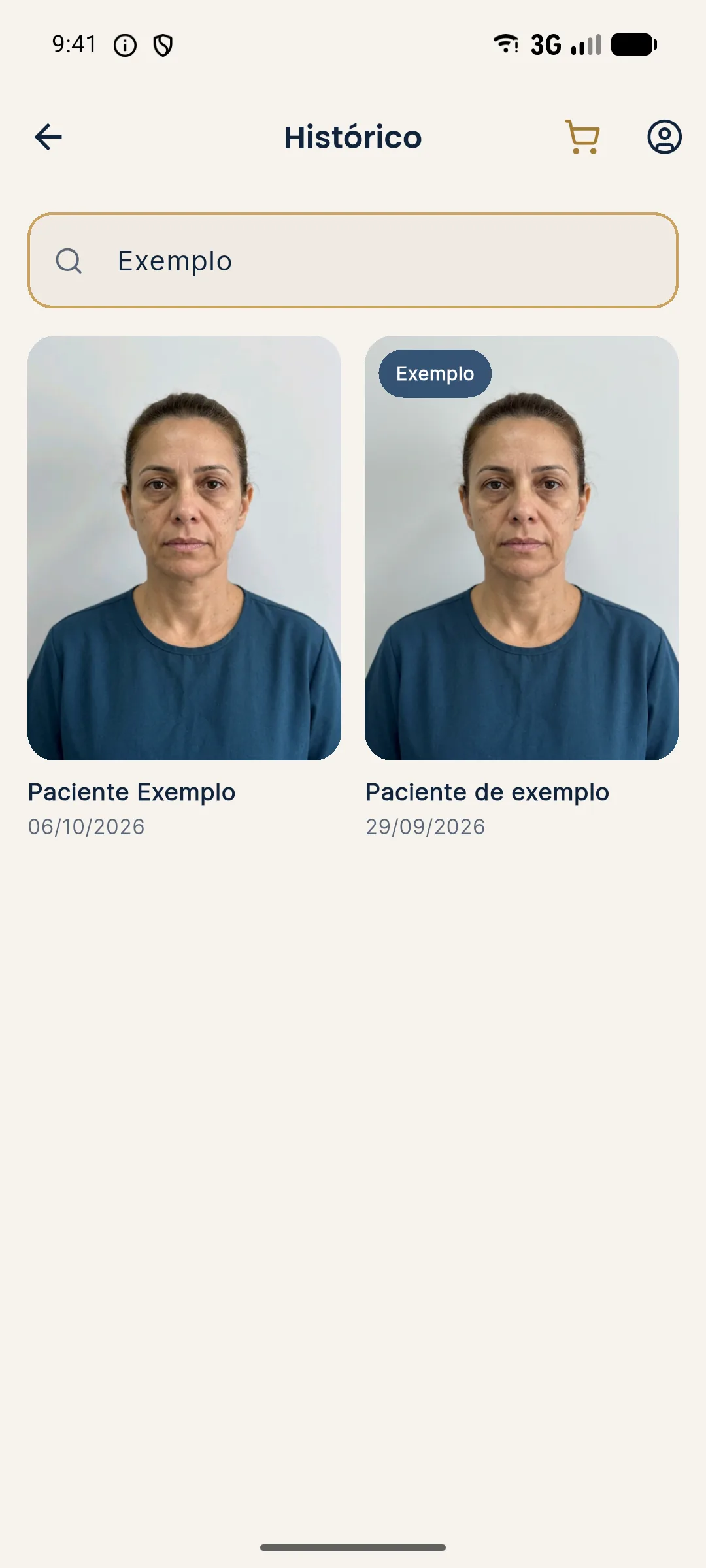
In Harmy, the per-patient history already gathers the projections and, when there are any, the PDF quotes. That works as memory to fill in the spreadsheet, not as an automatic report. The flow is in organizing projections by patient and linking plan and quote in facial harmonization.
How do you separate completion from acceptance?
Acceptance and completion are different things. Acceptance is the patient's "yes"; completion is the session that actually happens. If acceptance is high and completion low, the problem is in scheduling, payment or logistics. If acceptance is low, the problem is in the consultation. This distinction keeps you from blaming the wrong part of the funnel.
For those who want to expand the commercial side, see how to increase plan acceptance. The focus of this page, however, is the opposite of pushing: using the indicator to improve the plan and the communication, without pressuring anyone.
What should you do with the result?
Use the number for three questions. First: are the plans the right size? If the rate by item is low and the rate by ml is high, you may be proposing too many items with the ml concentrated in a few. Second: is the price being presented with context? If the rate by value is much lower than the rate by item, price may be the brake. Third: is the follow-up being booked? If completion at 30 days is low and at 180 days is reasonable, the problem is scheduling.
Remember that the simulation also influences the indicator. A subtle, honest image tends to produce plans that are better matched to reality; see why the simulation should be subtle. And every patient image requires consent: consent and LGPD for photos. LGPD is Brazil's personal data protection law.
Quick review
Summary
The plan completion rate is the ratio between what was proposed and what was carried out within a fixed window. Choose one unit, keep the criterion, record the reasons for postponing or declining, and use the number to adjust plan size, the way you present price and the follow-up schedule. The indicator raises questions; the answers come from the conversation with the patient and from clinical prudence.
Frequently asked questions
What is the plan completion rate in facial harmonization?
It is the ratio between what was proposed in the plan and what the patient carried out within a defined period. It can be measured by items, by areas or by ml.
Does a low completion rate mean the clinic sells poorly?
Not necessarily. It may point to a plan that is too big, a price that was poorly explained, a lack of trust or patient priorities that changed. The number raises a question, it does not give the answer.
Is there an ideal rate?
There is no universal ideal value. Compare your clinic with itself over time, using the same criterion and the same period.
Does Harmy calculate this rate?
No. Harmy keeps the history per patient, with projections and quotes, and you can use those records as the basis for your own spreadsheet.
Harmy images are illustrative simulations generated by AI from the patient's photo to support the conversation between practitioner and patient. They are not a promise of results. Indication, technique, product and volume are solely the decision of the licensed practitioner. This content is for information only and does not replace a clinical assessment.