
Prioritizing by the patient's budget in the plan

Quick facts
- Goal
- Deliver a coherent plan within what the patient can invest, without shrinking safety or clinical logic
- Core rule
- Cut areas or split into sessions, never compress the volume below what makes clinical sense
- Tool
- Per-ml quote with a value per area, discount and validity, so the patient can compare scenarios
- Caution
- A quote does not decide the indication; the financial limit adjusts the order and pace, not the safety criterion
Every harmonization plan faces, sooner or later, a conversation about money. The most common mistake is treating that conversation as an obstacle and reacting with a discount or a volume cut. The healthier approach is to build the budget into the planning from the start, as one of the data points of the case, alongside the concern, the anatomy and the expectation.
This page shows how to turn a financial limit into an order of priority, when to split into sessions and how to use the per-ml quote so the patient can choose with clarity. The formal link between plan and proposal is in linking plan and quote in facial harmonization.
Is the financial limit part of the case?
It is, and the sooner you know, the better. A plan designed with no notion of the budget tends to be too big for most patients, which produces a "I'll think about it" and almost always a disappearance. A plan designed with the limit in mind arrives at a proposal the patient can accept without feeling pressured.
That does not mean asking "how much can you spend?" in the first sentence. Ask about priority and pace: "Do you prefer to solve one concern now and others later, or a full plan in stages?". The answer reveals the financial logic without causing discomfort.
What criteria define the essentials?
With a limited budget, the essentials are what combines three filters. None of them decides alone.
| Filter | Question | Where to go deeper |
|---|---|---|
| Main concern | What did the patient ask for, in their own words? | prioritizing by visual impact |
| Safety and anatomy | Is there a clinical order that cannot be reversed? | prioritizing by anatomical risk |
| Coherence of the whole | If this leaves the plan, does the face become disproportionate? | domino effect between areas |
The third filter is the one most often forgotten. Treating area A and leaving B for later can be great, or it can create a disproportion that the patient notices and attributes to the procedure. When that is a real risk, it needs to be said before the patient decides.
When do you cut an area and when do you split into sessions?
These are two different strategies, and choosing the wrong one is the most frequent mistake.
- Cutting an area: makes sense when the area is optional or when the patient does not consider it a priority. The plan gets smaller, but stays coherent.
- Splitting into sessions: makes sense when all areas matter, but the monthly investment is limited. The plan stays complete, just distributed over time, with adequate clinical intervals. See interval between sessions in the facial harmonization plan and when to divide the volume into sessions.
A third strategy, reducing the volume of each area to fit the price, deserves caution. A volume below what the case needs can produce an imperceptible change, and the patient concludes that "it didn't work" and that they spent money for nothing. The notion of the minimum volume to be noticed is in minimum perceptible volume on the face.
How do you structure three quote scenarios?
Showing a single scenario forces the patient to accept or refuse. Showing three allows a choice. The trick is that all three are clinically defensible, with none clearly "the right one" and the others "worse".
Each scenario should say what it covers, what it does not cover and what will require a new stage. A minimum viable plan is a good base for the first, and the two-session plan or the three-session plan serve as a template for the second.
How does Harmy help show the scenarios?
The app lets you build different scenarios by changing the ml per area and the intensity, and see the projection of each. That way the patient compares what each level of investment approximates, instead of imagining it. The shortcuts "First time", "Maintenance" and "Full harmonization" work as starting points that you adjust case by case.
The PDF quote carries the per-ml value for each area, discount, validity and notes, and comes out with the clinic's name and logo. The price table can be saved in My clinic, which speeds up building variations.
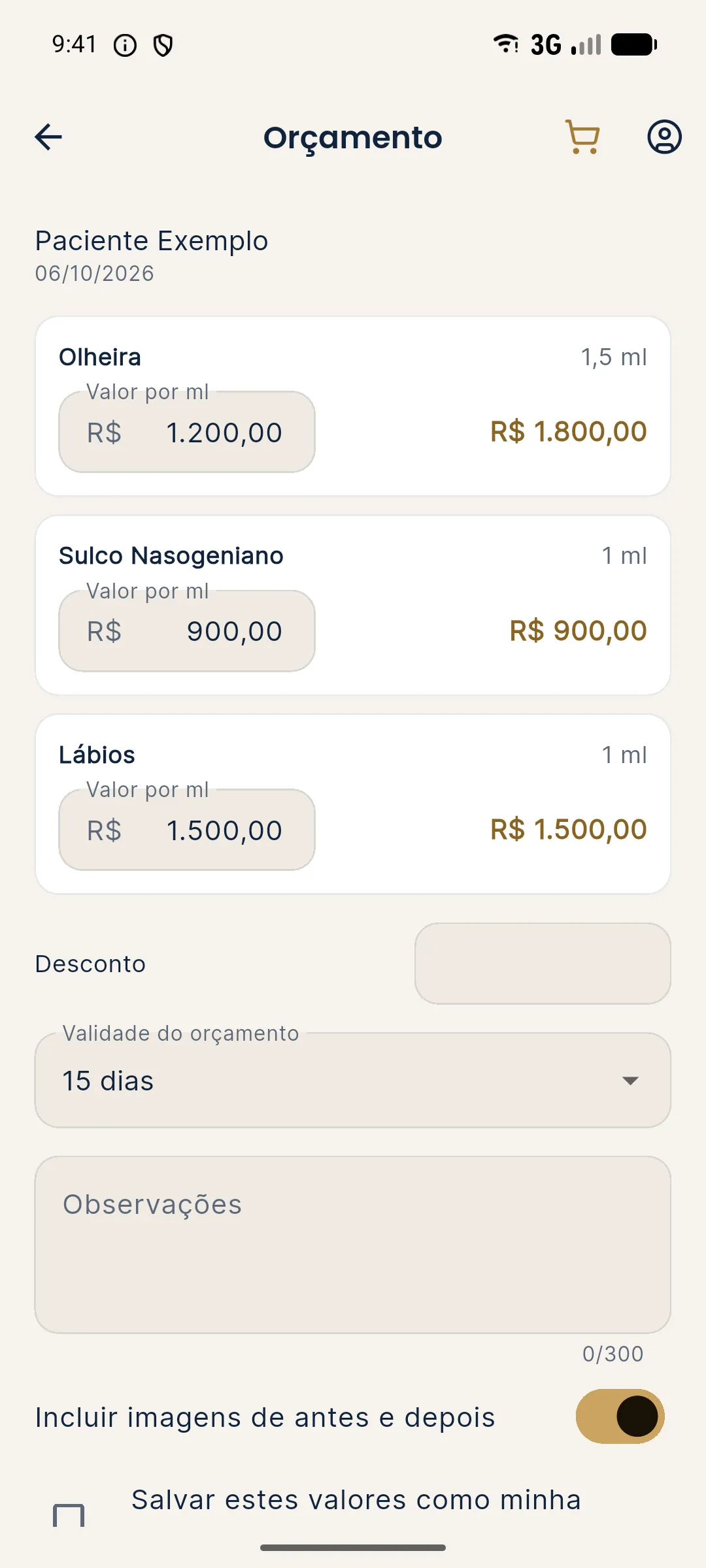
The routine of turning the plan into a proposal is in plan in the PDF quote: what to show and, from the commercial side, in pricing per ml.
How do you talk about money without creating pressure?
Price is information, not an argument. Present the quote after the patient understands the plan, and avoid phrases that anchor on urgency, like "only this week". If there is a validity period, state the deadline naturally. And never tie the quote to a promise of results.
The part of the conversation that changes the tone is the invitation to decide in the patient's own time. The page how to explain the quote by area details the wording, and how to close the consultation without selling covers closing without pressure.
What if the patient's budget is incompatible with what they want?
It happens. The concern calls for more than the patient can invest right now. There are three honest ways out: postpone, do the part that fits and leave the rest recorded as a future stage, or point out that the expectation needs adjusting. What is not honest is promising the same result with half the volume.
When the patient decides to postpone, record the full plan and a reassessment date. Plans can lose validity over time, and the topic appears in validity of the treatment plan and in versions of the treatment plan.
What should you track after the patient has chosen?
Splitting over time only works if a follow-up is booked. Stages without a date tend never to happen, and the plan is left incomplete. Book the next stage as the patient leaves the session, and use the app's own reminder, whose notifications the patient can turn off in Account › Reminders if they prefer. To measure whether split plans are being completed, the plan execution rate is the natural indicator.
Frequently asked questions
How do you build a facial harmonization plan for someone with a small budget?
Identify the main concern, treat first the area with the greatest gain within the limit and leave the others for future sessions, with the order recorded in the plan.
Is it worth diluting the volume to fit the budget?
It is not a good path. Reducing the volume below what the case needs usually produces an imperceptible result and leads the patient to pay twice for the same goal. Splitting over time is more honest.
How do you present more than one price scenario?
Show two or three scenarios with different areas and volumes, making clear what each one covers and what is left out, so the patient can choose with information.
Can the budget change the clinical indication?
It should not. The budget changes the order and pace of the plan. The indication remains the clinical judgment of the licensed professional.
Harmy images are illustrative simulations generated by AI from the patient's photo to support the conversation between practitioner and patient. They are not a promise of results. Indication, technique, product and volume are solely the decision of the licensed practitioner. This content is for information only and does not replace a clinical assessment.