
Linking the Plan and the Quote in HOF

Quick facts
- Principle
- The quote mirrors the plan: each area becomes a line, with ml and price
- Fields
- Area, planned ml, price per ml, discount, validity, notes
- Risk
- A quote that changes the plan to fit the price, instead of the other way around
- Transparency
- Clear ranges, terms and validity, in writing
Plan and quote are the same document seen from two angles: the clinical and the financial. When they travel apart, problems show up fast. The patient approves the plan, balks at the price and asks to drop an area. The professional cuts volume to fit the price and compromises the result. Or the quote reaches the patient with vague fields and no validity, and becomes an argument later.
Linking plan and quote is simple work, but it takes method: each area of the plan becomes a line, with volume, price and terms, and financial decisions are kept separate from clinical ones. This page shows how to make that link transparently, how to handle a patient who cannot pay for everything and what Harmy offers to organize this step.
Why link the plan and the quote?
The benefits are practical.
- Coherence. What is proposed is what is charged, with no gap between what was said and what was billed.
- Clarity for the patient. They see what each area costs and understand the whole.
- Easier prioritizing. With separate lines, it is simple to decide what to do first.
- Protection. The document records the agreement, with validity and terms.
- Clinic control. It is easy to compare what was quoted with what was done.
The link to pricing appears in pricing per ml, and the quote itself in how to explain the quote by area. What to show in the PDF is in the plan in the PDF quote: what to show.
How does an area of the plan become a quote line?
The process has few steps, and all of them must be consistent with the clinical plan.
A hypothetical example illustrates the format (fictional values):
| Area | Planned ml | Price per ml (example) | Quote line |
|---|---|---|---|
| Cheekbone | 2 ml | R$ 1,000.00 | R$ 2,000.00 |
| Lips | 1 ml | R$ 1,000.00 | R$ 1,000.00 |
| Chin | 1 ml | R$ 1,000.00 | R$ 1,000.00 |
| Total | R$ 4,000.00 |
The example is hypothetical and only shows the arithmetic. Each clinic sets its own prices, which can vary by area, product and professional.
What to do when the quote does not fit?
This is the most delicate situation, and the one that tests the ethics of the plan the most. The patient likes the plan, but the total is more than they can pay. There are two bad ways out and two good ones.
Bad: cutting the volume of every area until it fits (the result falls below what is indicated) or doing everything at once on a payment term that is too short, pressuring the patient into debt.
Good: prioritizing stages, doing first what matters most, or offering installments clearly, respecting the payment terms.
Prioritizing follows the criteria in prioritizing by the patient budget, prioritizing by visual impact in the plan and prioritizing by risk in the plan. The conversation about price appears in I saw it cheaper.
What information should the quote have?
A clear quote has, at a minimum:
- identification of the clinic and the patient;
- issue date and validity (in days);
- list of areas with volume (ml) and price;
- discount, if any, shown transparently;
- total;
- payment terms and informational installments;
- important notes, such as the planned stages;
- a notice that the images are illustrations, when included.
Formal requirements for offers and consumer information follow Brazil's Consumer Defense Code and the rules of your professional council. Confirm with the clinic's legal counsel.
What about touch-ups and maintenance?
The quote should say what is included and what is not. Touch-ups may or may not be included, and maintenance over time is a future cost the patient should know about. Making this clear from the start avoids misunderstandings.
Points to spell out:
- whether a touch-up is included in the price and within what period;
- whether the plan's second stage is priced separately;
- that maintenance (repeating the treatment) is a recurring expense;
- that the volume used may differ from the planned volume, and how that is handled (see planned ml vs ml used).
Maintenance is in annual maintenance plan in HOF and follow-up in follow-up and patient retention.
How does Harmy link plan and quote?
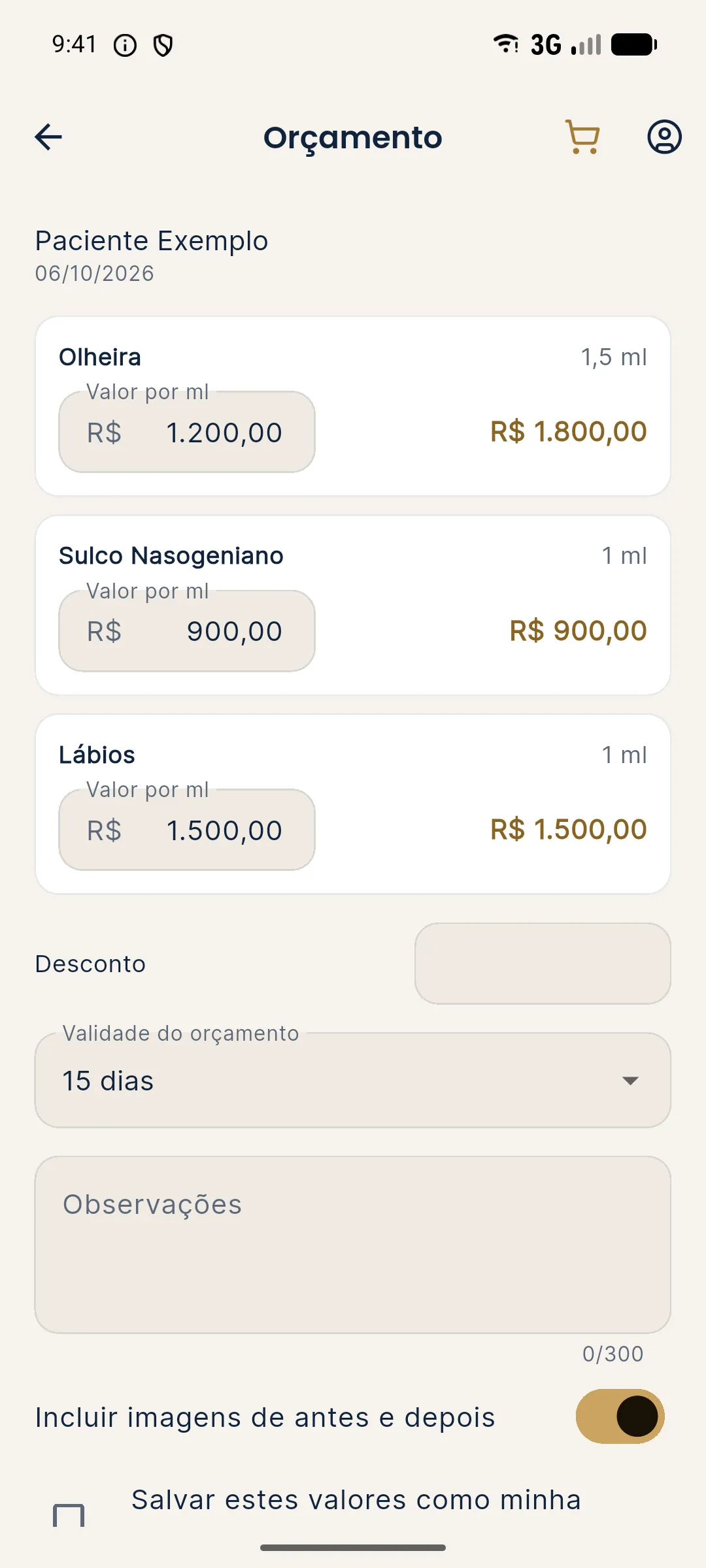
Because it is generated from the plan, the app's quote reduces the risk of a gap between what was proposed and what was charged. The steps are in building a per-ml quote in Harmy and PDF quote. The price of each projection in Harmy (R$ 3.99, no monthly fee) is a clinic cost, and whether to pass it on is the clinic's decision.
Quiz: plan and quote
Summary
- The quote is the financial mirror of the plan: each area becomes a line.
- Calculate planned ml x price per ml, add up, apply the discount and state the validity.
- If it does not fit, prioritize stages instead of shrinking volumes.
- Spell out touch-ups, maintenance and terms in writing.
- Harmy generates the PDF quote from the plan.
Frequently asked questions
How do you turn the plan into a quote?
List each area of the plan with the planned volume in ml, apply the price per ml set by the clinic, add it up, apply a discount if any and state the validity and terms.
Can the quote change the plan?
The quote should not drive the clinical indication. If the patient cannot pay for everything, the right move is to prioritize stages, not to cut volumes below what is indicated just to hit the price.
Do I need to tell the patient the price per ml?
Showing the price per area and the total is a common transparency practice. The format and the required information should follow Brazil's Consumer Defense Code and the rules of your professional council.
How long is the quote valid?
Set a validity period, in days, and write it on the document. This protects the clinic and the patient from changes in cost and plan, and makes the agreement clear.
Harmy images are illustrative simulations generated by AI from the patient's photo to support the conversation between practitioner and patient. They are not a promise of results. Indication, technique, product and volume are solely the decision of the licensed practitioner. This content is for information only and does not replace a clinical assessment.