
I Saw It Cheaper Elsewhere: How to Answer Without Price Talk

"I saw it cheaper somewhere else." Almost every clinic hears this sentence every week. The instinctive reaction is to defend yourself or lower the price, and both come at a cost. Defending sounds arrogant. An automatic discount teaches the patient that the price is negotiable and that the quality you offer is worth less than it seems.
There is a better path: answer about scope and safety, without talking about price and without talking about anyone. The text is about communication, and the pricing decision is yours. On advertising and rules, follow what your professional council provides (in Brazil, CFM, CFO and others).
What is the patient really saying?
The sentence has four likely versions:
- Curiosity. "I just wanted to know why yours is different."
- Budget. "I'm at the limit of what I can pay."
- Negotiation. "If you lower it, I'll book."
- Doubt about value. "Am I overpaying?"
Ask lightly: "what did you see? Can you tell me what was included?". Often the patient does not even know. The question alone changes the mood.
The principle: compare scope, not price
Two quotes are only comparable when what is inside them is the same. Help the patient compare what matters, without citing figures or names:
| Item | Question they can ask | What to say about yours |
|---|---|---|
| Assessment | Is the consultation included? | Explain how your assessment works |
| Plan | Is there planning by area, with ml? | Show how the plan is built |
| Material | Is the product from a traceable source? | State that traceability is recorded |
| Professional | Who performs it? | Say who does it and with what qualification |
| Safety | Is there preparation for complications? | Talk about the team, the protocol and hyaluronidase on hand |
| Follow-up | Is a reassessment included? | Say what is included and what is not |
| Contact | What is aftercare support like? | Explain the channel and the response time |
This list works as a script. You do not need to defend every item, only make clear what you offer.
Never speak badly of the other place
It is tempting to suggest that a low price comes from a bad product, an unprepared professional or risk. Even if you are right, the sentence backfires:
- it sounds like defending your own interest;
- it may violate your council's rules on relations between colleagues;
- it puts the patient in the position of defending their own choice;
- it may be wrong, because you do not know the case.
Instead, talk about safety as your own value. Say what you do, what you record, what you use and how you follow up. The patient draws the conclusion.
How to show scope in practice
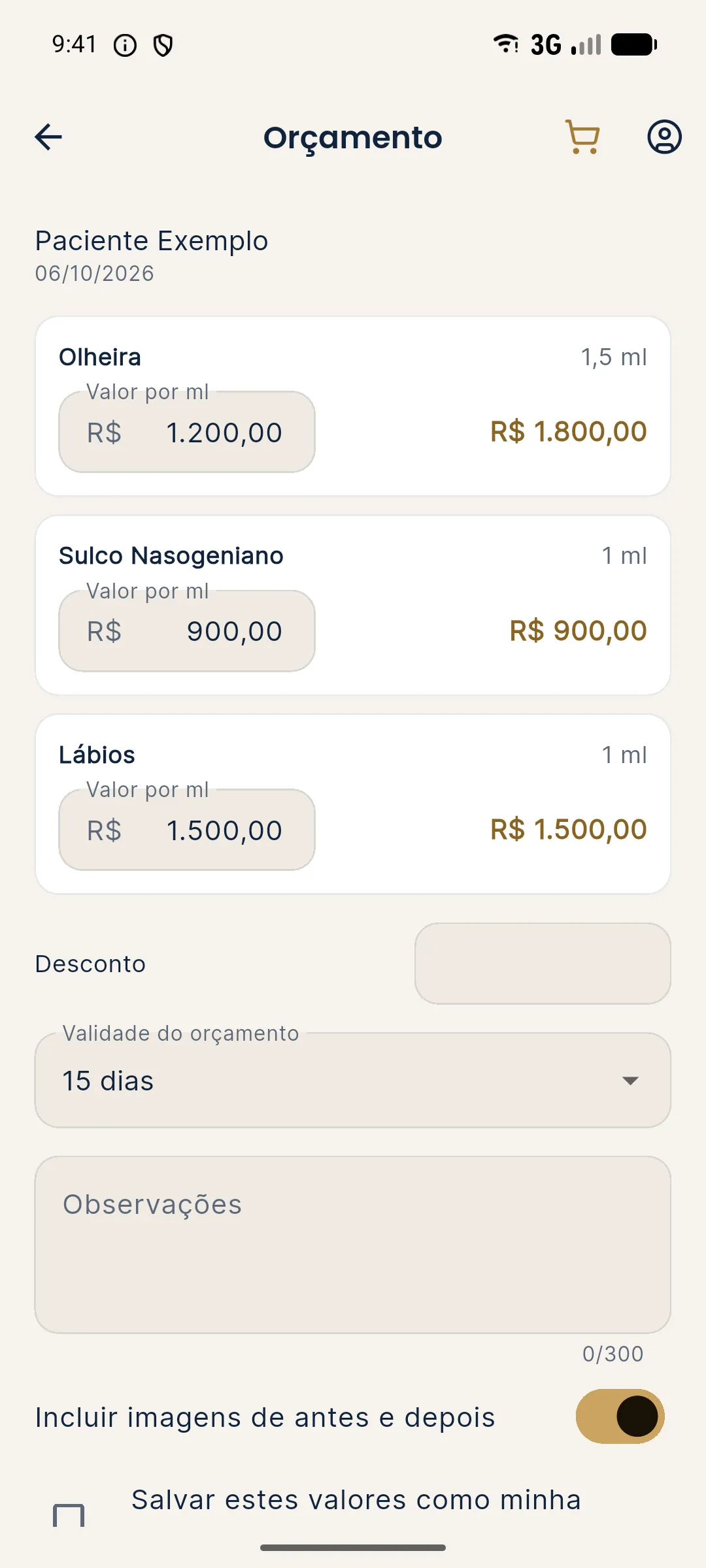
One concrete way is to present the quote by area, with what is included. The patient sees the plan and understands what they are paying for. See how to explain the quote by area and a quote the patient understands.
What if price is the real problem?
If the issue is budget, accept it with respect and offer alternatives that do not compromise safety or scope:
- Phased plan. Start with the priority area and leave the rest for later. See phased plan.
- Fewer areas. A smaller, well-done plan is worth more than a large, rushed one.
- Payment options. Informational installments, according to the clinic's policy.
- Waiting. Accept that the patient cannot right now, without pressure.
Avoid offering discounts that undermine the viability of the care. If the clinic has a discount policy, apply it transparently and equally to everyone. On this topic, see discount request and selling more: pricing per ml.
What to say to someone who insists on price?
Some patients only want the lowest price. For them, an honest and calm answer avoids friction:
That is not losing the patient. It is respecting their decision and keeping the door open. Many come back, and those who do not were not the profile your clinic serves.
What should be recorded?
- The question and the answer, in a few lines.
- What was presented as scope.
- The patient's decision (book, wait, compare).
Informed consent and the quote must match what was said, because scope is part of what the patient accepts. The duty to inform includes making clear what is and is not included.
When a low price is worrying
If the patient reports that the price they saw is very low, there is a real risk: a product of doubtful origin, an unqualified professional or an inadequate environment. In that case, you can guide without accusing:
- suggest that the patient confirm the professional's qualification with the professional council;
- suggest that they ask for information about the product, such as registration and batch;
- explain that the environment and preparation for complications are part of safety.
This is guidance to the patient, not criticism of a colleague. For the ethical basis, see what can be advertised, CFO and CONAR and consumer law in the orofacial harmonization (HOF) clinic.
Frequently asked questions
Should I match the competitor's price?
It is not necessary and not always healthy. Compare scope, safety and follow-up, and set the clinic's pricing policy based on your costs, without getting into a price war.
Can I speak badly of the other professional?
No. Criticizing colleagues or clinics is unethical, weakens your position and can cause problems with your professional council. Talk about what you offer, not what the other does.
How do I explain the price difference without citing figures?
Explain what is included in your service: assessment, materials, technique, safety, follow-up visit and ongoing support. The patient decides whether that scope makes sense for them.
Is the patient right to compare prices?
Yes, it is their right. The professional's role is to make sure the comparison is between comparable things, stating what each offer includes and what it does not.
Harmy images are illustrative simulations generated by AI from the patient's photo to support the conversation between practitioner and patient. They are not a promise of results. Indication, technique, product and volume are solely the decision of the licensed practitioner. This content is for information only and does not replace a clinical assessment.