
Cross-Linked vs Non-Cross-Linked Hyaluronic Acid: Differences
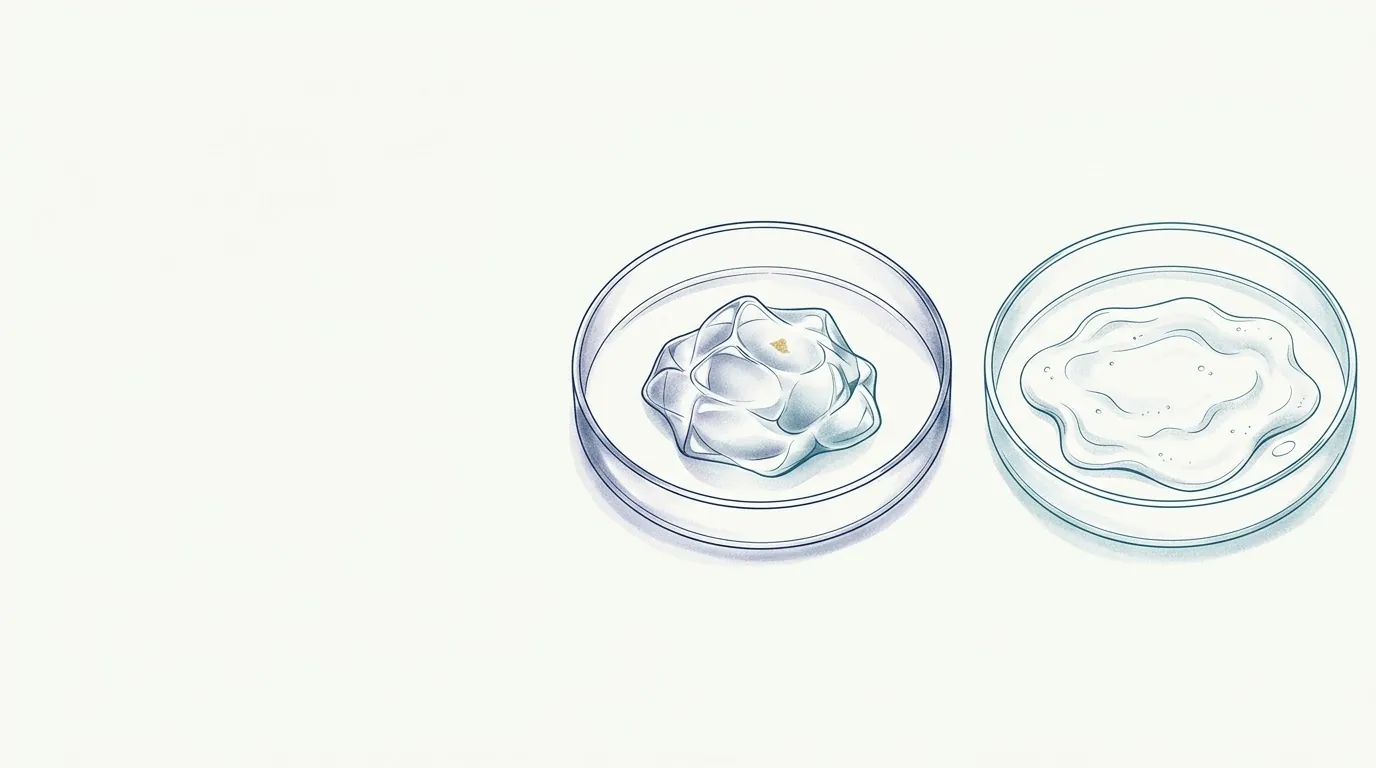
All injectable hyaluronic acid has the same base molecule. What separates a lip filler from a skin booster is, above all, cross-linking: whether the chains were bonded together, and to what degree. That difference decides how long the product stays in the tissue, whether it gives volume and how it behaves in each area.
The glossary entry on cross-linking explains the chemical process. Here the focus is clinical use: when a cross-linked gel is the choice, when non-cross-linked makes more sense and where molecular weight fits into this conversation.
What is the difference between cross-linked and non-cross-linked?
The hyaluronic acid present in skin is broken down by the body itself within a short time. For the injected product to last months, the manufacturer bonds the chains with a chemical agent, generally BDDE, forming a three-dimensional network. This is cross-linked hyaluronic acid.
Non-cross-linked keeps the chains free. It is fluid, spreads easily and breaks down quickly. It does not serve to give shape, but it can be used for superficial hydration.
| Characteristic | Non-cross-linked | Lightly cross-linked | Cross-linked (filler) |
|---|---|---|---|
| Structure | Free chains | Network with few bonds | Network with more bonds |
| Consistency | Fluid | Fluid gel | Soft to firm gel |
| Persistence in tissue | Short (days) | Intermediate | Long (months) |
| Volumizing capacity | None | Minimal | Moderate to high, depending on the gel |
| Typical use | Hydration, mesotherapy | Skin booster, fine lines | Volume, contour, support |
| Number of sessions | Several | Generally more than one | Generally one, with follow-up |
Persistence times vary with the product, the area and the patient. The reference for each product is its approved instructions for use.
Where does molecular weight fit in?
Molecular weight is the size of the hyaluronic acid chains, and it is a different characteristic from cross-linking. The detail is in the entry molecular weight of hyaluronic acid. In short:
| High molecular weight | Low molecular weight | |
|---|---|---|
| Behavior | More viscous, forms a more structured gel | More diffusible, less viscous |
| Persistence when free | Longer | Shorter |
| Described role | Structural and hydrating | More associated with signaling in the tissue |
| Where it appears | Base of fillers and many skin boosters | In skin quality formulas, sometimes combined with the high |
Fillers usually start from high molecular weight hyaluronic acid, which is then cross-linked. Skin quality products, on the other hand, may use free, lightly cross-linked hyaluronic acid or complexes of high and low molecular weight, as in hybrid hyaluronic acid.
What does cross-linking change in clinical use?
The degree of cross-linking, the concentration and the technology of each product define properties you feel in practice. They are described in rheology of fillers:
- G prime: the firmness of the gel and its ability to resist deformation. A firm gel favors projection and support.
- Cohesivity: how well the gel stays together after injection. It influences integration into the tissue and the risk of migration.
- Water absorption capacity: some gels swell more after placement, which weighs on the initial swelling and the final volume.
- Resistance to degradation: the more cross-linked, the longer in the tissue in general.
Monophasic and biphasic
Another distinction that appears on labels is the phase of the gel. In monophasic, the gel is homogeneous. In biphasic, particles of cross-linked gel are suspended in a phase of free or less cross-linked hyaluronic acid, which acts as a carrier. Both exist in different lines and have distinct spreading and integration behaviors.
How to choose between one and the other?
The right question is not "which is better" but "what is the goal in this area":
| Goal | Most used gel type | Why |
|---|---|---|
| Hydration and glow | Non-cross-linked or lightly cross-linked | Does not need volume; needs to spread |
| Superficial fine lines | Lightly cross-linked, soft | Thin skin does not tolerate a firm gel |
| Under-eye circles | Soft cross-linked, low to medium firmness | Needs to last, but the skin is very thin |
| Lips | Soft to medium cross-linked | High-movement area, needs softness |
| Sulci | Medium cross-linked | Soften the fold with integration into the tissue |
| Cheekbone, chin, jaw | Firm cross-linked | Projection and support over bone |
The complete map of gel by area is in hyaluronic acid by area. The final choice belongs to the licensed professional, after assessment, based on the product label and the rules of their professional council.
Does duration depend only on cross-linking?
No. Cross-linking is one factor, but how long the product stays in the tissue also depends on:
- Treated area: high-movement areas, such as the lips, tend to break the gel down faster than static areas over bone.
- Volume placed: larger deposits usually last longer than small, scattered amounts.
- Hyaluronic acid concentration in the product.
- Patient metabolism and habits, such as sun exposure, smoking and intense physical activity.
So promising an exact duration is a mistake, even with a highly cross-linked gel. The right approach is to speak in a usual range and to reassess at follow-up.
Which choice mistakes appear most often?
- Firm gel in thin skin, such as under-eyes and superficial lines, with risk of relief, irregularity and Tyndall effect.
- A gel that is too soft in a support area, such as the chin and jaw, with little projection and a need for more volume.
- A skin quality product used to give volume, which does not deliver what the patient expects.
- Talking to the patient only about "hyaluronic acid", without explaining that different products have different goals.
What are the risks of each?
| Risk | Non-cross-linked or lightly cross-linked | Cross-linked |
|---|---|---|
| Swelling | Common and transient | Common; may be greater with gels that absorb more water |
| Papules | Frequent right after placement | Less common |
| Irregularity and nodules | Rare | Possible, especially with a gel unsuited to the area |
| Tyndall effect | Uncommon | Possible with gel in a superficial plane |
| Late reactions and granuloma | Rare | Rare, described with fillers |
| Vascular occlusion | Possible | Possible, with greater potential for damage because of the volume |
How to explain it to the patient?
The patient hears "hyaluronic acid" and always imagines the same thing. A simple explanation avoids confusion about price and duration.
And in Harmy?
Checklist for choosing the type of hyaluronic acid
- Goal of the area defined: hydration, softening a line, volume or projection.
- Skin thickness and mobility of the area assessed.
- Gel type compatible with the goal (non-cross-linked, light, soft, firm).
- Indication and area checked in the instructions for use of the registered product.
- Patient informed about the duration and number of sessions of each type.
- Hyaluronidase available, with a protocol that considers more heavily cross-linked gels.
- Lot and product recorded in the patient chart.
Frequently asked questions
What is cross-linked hyaluronic acid?
It is hyaluronic acid whose chains have been bonded together by a chemical agent, forming a network gel that resists breakdown in the tissue for months. It is the basis of the fillers used for volume, contour and support.
What is non-cross-linked hyaluronic acid?
It is hyaluronic acid in free chains, with no bonds between them. In tissue it breaks down quickly, which is why it is used for hydration and skin quality, not for volume.
How long does non-cross-linked hyaluronic acid last?
In its free form, it usually breaks down within a few days in the tissue, although the effect on skin hydration may be noticed for longer. That is why protocols with non-cross-linked product call for more than one session and maintenance.
What is the difference between high and low molecular weight hyaluronic acid?
Molecular weight is the size of the chains. High-weight chains form more viscous, longer-lasting gels; low-weight ones diffuse more and last less when free. It is a different characteristic from cross-linking, although both influence how the product behaves.
Does hyaluronidase work on cross-linked hyaluronic acid?
Yes. Even when cross-linked, the gel is still hyaluronic acid and can be broken down by the enzyme. More heavily cross-linked gels may respond more slowly, which reinforces the need for a defined protocol.
Harmy images are illustrative simulations generated by AI from the patient's photo to support the conversation between practitioner and patient. They are not a promise of results. Indication, technique, product and volume are solely the decision of the licensed practitioner. This content is for information only and does not replace a clinical assessment.