
Planned ml vs ml used: how to record the difference

Quick facts
- Topic
- Recording the deviation between the ml planned and the ml actually used
- Why record it
- The deviation teaches you about the plan, the skin and how you read the face
- Who decides the volume
- The qualified professional, during the procedure
- Caution
- A difference with no record becomes a billing and patient record doubt
Every plan starts with a number: so many ml in this area, so many in that one. And every procedure ends with another number, the one actually used. They rarely match. The difference is not a flaw, it is information. It shows where the reading of the face was more or less generous than reality and, well recorded, it makes the next plan better. Poorly recorded, it becomes a doubt about billing, the patient record and memory.
This page covers how to record the deviation between planned ml and ml used: why it happens, how to note it, what it teaches, how to discuss it with the patient and what to do in the quote. For planning ranges, see ml per area: ranges used in visual planning.
Why does the ml used differ from the planned ml?
The plan is made with the face at rest, from photos and the exam. During the procedure, the tissue response, the skin, the relief and the patient's reaction come into play, and the professional decides in real time. Some common reasons:
- The tissue responded more or less than expected.
- Asymmetry required different volumes on each side.
- A decision was made to stop earlier, for safety or aesthetics.
- The patient reacted to some step and the plan was adjusted.
- An area was added or removed during the appointment.
In none of these cases is the deviation an automatic error. It is a clinical decision. What would be an error is failing to record it. The decision on volume always belongs to the qualified professional, according to the rules of their professional board.
How do you record the difference?
A simple table per area does the job. The point is to keep both numbers side by side, with the date and a short reason.
| Area | ml planned | ml used | Difference | Reason for deviation |
|---|---|---|---|---|
| Cheekbone | 2.0 | 1.5 | minus 0.5 | Tissue response, stopped earlier |
| Lips | 1.0 | 1.0 | 0 | As planned |
| Chin | 1.5 | 2.0 | plus 0.5 | Asymmetry adjustment |
| Fold | 1.0 | 0 | minus 1.0 | Decided not to treat after reassessment |
The numbers in the table are a hypothetical example, only to illustrate the format. What matters is the structure: planned, used, difference and reason, always in the same place in the patient record. For the rest of the record, see plan diary: progress record per session and abbreviations and notation in the HOF plan.
What does the deviation teach about the plan?
Over time, the deviations form a pattern. If you always use less than you plan in an area, the plan overestimates. If you use more, it underestimates, or the patient asks for a top-up. That pattern is data about your reading and about the profile of your patients.
A few questions help you learn:
- Is there an area where the deviation repeats in the same direction?
- Is there a skin type or patient type where the plan tends to miss?
- Does the deviation show up more when the plan is complex, with many areas?
- Was the patient satisfied with the volume used or with the volume planned?
If you find that you plan more than you use, attention goes back to the risk of expectation: the simulation may have shown a larger effect than the actual volume delivers. See percentage distribution of volume across areas and comparing Subtle, Moderate and Pronounced intensities.
How do you handle the deviation with the patient and in the quote?
The patient needs to know in advance how the deviation works. If the price is fixed per package or per area, the deviation does not change the price. If it is per ml used, it does, and that must be stated in the quote. Transparency avoids the discomfort of a bill different from the one expected.
Agree on this in writing, together with the quote. To structure prices, see pricing per ml. Remember that the professional is responsible for the record, so clarity protects both sides.
How does Harmy fit into this?
The ml in the app is the plan's ml. You enter it per area, in steps of 0.5 ml, from 0.5 to 5 ml, and it feeds the projection and the PDF quote. For a bilateral area, the ml is the total, split between the two sides. The ml actually used is the one in your procedure record, and the app does not track it.

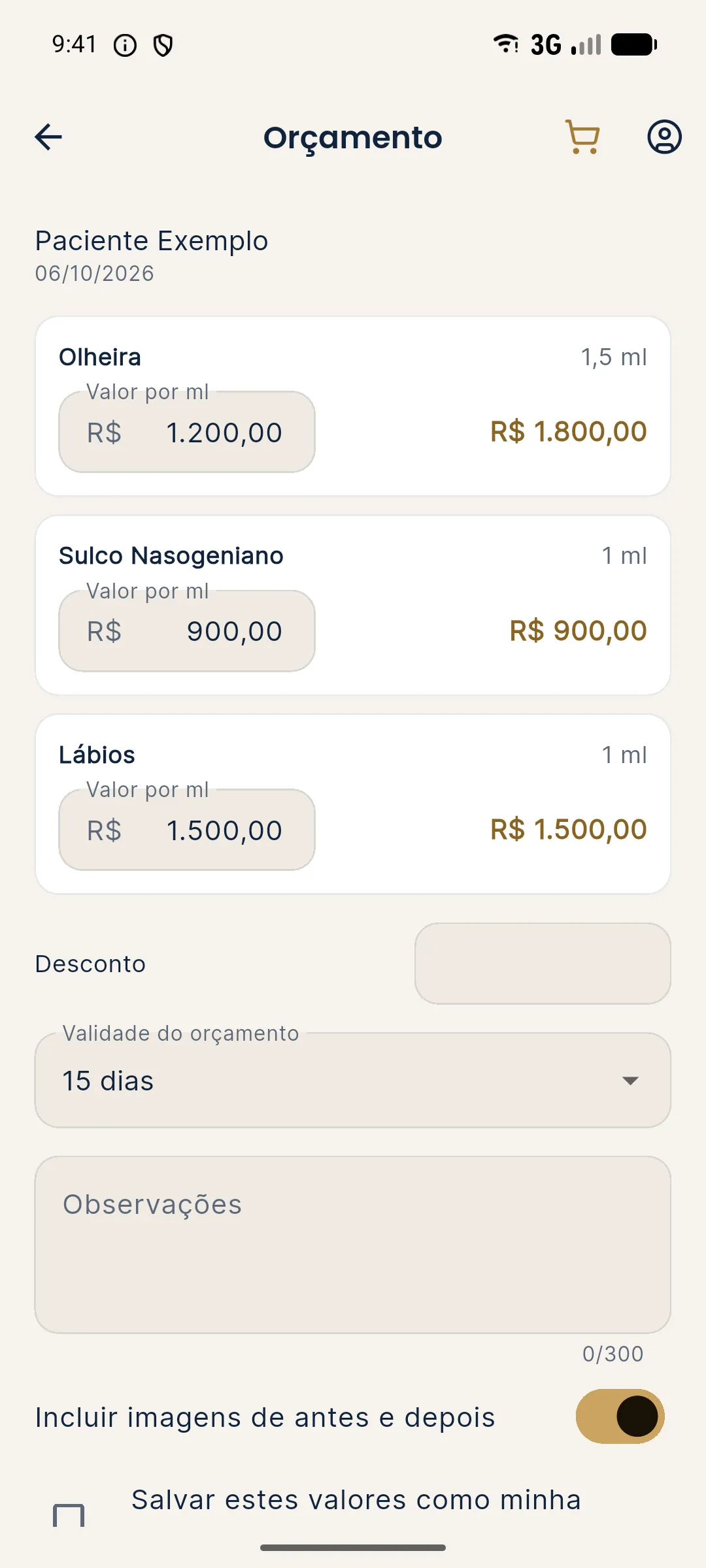
A good practice is to record the ml used in the history session itself, in its notes, to keep plan and reality in the same place for the patient. The app stores sessions per patient, and search is by name. After the procedure, "Add actual result" stores the photo aligned by the eyes, which helps you see the relationship between the volume used and what showed up.
Every decision on volume, product and technique belongs to the qualified professional, after assessment. The simulation is illustrative and does not promise results.
Frequently asked questions
Is it normal to use less or more ml than planned?
It can happen. The plan is a forecast, and the final decision is the professional's during the procedure, based on the tissue response. The important thing is to record it.
What should I do about the difference in the quote?
Agree with the patient beforehand how the deviation will be handled, and record it. The quote should say whether the price is per ml used or per package.
Does the ml in a Harmy projection count as the ml of the procedure?
No. The ml in the app feeds the illustration and the quote. The volume actually used is the one in your procedure record.
How does the deviation help the next plan?
It shows where the plan overestimated or underestimated the need, and lets you calibrate the next forecast with the patient's own data.
Harmy images are illustrative simulations generated by AI from the patient's photo to support the conversation between practitioner and patient. They are not a promise of results. Indication, technique, product and volume are solely the decision of the licensed practitioner. This content is for information only and does not replace a clinical assessment.