
ml per area: ranges used in visual planning

Quick facts
- Topic
- ml ranges per area in the app's visual planning
- App scale
- From 0.5 to 5 ml per area, in 0.5 ml steps
- What ml means in the app
- A parameter for the illustration and the quote, not a prescription
- Golden rule
- When in doubt between two values, plan the lower one and reassess
The question "how many ml?" is the one that comes up most in planning and the one with the least single answer. The number depends on the area, anatomy, skin, product and goal. Even so, the plan needs a value for the conversation, for the quote and for the simulation. The trick is to treat that value as a forecast and a communication tool, not as a recipe.
This page explains how ml works in Harmy's visual planning, what ranges the app accepts, how to think about volume per area without overdoing it and how to keep the number on the screen from becoming a promise. For recording the difference between planned and used, see planned ml vs ml used.
How does ml work in the app's planning?
In Harmy, each marked area receives an ml value, from 0.5 to 5 ml, in 0.5 ml steps. For bilateral areas, such as cheekbones and temples, the value entered is the total, split between the two sides. The AI respects the volume: the more ml, the more noticeable the change in the illustration. This is a property of the image, not a clinical measurement.
In the app, ml serves three purposes: generating the projection, showing the volume over the After image with the "Show procedures" feature, and building the PDF quote. None of them is a prescription. The decision on the real volume belongs to the qualified professional, after assessment, according to the rules of their professional board.
What ranges are usually used in visual planning?
The ranges below describe how visual planning is usually organized, as a conversation reference and with no protocol value. They vary with the patient, product and technique, and may be lower or higher at the professional's discretion.
| Area | Visual planning range | Note |
|---|---|---|
| Glabella | Symbolic value in the app | High vascular risk area |
| Temples | Moderate range | High vascular risk area |
| Tear trough | Low range | Little margin, thin skin, high risk |
| Cheekbone | Moderate range | Weighs on the proportion of the midface |
| Nasolabial fold | Low to moderate range | High vascular risk area |
| Mouth corners | Low range | Little volume produces a visible change |
| Lips | Low to moderate range | Naturalness depends on proportion |
| Chin | Moderate range | Projection can only be read in profile |
| Jawline | Moderate to high range | Adds up with the chin and cheekbone |
The table is qualitative on purpose. Universal numeric values mislead, because they ignore the anatomy of each face. What counts is the order of magnitude and the idea that delicate areas call for less, while structural areas tolerate more. To see how volumes are distributed across areas, read percentage distribution of volume across areas.
How do you choose the value without overdoing it?
A rule of conduct helps: when in doubt between two values, plan the lower one and leave the top-up for the follow-up. This reduces the risk of excess, gives time to assess the response and preserves naturalness. Some practical criteria for choosing:
- Observable goal: what change do you want to assess? A subtle goal calls for a small volume.
- Anatomy and skin: thin skin with little tissue tolerates less; absent bony structure calls for assessing the skeleton first.
- The whole: the sum of all areas matters more than the value of each one.
- History: residual material and previous treatments reduce the margin.
- Expectation: a patient who wants "a lot of change" may be asking for more than the face can handle.
When the sum grows, the risk is the effect of excess volume, the subject of pillow face: how planning avoids the effect. For the idea that structure comes before detail, see structure before detail in the HOF plan.
And intensity, how does it relate to ml?
The ml states the volume of the plan. The intensity (Subtle, Moderate or Pronounced, with Moderate as the default) controls how much the projection emphasizes the change in the image. The two combine. A small ml at Pronounced intensity can produce an image more striking than the plan supports. The reverse, a high ml at Subtle, produces a discreet image that may underestimate the plan. The comparison is in comparing Subtle, Moderate and Pronounced intensities.
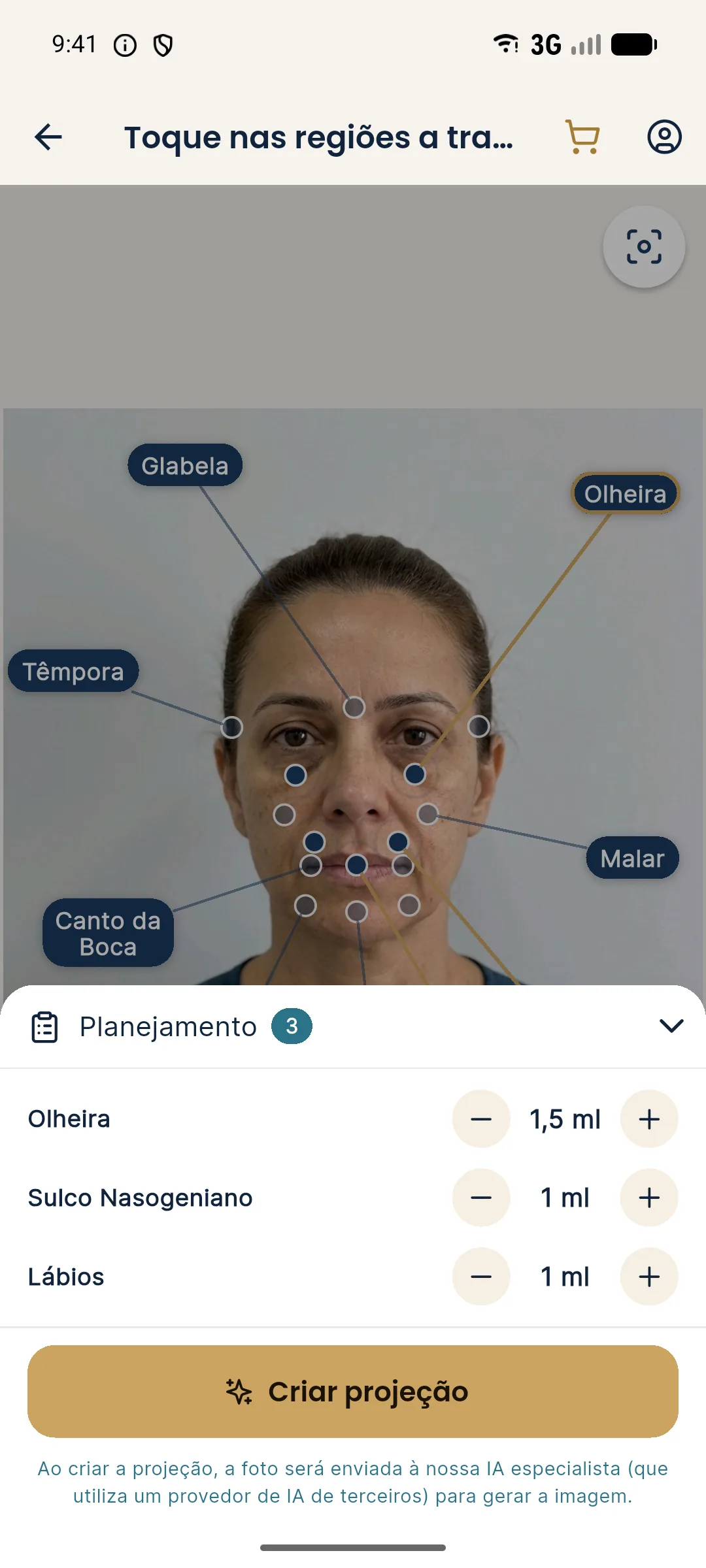
A useful practice is to keep Moderate intensity in initial conversations and use Subtle when the skin is thin, the area is delicate or the patient fears overdoing it. Reserve Pronounced for justified cases and always with the caveat that it is a reference scenario.
How do you show the ml to the patient without creating expectation?
Patients tend to read the ml as a guarantee: "if it is 2 ml, it will look like the photo". Avoid this with three attitudes. First, present the ml as a forecast of the plan. Second, show the projection as an illustration. Third, explain that the final volume is decided on the day, based on the tissue response.
In Harmy, the "Show procedures" feature displays the ml of each area over the After image. Use it with that explanation, and never as a commitment.
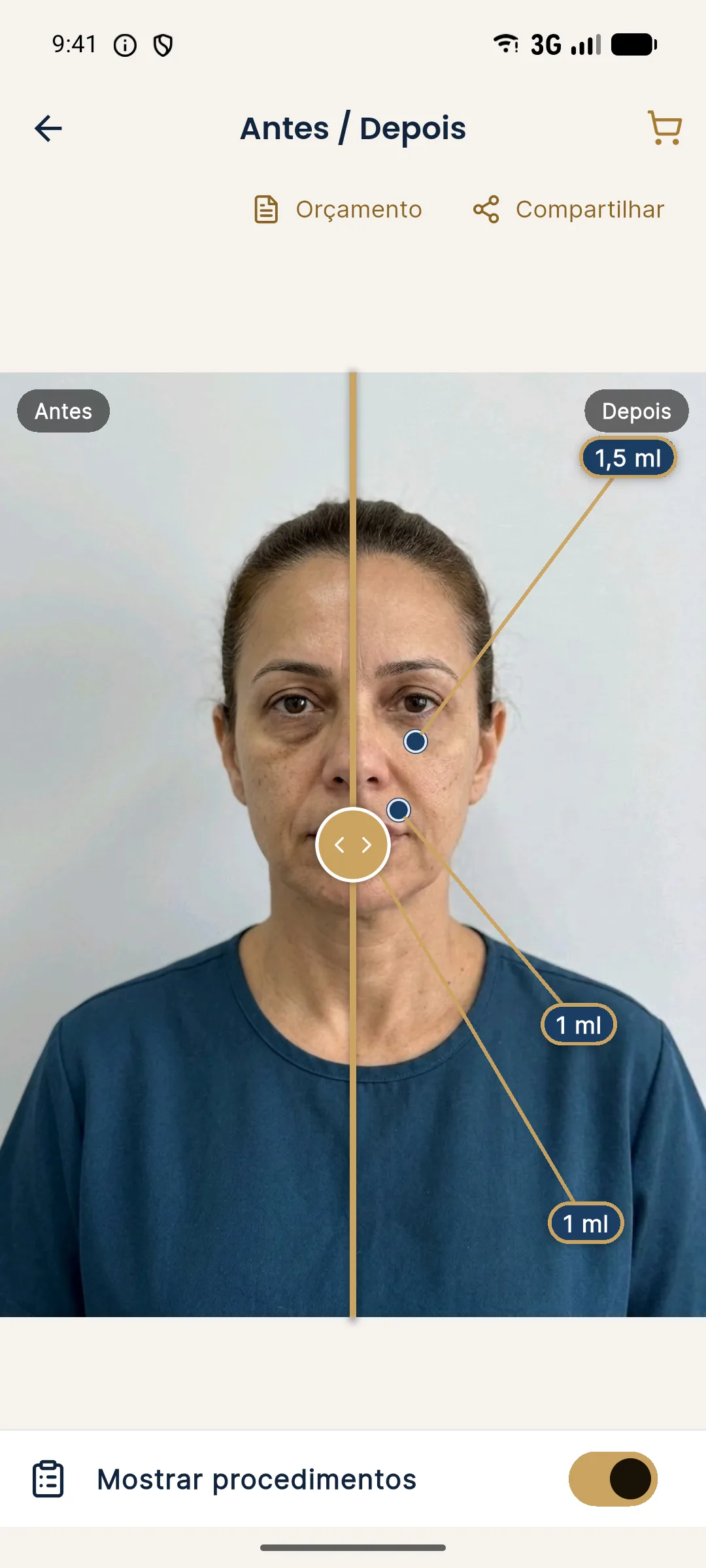
Every decision on volume, product and technique belongs to the qualified professional, after assessment. The simulation is illustrative and does not promise results.
Frequently asked questions
What is Harmy's ml range per area?
From 0.5 to 5 ml per area, in 0.5 ml steps. For a bilateral area, the ml entered is the total, split between the two sides.
Does the app's ml tell me how much to inject?
No. The ml feeds the illustration and the quote. The volume used in the procedure is the decision of the qualified professional, after assessment.
Is there an ideal volume per area?
There is no universal value. Ranges vary with anatomy, product, skin and goal, and must always be decided case by case.
Does more ml make the projection more visible?
Yes, in the illustration, the more ml the more noticeable the change. That does not mean more volume is better on the real patient.
Harmy images are illustrative simulations generated by AI from the patient's photo to support the conversation between practitioner and patient. They are not a promise of results. Indication, technique, product and volume are solely the decision of the licensed practitioner. This content is for information only and does not replace a clinical assessment.