
The Plan in the PDF Quote: What to Show the Patient

Quick facts
- Topic
- What to show in the PDF quote
- Patient version
- Areas, ml, prices, validity and notices
- Stays in the patient record
- Medical history, clinical findings, technique details and risks in full
- Caution with images
- Illustrative simulation, never as a result
- Installments
- Informational, without promising terms the clinic does not offer
The PDF quote is the document the patient takes home, shows to family and rereads before deciding. That is why what goes into it matters as much as the plan itself. This page separates what should go in the patient version from what stays in the patient record, and shows how to build a PDF that is clear, honest and free of promises.
Why separate the patient version from the patient record?
They are documents with different functions. The patient record is a clinical register: medical history, exam, findings, complications, product, lot, volume. The quote is commercial and informational communication: what will be done, how much it costs, how long it is valid. Mixing the two bloats the PDF, exposes unnecessary clinical data and can cause noise if the patient shares the file. The custody and content of the patient record follow patient records and documentation in facial harmonization.
Think about LGPD (Brazil's data protection law) too: the PDF circulates outside the clinic and may end up in family chats or on social media. Show only what is necessary and avoid sensitive data. See consent and LGPD for photos.
What goes into the patient version?
| Item | Why it goes in | Caution |
|---|---|---|
| Patient name and date | Identifies and gives validity | No unnecessary data, such as a full ID number |
| Planned areas | Clear scope of the plan | Popular names help: "smile lines" |
| ml per area | Transparency of the plan | A range or planned value, at the professional's discretion |
| Price per area and total | Financial decision | No comparison with third parties |
| Discount, if any | Clarity | Do not push to "close today" |
| Validity | Avoids price disputes | Realistic deadline |
| Notes | Agreements on stages and follow-up | Plain language |
| Clinic name and logo | Identity and contact | In line with advertising rules |
| Simulation notice | Honesty when there is an image | Fixed text from the app |
For the criteria on price per ml and per area, see quote per ml or per area and a quote the patient understands.
What stays only in the patient record?
Medical history, medications, allergies, exam findings, asymmetry assessment, risk analysis by area, technique and execution details, product lot, the signed informed consent and the record of any complication. These items do not appear in the PDF. The risks, in particular, are explained at the visit and in the consent form, and the PDF can simply state that the procedure has risks disclosed in a separate document.
How does Harmy build the quote?
After creating the projection, the professional opens the quote: sets the price per ml for each area, applies a discount, chooses the validity in days, adds notes and decides whether to include the images. The PDF comes out with the clinic's name and logo, informational installments and the notice. The price table can be saved in My clinic, so you do not have to type it again.
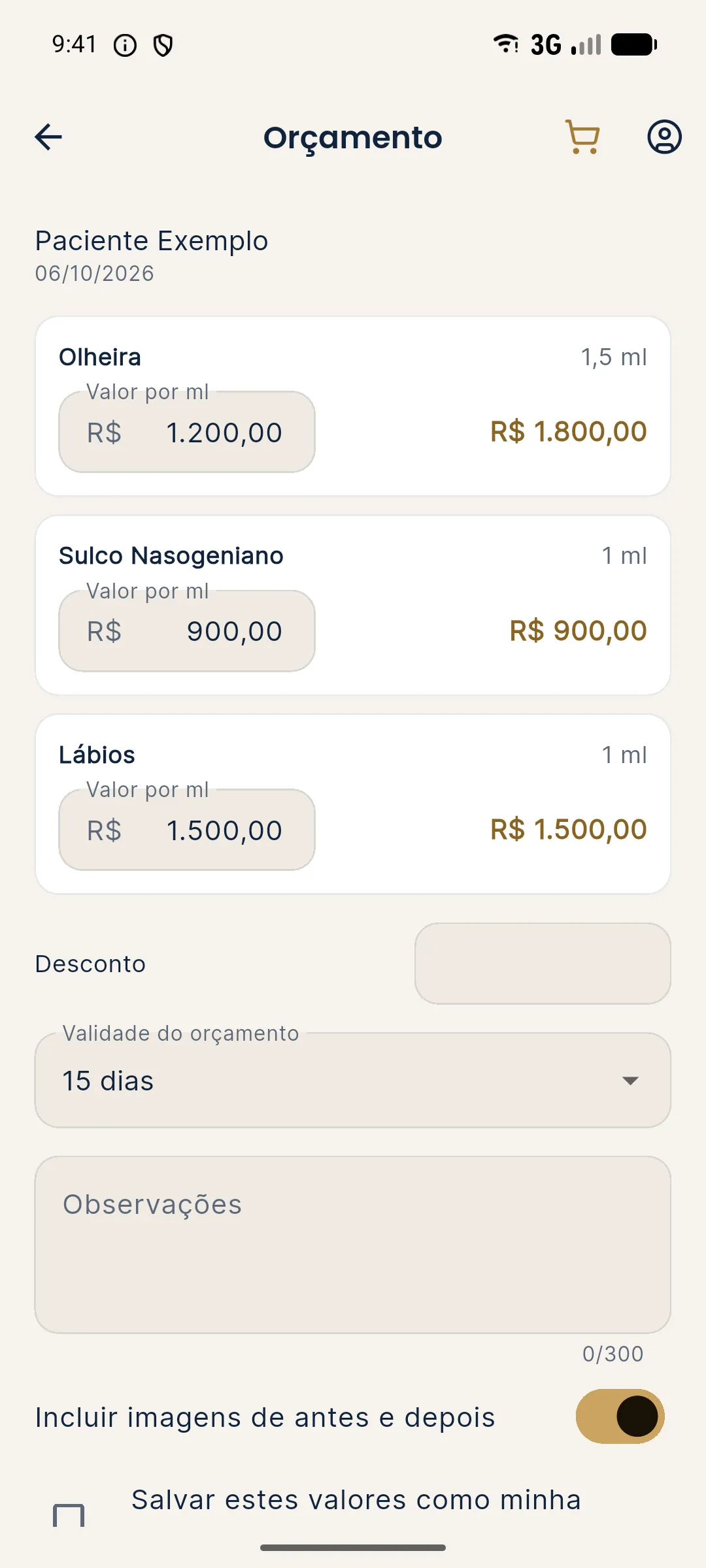
Once generated, the PDF is ready to share. See the step by step in PDF quote and in building a quote per ml in Harmy.
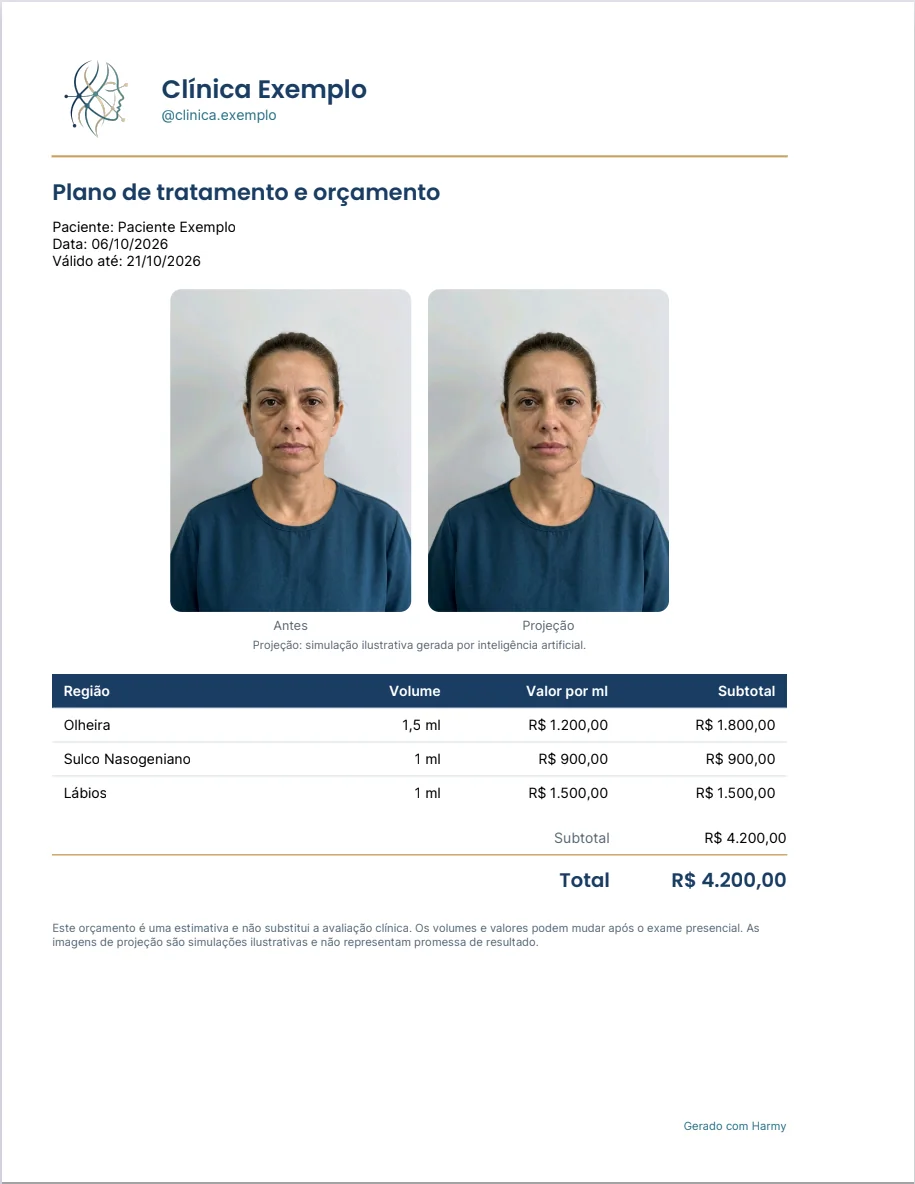
Should I include the simulation images?
It depends on the patient and the conversation. Including them helps recall what was agreed, but it can also become a "promise" if the patient shares the image out of context. If you include them, always use the illustrative simulation notice and talk about it. If the patient is undecided or anxious, consider sending the PDF without images and leaving the simulation for the visit. See notice text for illustrative simulation and printed vs on-screen simulation.
Never use the PDF, with or without an image, in advertising as if it were a result. Advertising before and after photos has its own rules, described in what you may advertise: CFO and CONAR (advertising rules in force in Brazil).
How do you present the plan in stages?
When the plan has more than one stage, show the stages in the PDF, each with its areas and prices, rather than a single total. That avoids the feeling of a "closed package" and lets the patient decide stage by stage. Also write what changes if the first stage shows a different response from what was expected.
More on this reasoning in linking plan and quote in facial harmonization and versions of the treatment plan.
What language should you use in the notes?
Short, concrete and free of promises. Prefer "Reassessment in two weeks, at no extra cost" to "Guaranteed result with follow-up". Prefer "Area to be decided after the first stage" to "We strongly recommend". Avoid superlatives, artificial urgency and comparisons with other clinics.
For the conversation about prices, see simulation and quote in the same conversation and quote acceptance rate in facial harmonization.
How do you handle discounts, validity and price adjustments?
The discount should appear on its own line, with the amount or percentage stated, so the patient understands the math. Avoid discounts conditioned on "closing today", because they create pressure and can breach communication ethics. Validity must be realistic: a deadline that is too short forces a decision without time, and one that is too long exposes the clinic to supply cost adjustments. Also say what happens after the validity ends, for example, that the price will be reassessed.
If the clinic adjusts prices periodically, state this neutrally in the document itself. For pricing policy, read how to build the clinic's price table and pricing per ml.
How do you keep the version that was sent?
Keep in the patient record a copy of the PDF exactly as it was sent, with the date. If the patient returns weeks later saying the agreement was different, you will have the document. In Harmy, the history by patient keeps the sessions, and the PDF can be regenerated, but the file that was sent is what counts as the record. If the plan changes, generate a new dated version and leave the previous one archived, without overwriting it.
Reasoning quiz
Summary
The patient's PDF is short, clear and honest: areas, ml, prices, validity, notes and the notice. Everything clinical stays in the patient record, and everything about risks stays in the consent form. Use images with judgment and never as a promise.
Frequently asked questions
What should be in a facial harmonization PDF quote?
Areas, planned ml, price per area, discount if any, validity, notes and a simulation notice when there are images. Extensive clinical details stay in the patient record.
Can I include the simulation in the PDF?
Yes, with the illustrative simulation notice. Harmy's PDF lets you include or leave out the images, and the professional decides case by case.
Does the quote replace the informed consent form?
No. The quote covers prices and scope, and consent is a separate document that explains the risks and is signed before the procedure.
Do the PDF installments count as a contract?
In Harmy, installments are informational. Actual payment terms must be confirmed and formalized by the clinic.
Harmy images are illustrative simulations generated by AI from the patient's photo to support the conversation between practitioner and patient. They are not a promise of results. Indication, technique, product and volume are solely the decision of the licensed practitioner. This content is for information only and does not replace a clinical assessment.