
How to Build a Price List for an Orofacial Harmonization Clinic

The price list is the document that turns the clinic's costs into a commercial decision. Poorly done, it causes two opposite problems: a price too low, which covers neither cost nor margin, and a price too high without justification, which blocks acceptance. Well done, it becomes a tool: the quote goes out quickly, the team answers with confidence and the professional knows how much each appointment really earns.
Here is a step-by-step method for building the price list of an orofacial harmonization (HOF) clinic, organized by area, ml and plan, with care about what can and cannot be advertised. The numbers in the examples are hypothetical and do not indicate market prices. To go deeper, see pricing per ml and profit margin in HOF.
Where to start: the real cost
A price without a cost is a guess. Before the list, work out the cost of each procedure. What goes in:
| Component | Example |
|---|---|
| Materials | Product, disposables, anesthetic, dressings |
| Professional's time | Cost per clinical hour. See cost per clinical hour in HOF |
| Overhead | Rent, electricity, cleaning, support staff |
| Taxes | Depending on the tax regime. See Simples Nacional for the HOF clinic |
| Payment fees | Card, early payout. See card machine fees in the procedure price |
| Losses | Product waste, expiration. See product loss and waste in HOF |
| Follow-up and touch-up | Time and materials for the included follow-up |
A cost that tends to be forgotten is the disposable material per patient. See cost of disposable material per patient.
How do I set the margin?
Margin is what is left after costs, and it must cover the owner's profit and the clinic's reserves. Decide the target margin based on what the clinic needs to sustain itself and grow, not on the "neighbor's price." Use the price per ml and margin calculator to test scenarios.
Hypothetical example: if the total cost of an appointment (materials, time, overhead, taxes and fees) is R$ 600.00 and the clinic wants a 40% margin on the price, the price will be the cost divided by 0.60, that is, R$ 1,000.00. Note that a 40% margin on the price is not the same as adding 40% to the cost (which would give R$ 840.00). This confusion is one of the most common causes of underpricing.
Which price list structure should I choose?
There is no single model. The most commonly used options:
| Structure | How it works | Advantage | Caution |
|---|---|---|---|
| Per ml | Base price per ml of material, multiplied by volume | Simple to scale | Can turn into a price war per ml |
| Per area | Fixed price per treated area | Easy to explain | Hides variation in volume and complexity |
| Per plan | Package of areas and sessions | Predictability | Requires care with consumer rights. See procedure packages in HOF |
| Hybrid | Base per ml plus a minimum price per area | Balance | More maintenance work |
Many clinics use a hybrid structure: a reference price per ml for volumetric areas, and prices per area or session for procedures with a specific technique or time. What matters is that the logic is explainable to the patient and consistent across quotes.
How do I organize by area?
List the areas the clinic works on and, for each one, define what is included and how the price varies. In the app, there are nine marking points (Glabella, Temple, Tear Trough, Cheekbone, Nasolabial Fold, Mouth Corner, Lips, Chin and Jawline), a good reference for the rows of the list. For each area, note down:
- the usual ml the clinic works with (a range, at the professional's discretion);
- the cost of materials and time;
- the complexity (areas with higher vascular risk require more time and attention);
- the follow-up included, if any;
- the note on limits and indications.
High vascular risk areas, such as the glabella, nasolabial fold and temples, call for care, hyaluronidase on hand and, often, more consultation time. The price should reflect this, without turning it into a sales argument. See areas and vascular danger zones of the face.
How do I create tiers by volume and plan?
When the patient treats more than one area, you can create plan conditions, as long as they respect the rules and consumer rights. Points to watch:
- Clear discount rule: in which cases and up to what limit. See discount policy of the HOF clinic and discount requests.
- Do not induce volume without indication: the plan cannot encourage the patient to treat more than they need.
- Staged plan: splitting into sessions helps with the quote and with safety. See staged plan.
- Quote validity: a defined period, with rules for adjustments.
- Payment terms: upfront, in installments, with or without interest, clearly stated. See installment payments for aesthetic procedures.
How does the price list feed into the quote?
The list becomes a quote when the professional chooses the areas and volume for a patient. A clear quote shows area, ml, price and terms. In Harmy, this process is straightforward: after marking the areas and setting the ml, you generate the PDF quote with the price per ml of each area, the discount, the validity in days and the notes, and you can include the images.
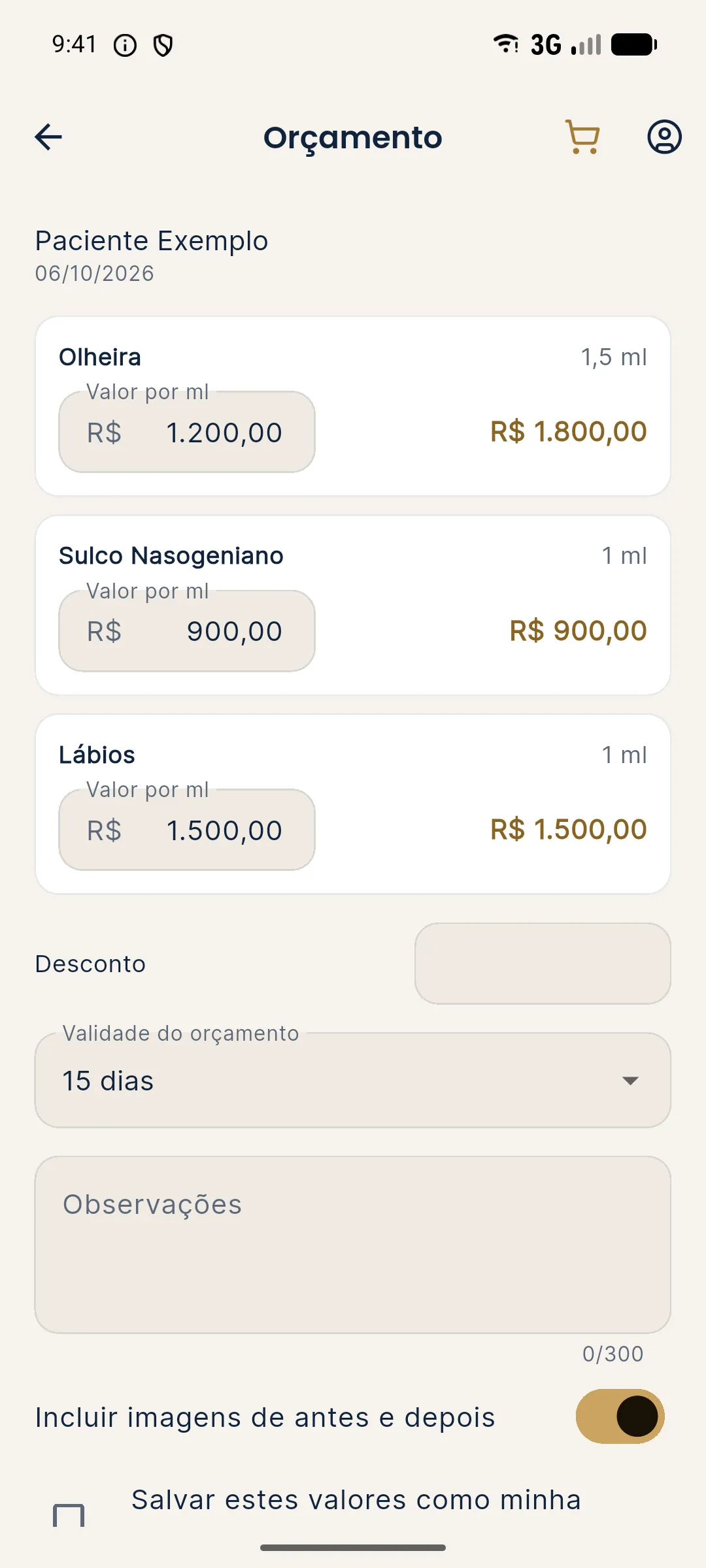
See building a quote per ml in Harmy and PDF quote.
Can I advertise the price list?
In general, healthcare advertising rules restrict advertising procedure prices, and the rules vary by professional board. The list should be understood as an internal document and an individual quote, handed to the patient who had the assessment. Check your board's rules before any public advertising. See advertising harmonization prices and how much does it cost in DMs.
How do I adjust prices without losing the patient?
Costs go up, and the list needs to keep pace. Some practices:
- Annual review marked on the calendar.
- Advance notice to patients with plans in progress.
- Honoring the accepted quote within its validity.
- Transparent communication: explain what changed in costs, without excessive justifications.
- Adjustment by tiers, rather than a uniform increase that ignores each procedure's margin.
See annual price adjustment in HOF.
How do I test whether the price is right?
Watch two signals: the quote acceptance rate and the real margin per procedure. If almost everyone accepts without discussion, the price may be too low; if almost no one accepts, the problem may be the price, the presentation or the audience profile. See quote acceptance rate in HOF and profit ranking by procedure in HOF. Adjust patiently, one variable at a time.
Frequently asked questions
How do I build a price list for a harmonization clinic?
Work out the cost of each procedure (materials, time, overhead, taxes and fees), set the margin you want, organize by area, ml and plan, and review periodically. The list is for internal use and quotes, and advertising prices follows the professional board's rules.
Should I charge per ml, per area or per procedure?
Each model has advantages. Per ml makes it easy to compare and scale volume; per area simplifies the conversation; per procedure or plan gives predictability. Many clinics combine them: a base price per ml and fixed prices per plan.
Can I post the price list on social media?
That depends on your professional board's advertising rules, which usually restrict advertising procedure prices. Use the list as an internal and quoting tool, and check the rules before publishing it.
How often should I adjust the price list?
Review it at least once a year and whenever costs change significantly. Announce the adjustment in advance and honor quotes already accepted within their validity period.