
Annual price increase in facial harmonization: when and how much

Quick facts
- Topic
- Annual price list increase
- Frequency
- Once a year, with a spot review if a cost spikes
- Basis of the calculation
- Inflation index, supply costs, clinical hour and margin
- Communication
- Advance notice, a clear reason and a rule for those who already have a quote
Fear of raising prices is one of the costliest fears in clinic management. Every year the rent goes up, the supplier raises prices, staff salaries are adjusted, the card terminal changes its fee and the dollar moves the imported supplies. If the patient price list stays frozen, the difference comes out of the owner's pocket, silently, as a shrinking margin. When the math gets tight, the reaction is usually an abrupt, poorly explained increase that scares the patient and looks opportunistic.
The better path is to make the increase small, regular and based on numbers. This page shows how to set the date, which indexes to look at, how to calculate the percentage per item, how to handle people with open quotes and how to communicate without friction. Any mention of prices must respect your professional council's advertising rules and Brazilian consumer law.
Why raise prices every year
Three practical reasons:
- Costs move on their own. Supplies, rent, energy, salaries and fees change, almost always upward.
- A small increase hurts less. An annual adjustment of a few points is easier to absorb than a jump that accumulates two or three years.
- Margin cannot be left to chance. Without review, the margin you calculated when you opened the clinic disappears without warning.
There is also a positioning reason: a price list that never changes can signal that prices are arbitrary. A list reviewed with criteria shows an organized clinic. See how to build the clinic's price list and profit margin in facial harmonization.
What to look at before setting the percentage
There is no single percentage. The calculation combines four sources:
| Source | What to measure | Where it weighs |
|---|---|---|
| Official inflation | Change in a general price index over the period (such as Brazil's IPCA, published by an official body) | Minimum reference to restore purchasing power |
| Supply cost | Change in what you pay the supplier, per item | Procedures with a lot of product |
| Clinical hour | Increase in salaries, rent and fixed costs divided by hours | Long procedures |
| Selling costs | Card fees and tax | Every appointment |
The same increase across the board is the simplest, but almost never the fairest for margin. Procedures with a lot of supplies go up more, and those with few supplies follow the clinical hour more closely. Compare with the price list increase calculator and the minimum price per procedure calculator.
Step by step of the annual increase
Pick a fixed date in the year, such as the start of a quarter, and repeat it. Predictability helps the team and reduces the feeling of an "increase out of nowhere." The break-even calculator shows how much higher costs raise the minimum revenue.
Open quotes and plans in progress
The front desk's most frequent question is: "what about people who already asked for a quote?" Set a simple rule and write it down:
- Quote validity. The amount holds until the stated validity date. After that, the new list applies.
- Staged plan already accepted. Decide whether later stages keep the agreed amount or follow the new list, and record it in the plan consent.
- Package already paid. The amount paid is honored according to the contract.
- Reservation with a deposit. The deposit secures the amount within the agreed period.
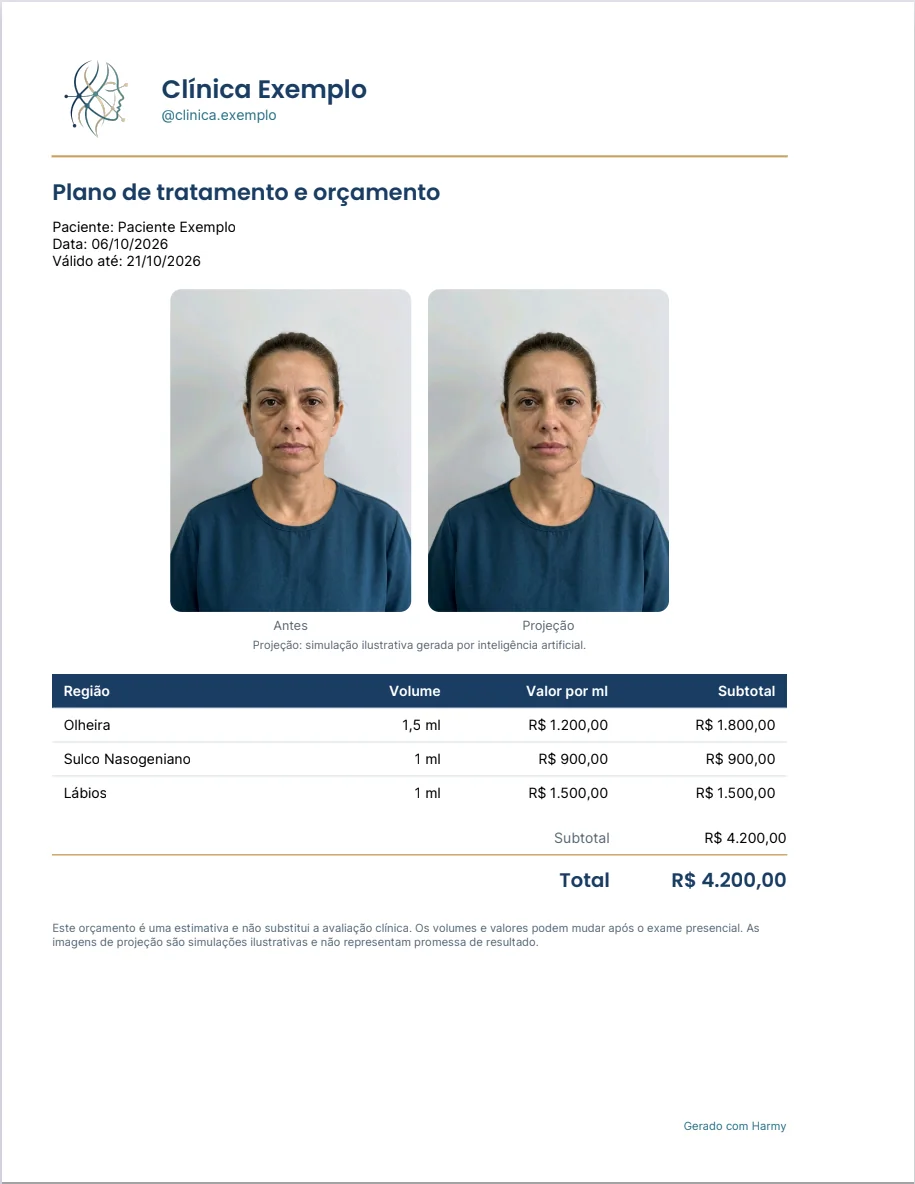
Having a validity period on quotes avoids a good share of conflicts. Harmy helps here: the PDF quote shows the validity in days, informational installments and a notice, and uses the price per ml saved in My clinic. When you raise prices, update the saved value and new quotes will already come out right.
For long plans, use the staged plan acknowledgment form and the staged plan page to define what happens with the price.
How to communicate without friction
Communication about the increase should be short, individual and advance. Avoid long justifications and apologies, which convey insecurity. Three principles:
- Advance notice. Tell patients under follow-up a few weeks ahead.
- Transparency. State the date, the fact that the list was updated and what changes for anyone who already has a quote.
- Focus on care. Reinforce what stays the same: assessment, safety, follow-up.
Avoid pressure like "buy before it goes up," which can be seen as an inappropriate sales appeal. The message for sending the quote by WhatsApp and the script for presenting the quote help keep the tone.
Discount requests after the increase
It is normal for some patients to comment on the increase. Prepare the team:
- Explain that the list is the same for everyone.
- Show what the price includes (assessment, review, follow-up).
- If there is a payment policy, present the options before talking about a discount.
- Record who questioned it and why, to adjust the communication next year.
See discount requests and discount policy. Granting systematic discounts after the increase cancels out the increase itself.
Signs that the increase needs adjusting
Raising prices with a method is part of caring for the clinic. A price list that keeps up with costs keeps the clinic alive to treat safely, train the team and invest in what matters. And, communicated with respect, it tends to be less problematic than the owner imagines.
Frequently asked questions
When should a facial harmonization clinic raise its prices?
Once a year is usually enough, on a fixed date known to the team. If some cost spikes between increases, do a spot review of that item without waiting for the date.
How much should prices go up?
The minimum is to cover inflation for the period, but the correct calculation uses the increase in your supply costs, clinical hour and fixed costs. Each item can have a different increase.
How do I tell patients about the increase?
In advance, simply and without over-apologizing: give the date, the general reason and what happens to anyone who already has a quote or a plan in progress.
Does raising prices cause patients to leave?
There may be some loss, and the clinic should track it. Often the effect is smaller than the fear, especially when the perceived value of the care is clear and the communication is transparent.