
Disclaimer text for an illustrative harmonization simulation

Quick facts
- Topic
- Illustrative simulation disclaimer on image, PDF and in conversation
- Purpose
- Prevent the simulation from being read as a promise or a result
- Where it goes
- Share image, quote PDF, patient link, message
- In Harmy
- The share image and the PDF already include the simulation disclaimer
- Who decides
- Qualified professional, according to the rules of their professional council and the law
The simulation is a conversation tool. It shows an idea of direction, based on a frontal photo and an entered volume, and so it is not a result, not a guarantee and must not be read as one. The disclaimer is the piece that turns that rule into visible text: short, clear and placed where the patient actually looks. This page gathers disclaimer templates for image, PDF, message and speech, explains where to place each one and points out what to avoid.
Why does the disclaimer matter?
Because the image is persuasive. A patient who sees the "after" on their phone tends to store the image in memory as what will happen, even when you talked about a simulation during the consultation. Days later, the conversation fades, but the image stays. A written disclaimer, next to the image, reduces that risk.
There is also the ethical and legal side. Healthcare advertising has rules, and your professional council's rules may restrict the use of before and after images, including simulations. In any case, never present the projection as an actual result. The guide to what can be published is in what can be published, CFO and CONAR (in Brazil, the CFO is the federal dentistry council and CONAR is the advertising self-regulation body), and the concept is in illustrative simulation.
What must a good disclaimer say?
A good disclaimer has four elements, in the order the patient reads them:
- What the image is. "Illustrative simulation."
- What it is not. "Not a result or a guarantee."
- Where it comes from. "Generated by AI from your frontal photo and the planned volume."
- What decides. "The actual result depends on the assessment and on how your body responds."
The shorter, the better. But the text must be legible: adequate font size, contrast with the background and placement next to the image, not on a separate page.
Ready-made templates
The templates below are a starting point. Adapt them to your clinic's tone and check them against your professional council's rules.
| Where to use | Short template | Note |
|---|---|---|
| Image footer | Illustrative simulation. Not a result or a guarantee. | Visible, not hidden |
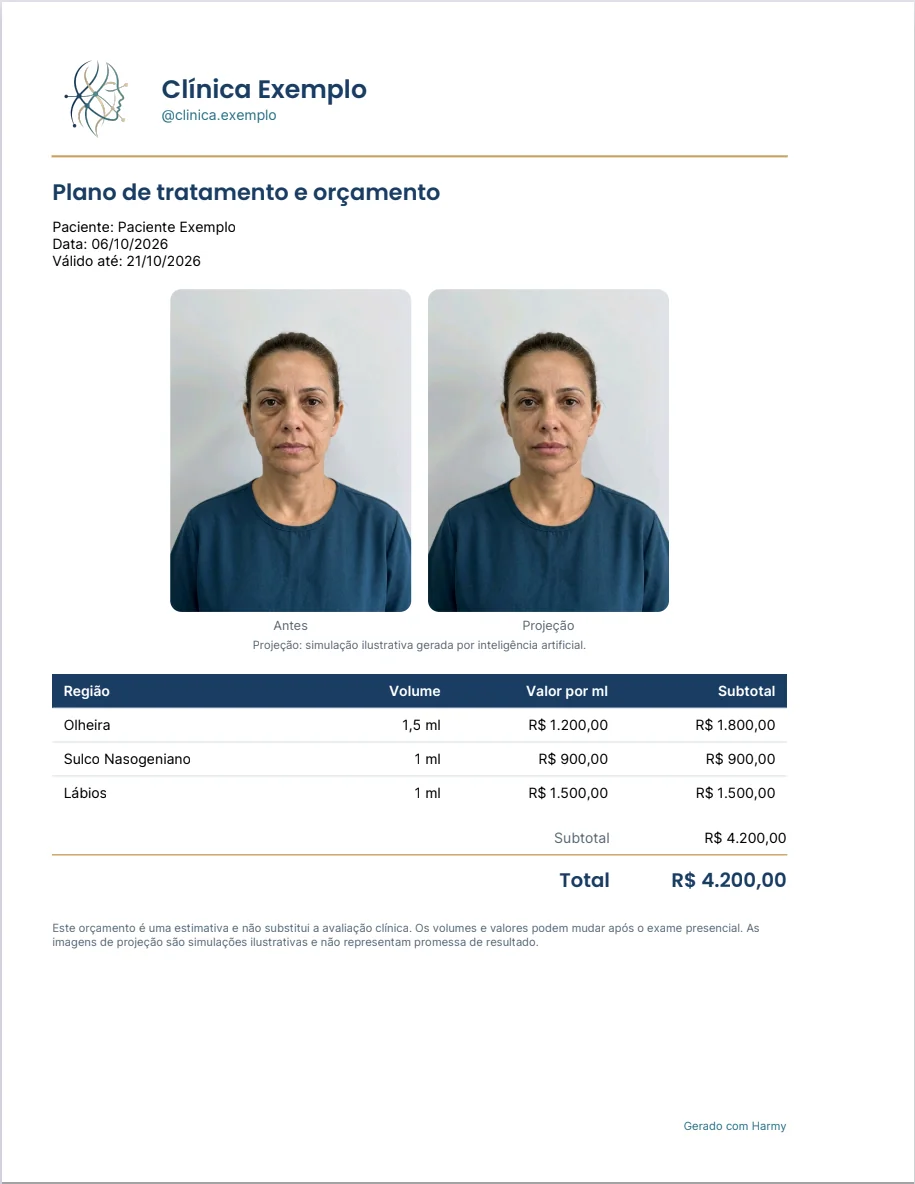
| Quote PDF | Illustrative simulation images, generated by AI from a frontal photo. The actual result varies and depends on clinical assessment. | Near the images |
| WhatsApp message | Here is the illustrative simulation I showed you in the consultation. It is an idea of direction, not a promise of results. | With the message |
| Patient link | Illustrative simulation to support our conversation. The actual result depends on clinical assessment. | At the top of the page |
| Spoken in the consultation | I am going to show you a simulation. It is an idea, not a guarantee, and we decide together what makes sense. | Before opening the image |
Where do you place the disclaimer on each piece?
On the image. The disclaimer should sit next to the Before/After, in the footer or in a visible band, with enough contrast. A footer so small it cannot be read does not do its job.
In the PDF. The disclaimer goes near the images, not only at the end of the document. If the PDF has several pages, it is worth repeating it on every page that has an image. See the plan in the PDF quote: what to show.
In the message. When you send the image by message, write the disclaimer along with it, not just in the image caption. This prevents the image from being forwarded without context.
In the consent form. Record the mention of the simulation in the informed consent or in an attachment. See informed consent by procedure and recording the simulation in the patient record.
What does Harmy already do?
In Harmy, the share image comes out with the before and after, the clinic header and the simulation disclaimer. The PDF quote also carries the disclaimer, along with price per ml, discount, validity and notes, and can include the images if you choose. That solves part of the problem, but it does not replace the conversation or the entry in the patient record.
The patient link (harmy.com.br/v/...) opens the slider on their phone with the clinic's logo and contact. Even then, explain verbally that it is a simulation.
What to avoid in disclaimers
- Promise language: "you will look like this", "guaranteed result", "transformation".
- Hidden disclaimer: tiny font, low-contrast color, separate page.
- Disclaimer only in English or in technical terms that the patient does not understand.
- Disclaimer too generic: "merely illustrative image" without saying it is AI-generated from their photo.
- Sharing without a disclaimer: sending the image on social media without the text alongside.
- Using the simulation as marketing material without respecting your professional council's rules.
Also avoid too many disclaimers, which tire people out and become an ignored routine. One disclaimer per piece, well placed, works better than five on every page. For the ethics of simulation in general, see ethics of result simulation.
How do you talk about the disclaimer with the patient?
The line must come before opening the image, not after. A patient who sees first and hears the disclaimer later has already fixed the image in mind. For more ready-made phrases, see explaining that a simulation is not a guarantee.
How do you record that the disclaimer was given?
Note in the patient record the date, the image shown, the disclaimer read or handed over and the patient's agreement. If there is a signature on the consent form, attach it. If the disclaimer was sent by message, keep the conversation according to your data policy. Remember that the patient's photo is sensitive data: see consent and LGPD for photos (LGPD is Brazil's data protection law).
Quick review
Summary
The illustrative simulation disclaimer must say what the image is, what it is not, where it comes from and what decides the actual result. Place it next to the image, in the PDF, in the message and in speech, record it in the patient record and never use the simulation as a posted result. Harmy already includes the disclaimer in the image and the PDF, and you complement it with the conversation and the consent form.
Frequently asked questions
Do I need to put a disclaimer on every simulation I show the patient?
It is the safest practice. The disclaimer makes clear that the image is illustrative and does not promise results, which reduces misunderstandings and protects the professional.
Can the disclaimer be small in the footer?
The disclaimer must be legible and visible, not hidden. Text that nobody can read does not do its job. Also follow your professional council's rules on advertising.
Does Harmy already add the disclaimer?
Yes. The share image and the quote PDF come with the simulation disclaimer. You can add your own notice in the conversation and in the consent form.
Can I publish the simulation on social media?
That depends on your professional council's rules and on healthcare advertising, and never as if it were an actual result. See the page on what can be published.
Harmy images are illustrative simulations generated by AI from the patient's photo to support the conversation between practitioner and patient. They are not a promise of results. Indication, technique, product and volume are solely the decision of the licensed practitioner. This content is for information only and does not replace a clinical assessment.