
Patient Approval of the Treatment Plan: How to Formalize It

Quick facts
- Goal
- Record that the patient understood and accepted the plan before starting
- Document
- Plan with areas, product, expected volume, stages, risks and price
- Difference
- Approving the plan does not replace the informed consent for the procedure
- Attention
- Terms and contracts should be reviewed by a lawyer and follow the rules of your professional council
A well-made plan that nobody recorded later turns into an argument about what was agreed. The patient remembers one thing, you remember another, and the final result gets judged against each person's memory. Plan approval is not bureaucracy: it is the point where the consultation conversation becomes an agreement both sides can refer back to.
This page shows what the plan approval needs to contain, what ways of recording it exist, how it relates to informed consent and to the quote, and how to handle changes. For the commercial side, see how to increase plan acceptance and staged plans.
What does approving a plan mean, and what does it not mean?
Approving the plan means the patient states, on the record, that they agree with the proposal: which areas, which product, what expected volume, in how many stages, for what price and with what limits. It is not a guarantee of results, and it is not authorization for any future conduct.
Two confusions are common:
- Plan approval vs. consent: the plan is the proposal. Consent records that the patient was informed about risks, alternatives, benefits and limits. Many clinics use one document for each.
- Approval vs. quote: the quote says how much it costs. The plan says what will be done. They can be on the same sheet, but they are two different pieces of information.
What should the approved plan contain?
Volume should appear as a range ("around 1 to 2 ml"), because the final adjustment happens during the injection, at the discretion of the licensed professional. Technique details, the injection plan or exact points do not need to go in the patient's document.
What ways of recording acceptance exist?
There is no single correct way. What matters is that the record is clear, dated and stored securely.
| Method | Advantage | Caution |
|---|---|---|
| Signed paper | Simple, accepted by everyone | Store and scan securely |
| Digital signature | Fast, traceable, paperless | Use a suitable service; see digital signature of consent forms |
| Entry in the patient record | Integrates with the clinical history | Must be clear about what was accepted |
| Acceptance by message | Practical for stages and adjustments | Keep the conversation; do not replace the procedure consent |
In general, a combination works best: a signed document at the start, plus messages for small adjustments. The choice should respect the rules of your professional council and your legal advisor's guidance.
When should you ask for approval?
The best moment is after the conversation is complete and before any procedure. Asking for approval in a hurry, at the door of the room, turns acceptance into a formality. Asking days later by message misses the chance to clear up doubts on the spot.
Giving time to decide usually improves the quality of the acceptance. See also patients who disappear after the quote.
How does Harmy help document the plan?
In Harmy, the plan sets the ml per area, and the PDF quote brings together price per ml, discount, validity, notes and, if you want, the images, with the clinic's name and logo. That PDF can be the visual basis of the plan presented to the patient, alongside your approval document.
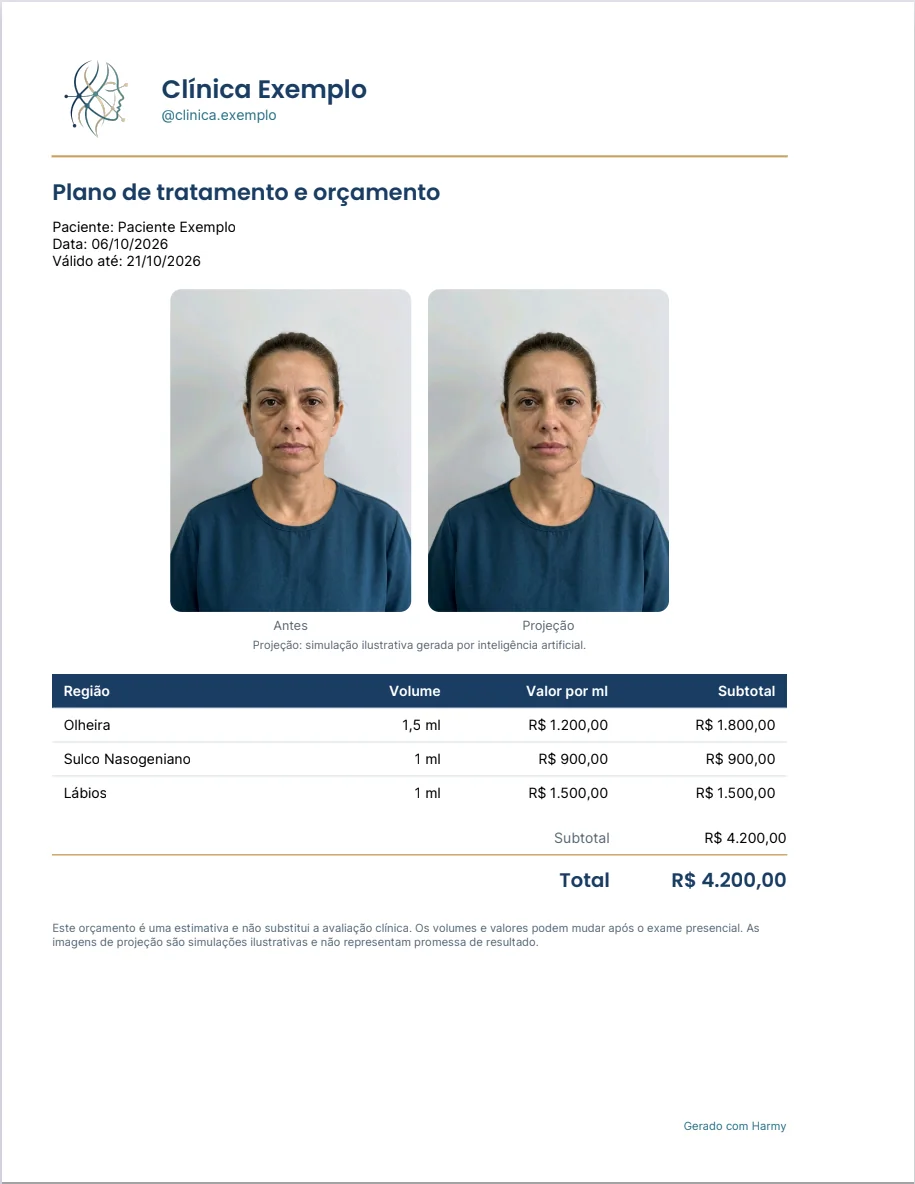
If you include the projection in the PDF, remember it is an illustrative simulation. The text of the approved plan should talk about the procedure, not promise the image. See explaining to the patient that it is a simulation.
What if the plan changes after approval?
Plans change: the patient decides to drop an area, the professional sees during the injection that less volume is enough, a complication requires stopping. What cannot happen is the procedure differing from the plan without a record.
A practical rule: a change that significantly alters the area, volume, product or price calls for a new acceptance. A small adjustment within the agreed range can be recorded in the patient record on the day.
How do you look after the plan's data and images?
The plan usually carries name, photos and health information, which are sensitive data under LGPD (Brazil's General Data Protection Law). Store it with restricted access, avoid sending it through uncontrolled channels and use the images only for the purpose consented to. The page consent and LGPD in photos covers the topic in detail, and LGPD summarizes the term.
Common mistakes in approval
- Asking for a signature before the patient has read the plan.
- Recording only the price, without the areas and limits.
- Promising a result in the text of the plan.
- Forgetting to update the acceptance when the plan changes.
- Mixing plan, quote and consent in one confusing sheet.
- Storing the document without security.
How do you handle a patient who approves only part of the plan?
It is common for a patient to approve one area and postpone the others. Record exactly what was approved and what remains open, with the date, and make clear that the quote for the remaining stages stays valid only for the stated period. This prevents the partial approval from later being read as approval of the whole plan, and also prevents charging for something the patient did not accept. When you resume the pending stages, repeat the conversation and update the acceptance.
Frequently asked questions
Do I need written approval of the harmonization plan?
Recording acceptance is good practice. The exact form (paper, digital signature or an entry in the patient record) should follow the rules of your professional council and your legal advisor's guidance.
Is approving the plan the same as signing the informed consent?
No. The plan is the treatment proposal with areas, volumes, stages and price. Informed consent records that the patient understood the risks, alternatives and limits of the procedure. The two complement each other.
Can the patient change the plan after approving it?
Yes, and so can you. Any relevant change in area, volume or price should be discussed and recorded with a new acceptance, so the approved plan reflects what was done.
Can Harmy's projection be part of the approved plan?
It can be used as a visual aid in the conversation, but it is an illustrative simulation, not a promise of results. The approved plan should describe the procedure and its limits, not promise the image.
Harmy images are illustrative simulations generated by AI from the patient's photo to support the conversation between practitioner and patient. They are not a promise of results. Indication, technique, product and volume are solely the decision of the licensed practitioner. This content is for information only and does not replace a clinical assessment.