
Why a facial harmonization simulation should be subtle

Quick facts
- Principle
- The image shown to the patient becomes their mental goal; if it is exaggerated, any real result will seem insufficient
- Core risk
- Anchoring effect: the first number or image seen organizes all later judgment
- Practical rule
- Simulate a little below what you expect to deliver, never above
- Caution
- A simulation is an illustration, not a promise of results, and that needs to be said out loud
When you show an image to a patient, they do not read it as "one possible illustration". They read it as "what I am going to get". That reading is almost automatic, and it is why calibrating the simulation is a clinical and ethical decision, not just an aesthetic one. A subtle simulation is not a lack of ambition: it is the way to keep the implicit promise of the image within what tissue, volume and healing can deliver.
This page explains the psychological mechanism behind this, shows how subtlety protects your relationship with the patient, and offers a method for leading the conversation when they ask for "a little more". For the opposite side, the cases where the image gets in the way, see when the simulation gets in the way of the plan.
What is the anchoring effect and why does it matter here?
Anchoring is a well-described phenomenon in the psychology of judgment: the first piece of information received, even if arbitrary, pulls later estimates in its direction. In a practice, the first "after" image the patient sees is the anchor. Everything you say afterward, such as "the result is usually more discreet" or "there is swelling in the first few days", is interpreted from it.
That is why the order and intensity of the presentation count. If the first image is exaggerated, verbal caveats arrive late and lose weight. If the first image is already restrained, the caveats only confirm what the patient is seeing, and the conversation stays coherent.
What is the cost of an exaggerated simulation?
The cost appears after the procedure, and usually takes three forms:
- Dissatisfaction with a technically adequate result: the face changed exactly as planned, but the patient was comparing it with a more intense image.
- Requests for extra volume under pressure: to "match the photo", the patient asks for more product, and the plan goes too far. The risk of excess is covered in when total volume becomes excess.
- Erosion of trust: the phrase "you showed me something else" is hard to get around, even with a signed consent form.
There is also an ethical cost. The illustrative simulation exists to support an informed decision. If it pushes the decision through inflated expectations, informed consent loses its basis, because the patient consented to something different from what was possible.
How does subtlety translate into numbers?
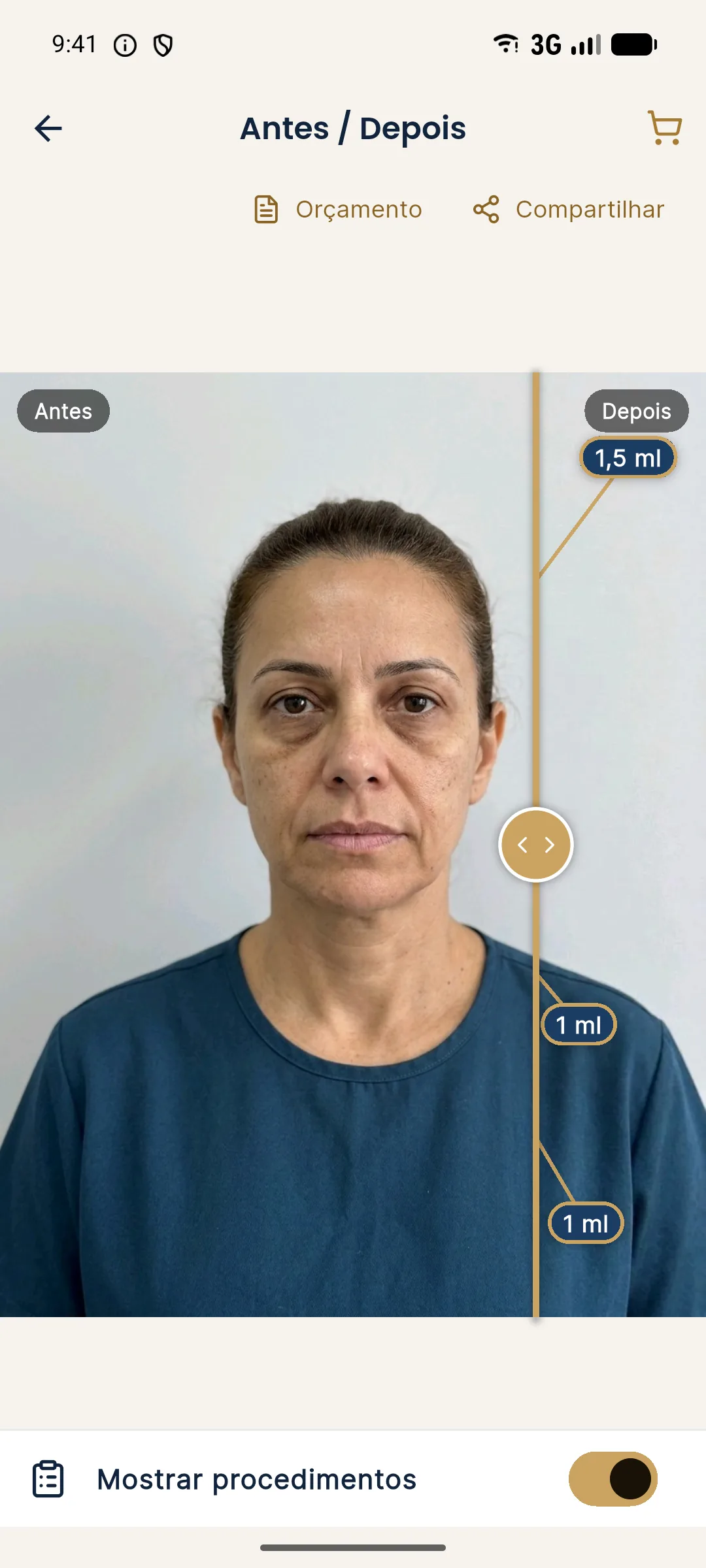
Subtlety has to do with volume and intensity. In Harmy, the intensity per area is Subtle, Moderate or Pronounced, and the default is Moderate. The ml range from 0.5 to 5 ml, in steps of 0.5 ml. The AI respects the volume: the more ml, the more noticeable the change.
| Choice | What it communicates | When it makes sense |
|---|---|---|
| Subtle with low ml | A change that takes attention to notice | First time, patients who fear an artificial look |
| Moderate with moderate ml | A noticeable change without drawing attention | Default for most planning conversations |
| Pronounced with high ml | An evident change | Only when the patient already knows the effect and the plan supports it |
The values above are conversation categories, not dose ranges. The actual volume remains at the discretion of the licensed professional, after clinical assessment. To compare the three intensities side by side, see comparing the Subtle, Moderate and Pronounced intensities.
Why is a simulated face that looks like "someone else" a warning sign?
If the final image looks more like a filter than like the patient, something got out of control: either the simulation changed what it should not have, or the goal is incompatible with the anatomy. In both cases, the real result will not look like the image. Preserving the patient's features is discussed in facial identity: how to preserve it.
Patients may also bring references from app filters, which smooth and symmetrize in ways that cannot be reproduced with injectables. Dealing with that is the subject of filter face: how to handle unrealistic references.
How do you lead the conversation when the patient wants more?
The request "can it be a little stronger?" is common and legitimate. The poor response is to generate another image without a conversation. The good response turns the request into information about what the patient expects.
That record is an ally. How to store the chosen image is covered in recording the simulation in the patient record.
Is there a limit below which the simulation loses its usefulness?
There is. A change so discreet that the patient notices nothing also fails: they may conclude that the procedure "is not worth it" or that the app "did not work". The balance point is the minimum perceptible difference: the smallest change an attentive observer notices without zooming into the photo.
In low-volume areas, such as the lips, a 0.5 ml change can be clear under the magnifier and discreet to the eye. In those cases, the presentation mode with magnifier helps show the treated area without inflating the change.
How do you keep subtlety from becoming an excuse for under-delivering?
Subtle is not a synonym for little. The yardstick is consistency among three things: what you showed, what you planned and what you can perform. If you show the subtle and perform the pronounced, the patient is surprised in the wrong direction, and that is also a breach of the agreement.
What signs show the calibration was done well?
At the follow-up, the patient describes the result in words close to those used at the consultation. They say "it looks natural" or "you can tell up close", not "I expected more". When the account sounds like this, the image worked as an illustration and not as a promise. When it is the opposite, it is worth reviewing what was shown and said. The difference between the image and reality is covered in why the actual result differs from the simulation.
How does subtlety fit into the rest of the planning?
It is one of the axes of the natural-effect plan, which combines restrained volumes, adequate intervals between sessions and reassessment. The full design is in natural-effect plan and, for the patient's first time, in conservative volume in the first session. The explanation that the image is not a guarantee is in explaining that a simulation is not a guarantee.
If you work with areas that quickly change how the face is perceived, such as lip filler and cheekbone filler, subtlety weighs even more, because proportion errors there are noticed right away by the people who spend time with the patient.
Frequently asked questions
Why shouldn't the simulation show a large change?
Because the patient tends to treat the image as a goal. An inflated simulation creates an expectation that the real result, limited by tissue, volume and swelling, can hardly meet.
Doesn't a subtle simulation discourage the patient?
It may discourage someone who expects a dramatic change, and that is useful information: the expectation conversation happens before the procedure, not after.
What is the anchoring effect in a facial harmonization consultation?
It is the tendency to use the first reference received, such as an image or a figure, to judge everything that follows. In a simulation, the image presented first becomes the patient's yardstick.
How does Harmy keep the simulation subtle?
The projection changes only the marked areas, according to the ml and intensity chosen, and does not touch makeup, skin, expression, background, hair or lighting.
Harmy images are illustrative simulations generated by AI from the patient's photo to support the conversation between practitioner and patient. They are not a promise of results. Indication, technique, product and volume are solely the decision of the licensed practitioner. This content is for information only and does not replace a clinical assessment.